%2Fpic4564111.jpg)
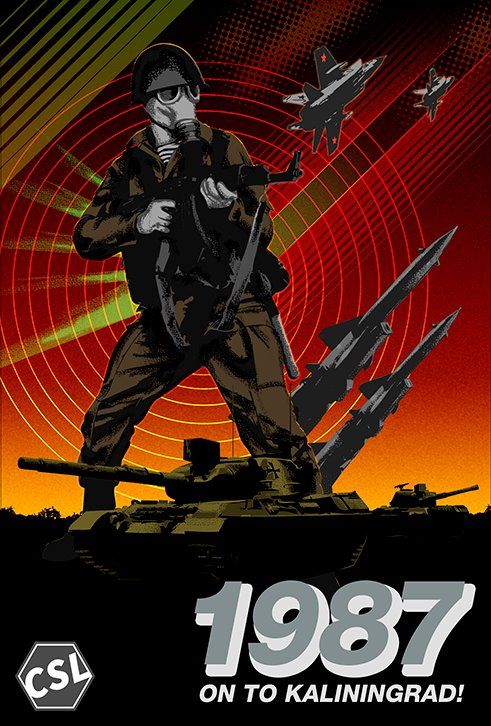
1987: On To Kaliningrad!
How do you play 1987: On To Kaliningrad!?
A few months [before June 2021,] we announced that we would be discontinuing both 1968 & 1987. These games were designed when I first started the company and frankly, I was in a rush to put out a catalog.
To find the best price for 1987: On To Kaliningrad!, howtoplay.ro compares deals from Romanian shops every day.
%2Fpic4564111.jpg)
A few months [before June 2021,] we announced that we would be discontinuing both 1968 & 1987.
These games were designed when I first started the company and frankly, I was in a rush to put out a catalog. Unfortunately I don't think either of these games are up to the quality I want to maintain with CSL so both will no longer be available on our catalog.
If you purchased 1968 and/or 1987, I will provide you with a 20$ discount toward your next purchase.
Finally, I apologize that these games ended up being broken.
—description from the designer
1987 is the second Procedural Combat Series game covering a hypothetical low-intensity WW3 based on the original objectives of the 1914 invasion of East Prussia, on the 70th anniversary of the Soviet Union. The order of battle for both sides is drawn from records from the 80s and the tactical situation is nuanced given the absence of major NATO ground forces such as the US, France, England etc. 1987 uses the same rules as 1950 with several changes in both scale and mechanics to reflect the tactical situation.
1987 includes rules for tactical nuclear strikes, refugees, political objectives airmobile units and more. Admittedly, there is little historical basis for this tactical situation given Kaliningrad came under Soviet control after WW2 and the major players in NATO were ready at moments to notice to cooperate as they were during the Balkan wars of the 90s. This situation is only possible if we assume that the major member nations of NATO have isolated themselves and are reluctant to commit.
Note that this is a completely fictional account that is meant to bear no relation to history other than the forces included in the Order of Battle. It assumes that Hitler was successfully assassinated in 1943 allowing Admiral Canaris of the Abwehr to stage a defensive campaign and negotiate a truce with the western allies. As related in Bodyguard of Lies, Canaris had been working towards a rapprochement with the western allies throughout the war. The assassination of Hitler provided the Wehrmacht to activate Beck’s plans to take over the government under Canaris’ guidance and attempt to enlist the West in a crusade against Bolshevism. While this attempt failed it did result in the immediate removal of any Germans who were in the Nazi Party. Canaris, Beck et al were violent anti-Nazis. Not that they were nice guys but they weren’t racist, paranoid criminals. While England and the United States were happy to end the war on a status quo ante basis and turn their attention to crushing the Japanese, they were less willing to attempt to force such a result on the Germans on the Eastern Front. Stalin, facing the likelihood of the full weight of the German war machine (with the SS units rationalized, raising the quality of the entire army), sought and obtained an armistice on the lines established by the Nazi-Soviet pact. Under pressure from the United States and the Commonwealth, Canaris permitted an independent Poland which slid into the Soviet orbit due to lingering distrust over the German invasion of 1939 (Katyn’s grisly harvest would not be discovered in this timeline.) and the return of the eastern provinces absorbed by the Soviets as a result of the Pact. An early end to the war resulted in a slowing of war technology and the development of nuclear weapons in smaller packages, suitable for tactical (artillery fired) weaponry first. Rocketry remains rudimentary, jets do dominate the skies but the equipment remained 15-20 years behind what developed in our 1987. As a result while there is a possibility of true strategic level nuclear war, the delivery of such weapons is by large jet bombers and not by ICBMs. The years leading up to 1987 had been bleak for the west. NATO had been developed as a potential counterbalance to an eastern European defensive alliance with the Soviets resulting from the fear of economic vassalage to the western powers. With the Soviets relatively impoverished due to World War II and the despair of having fought so hard with only an armistice to end things. The lack of a significant threat from the Soviet/Eastern European bloc caused the NATO powers to reconsider their commitment to the alliance, with many seeking to make their joint security pledges contingent on their own interests. This came to a head in early 1987 as Article 5 pledges were made voluntary and many parties to the alliance indicated that their choice to respond would be made on a case by case basis. The active components of NATO who would clearly respond to the call of the victim or aggression were reduced to Germany, the Netherlands, Belgium, aspects of US airpower and Canada. Meanwhile in the Soviet Union significant unrest grew as frustration over a permanent state of war with Germany caused continued economic sanctions (remember, no peace was signed, merely an armistice). Army morale sagged, citizens demonstrated and it seemed that the Soviet Union would come undone from internal centripetal forces. Something had to be done and the Politburo grabbed at the straw that always seemed to bring Russia together – a war. After all, they were already at war and the unwillingness of the Germans to end it was strangling the Soviet Union. The Poles would help as they wanted revenge. The goal was simple. Cause NATO a loss. Show that the Eastern bloc retained its vitality while NATO was losing its. No one wanted a full-fledged war, just enough of a spat to move from armistice to peace…
WEIGHT: 7/10 SOLITAIRE: 9/10 PLAYERS: 1-2
—description from the publisher
Frequently asked questions
Q1How much does 1987: On To Kaliningrad! cost?
Q2Where can I buy 1987: On To Kaliningrad! cheapest?
Q3How do you play 1987: On To Kaliningrad!?
Q4How many players does 1987: On To Kaliningrad! support?
Q5How long does a game of 1987: On To Kaliningrad! take?
Q6What age is 1987: On To Kaliningrad! for?
Q7How complex is 1987: On To Kaliningrad!?
All prices
Price history
Price trend over the last 90 days: minimum 49 lei, maximum 63 lei, now 63 lei.