In Carcassonne, players collectively build a medieval landscape by drawing and placing land tiles. The primary goal is to strategically place your meeples (which act as knights, highwaymen, monks, or farmers) on various features of the landscape, such as cities, roads, monasteries, and farms. By completing these features, you score points. The game continues until all land tiles have been played, and the player with the highest total score at the end of the game is declared the winner.
To find the best price for Carcassonne, howtoplay.ro compares deals from Romanian shops every day.
FromRON 119· 6 shops
🔥Good time to buy-14% vs 90-day avg
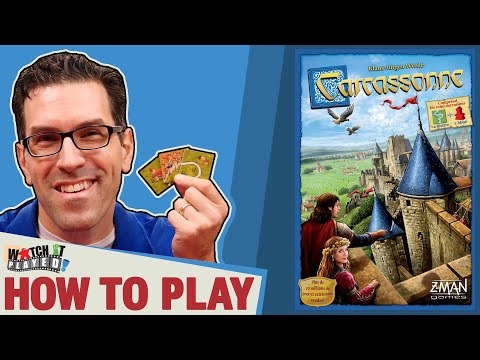
▶ Watch It Played · Carcassonne - How To Play
Carcassonne - How To Play
Watch It Played· 13 min· published Feb 1, 2018Community
the rules in 60 seconds▶ auto · 1/6
🧩
01
Setup
Separate river tiles (if any) and set them aside, then shuffle the remaining land tiles face-down into several stacks, placing the dark-backed start tile face-up in the center of the play area. Each player chooses a color, takes their meeples, and places one meeple on the zero space of the scoreboard.
To set up Carcassonne, first, identify any river tiles (if your copy includes them) and return them to the box as they are an optional expansion. Shuffle all remaining land tiles face-down and divide them into several stacks. Locate the start tile, which has a darker back, and place it face-up in the center of the play area. Each player selects a color, takes all their meeples (small wooden figures), and places one meeple of their chosen color onto the '0' space of the scoreboard. Any abbot pieces (another optional expansion) should also be returned to the box for now. Finally, choose a first player to begin the game.
Objective
In Carcassonne, players collectively build a medieval landscape by drawing and placing land tiles. The primary goal is to strategically place your meeples (which act as knights, highwaymen, monks, or farmers) on various features of the landscape, such as cities, roads, monasteries, and farms. By completing these features, you score points. The game continues until all land tiles have been played, and the player with the highest total score at the end of the game is declared the winner.
On your turn
A turn consists of three mandatory steps: 1. Draw a land tile: Take the top tile from any of the face-down stacks. 2. Place the land tile: You must place the drawn tile adjacent to an already-placed tile in the landscape. All features on the newly placed tile must match the features on the adjacent sides of the tiles it touches (e.g., a road must connect to a road, a field to a field, a city to a city). You may rotate the tile before placing it to find a valid connection. You cannot place a tile so that only its corners are touching another tile. 3. Optionally place a meeple: After placing the tile, you may choose to place one of your meeples from your personal supply onto one of the features (city, road, monastery, or field) on the tile you just placed. You cannot place a meeple on a feature if that feature is already occupied by another meeple (even your own) on an adjacent, connected tile. If you place a meeple on a road, it becomes a highwayman; on a city, a knight; on a monastery, a monk; and on a field, a farmer (laid down).
Scoring
Features are scored when they are completed. A city is complete when its walls form an unbroken perimeter. A road is complete when both ends are closed off (by a city, monastery, village, or by looping back into itself). A monastery is complete when it is entirely surrounded by eight other tiles (including diagonally). When a feature is completed, the player with the most meeples on that feature scores points. If there's a tie for the most meeples, all tied players score full points. Points are awarded as follows: Cities give 2 points per tile that makes up the city, plus 2 additional points for each coat of arms symbol within the city. Roads give 1 point per tile that makes up the road. Monasteries give 1 point for the monastery tile itself and 1 point for each of the 8 surrounding tiles. After scoring, meeples on completed features are returned to their owner's supply. Farmers are not scored until the very end of the game.
Game end
The game concludes immediately after the last land tile has been drawn and placed, and the current player has completed their turn (including any scoring). At this point, final scoring takes place for all incomplete features still on the board. Incomplete cities and roads are scored at 1 point per tile (and 1 point per coat of arms for cities). Incomplete monasteries are scored at 1 point for the monastery tile and 1 point for each adjacent or diagonally adjacent tile. Finally, farmers are scored: each farmer scores 3 points for every completed city that their farmland touches. The player with the most meeples in a farmland area claims all points for that farmland. If there's a tie for the most meeples in a farmland, all tied players score full points. After all final scoring is tallied, the player with the highest total score wins. In case of a tie for the highest total score, the tied players share the victory.
Tips
Strategic meeple placement is crucial. While you cannot place a meeple on a feature already claimed, you can strategically place a tile that connects your meeple's feature to an opponent's, potentially allowing you to share or even dominate the scoring for that feature if you end up with more meeples. Remember that farmers are a long-term investment, as they are not returned to your supply until the end of the game, but they can yield significant points. Understanding how fields are divided by roads and cities is key to maximizing farmer scores. Some versions of Carcassonne include 'The River' and 'The Abbot' mini-expansions, which introduce new tiles and rules, offering more strategic depth once you've mastered the base game.
🔬 game anatomy
Complexity1.9 / 5
BGG rating7.4 / 10
Vibe
CouplesFamily
Language dependence
No in-game text needed
🌐 plays without English
Play time
30–45 min
Players
2–5
Recommended age
7+ yrs
BGG rank
#240
✨ from Trișache · verified
Frequently asked questions
Q1What is the goal of the game?
In Carcassonne, players collectively build a medieval landscape by drawing and placing land tiles. The primary goal is to strategically place your meeples (which act as knights, highwaymen, monks, or farmers) on various features of the landscape, such as cities, roads, monasteries, and farms. By completing these features, you score points. The game continues until all land tiles have been played, and the player with the highest total score at the end of the game is declared the winner.
Q2How do you set up the game?
To set up Carcassonne, first, identify any river tiles (if your copy includes them) and return them to the box as they are an optional expansion. Shuffle all remaining land tiles face-down and divide them into several stacks. Locate the start tile, which has a darker back, and place it face-up in the center of the play area. Each player selects a color, takes all their meeples (small wooden figures), and places one meeple of their chosen color onto the '0' space of the scoreboard. Any abbot pieces (another optional expansion) should also be returned to the box for now. Finally, choose a first player to begin the game.
Q3How does a turn work?
A turn consists of three mandatory steps: 1. Draw a land tile: Take the top tile from any of the face-down stacks. 2. Place the land tile: You must place the drawn tile adjacent to an already-placed tile in the landscape. All features on the newly placed tile must match the features on the adjacent sides of the tiles it touches (e.g., a road must connect to a road, a field to a field, a city to a city). You may rotate the tile before placing it to find a valid connection. You cannot place a tile so that only its corners are touching another tile. 3. Optionally place a meeple: After placing the tile, you may choose to place one of your meeples from your personal supply onto one of the features (city, road, monastery, or field) on the tile you just placed. You cannot place a meeple on a feature if that feature is already occupied by another meeple (even your own) on an adjacent, connected tile. If you place a meeple on a road, it becomes a highwayman; on a city, a knight; on a monastery, a monk; and on a field, a farmer (laid down).
Q4How is scoring calculated?
Features are scored when they are completed. A city is complete when its walls form an unbroken perimeter. A road is complete when both ends are closed off (by a city, monastery, village, or by looping back into itself). A monastery is complete when it is entirely surrounded by eight other tiles (including diagonally). When a feature is completed, the player with the most meeples on that feature scores points. If there's a tie for the most meeples, all tied players score full points. Points are awarded as follows: Cities give 2 points per tile that makes up the city, plus 2 additional points for each coat of arms symbol within the city. Roads give 1 point per tile that makes up the road. Monasteries give 1 point for the monastery tile itself and 1 point for each of the 8 surrounding tiles. After scoring, meeples on completed features are returned to their owner's supply. Farmers are not scored until the very end of the game.
Q5When and how does the game end?
The game concludes immediately after the last land tile has been drawn and placed, and the current player has completed their turn (including any scoring). At this point, final scoring takes place for all incomplete features still on the board. Incomplete cities and roads are scored at 1 point per tile (and 1 point per coat of arms for cities). Incomplete monasteries are scored at 1 point for the monastery tile and 1 point for each adjacent or diagonally adjacent tile. Finally, farmers are scored: each farmer scores 3 points for every completed city that their farmland touches. The player with the most meeples in a farmland area claims all points for that farmland. If there's a tie for the most meeples in a farmland, all tied players score full points. After all final scoring is tallied, the player with the highest total score wins. In case of a tie for the highest total score, the tied players share the victory.
Q6What tips are there for beginners?
Strategic meeple placement is crucial. While you cannot place a meeple on a feature already claimed, you can strategically place a tile that connects your meeple's feature to an opponent's, potentially allowing you to share or even dominate the scoring for that feature if you end up with more meeples. Remember that farmers are a long-term investment, as they are not returned to your supply until the end of the game, but they can yield significant points. Understanding how fields are divided by roads and cities is key to maximizing farmer scores. Some versions of Carcassonne include 'The River' and 'The Abbot' mini-expansions, which introduce new tiles and rules, offering more strategic depth once you've mastered the base game.
Q7How much does Carcassonne cost?
Carcassonne costs between 119 and 289 RON across Romanian stores.
Q8Where can I buy Carcassonne cheapest?
The lowest price for Carcassonne right now is 119 RON at Regatul Jocurilor. The Prices tab lists every store currently tracking it.
Q9How do you play Carcassonne?
Carcassonne is a medieval game, for 2–5 players, taking ~30–45 minutes, featuring area majority / influence. Check the Rules tab for setup, gameplay, and scoring, or ask Trișache anything about Carcassonne — our AI assistant built by howtoplay.ro and trained specifically on board game rulebooks.

%2Fpic8621446.jpg)