The primary objective of Above and Below is to strategically build and expand your village over seven rounds. Players aim to accumulate the most village points by the end of the game, which are earned through various actions such as exploring caves, constructing buildings, harvesting resources, and recruiting new villagers. Success hinges on efficient resource management, clever villager assignment, and making advantageous choices during encounters.
To find the best price for Above and Below, howtoplay.ro compares deals from Romanian shops every day.
FromRON 244· 3 shops
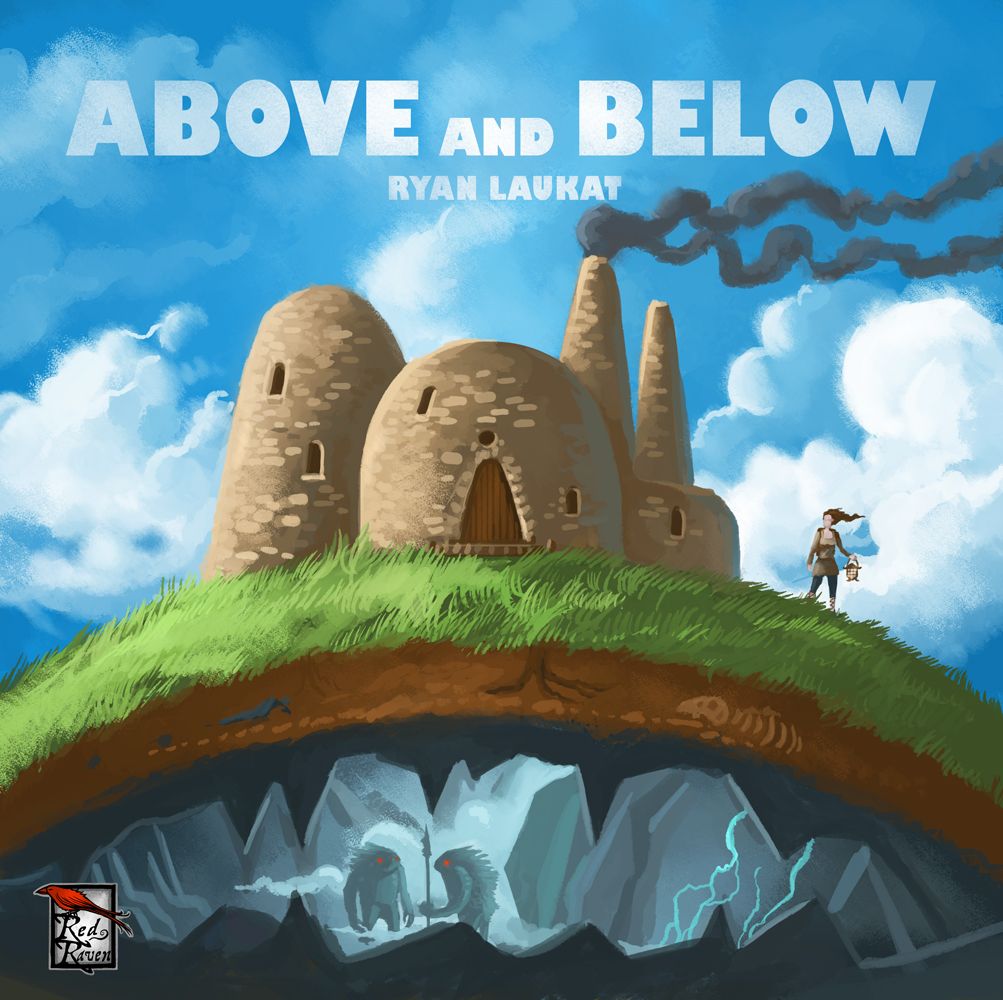
official art · Red Raven Games
the rules in 60 seconds▶ auto · 1/6
🧩
01
Setup
Each player receives a board, a starting house, starting villagers, and seven coins; the play area includes a reputation board, turn marker, player markers, cider token, villagers, draw piles for villagers, houses, outposts, and cave cards, along with coins, resources, dice, and an encounter book.
The rules, step by step
Setup
To set up, each player receives a personal board, a starting house, their initial villagers, and seven coins. The central play area is arranged with the reputation board, a turn marker, player markers, a cider token, and a draw pile of villagers (without house or cave backs). Additionally, six houses with stars, four out of nine key houses, house and outpost cards with their respective draw piles, and cave cards are laid out. Coins, resources, dice, and the encounter book are placed nearby for easy access. A first player is assigned using a card, and any other players receive one extra coin. Specific rules for four-player setup can be found on pages 4-5 of the rulebook.
Objective
The primary objective of Above and Below is to strategically build and expand your village over seven rounds. Players aim to accumulate the most village points by the end of the game, which are earned through various actions such as exploring caves, constructing buildings, harvesting resources, and recruiting new villagers. Success hinges on efficient resource management, clever villager assignment, and making advantageous choices during encounters.
On your turn
The game is played in seven rounds, starting with the first player and proceeding clockwise. During their turn, players assign villagers to tasks by moving them from the 'ready' area to the 'exhausted' area. Tasks include: exploring (taking a cave card, assigning two or more villagers, rolling dice to compare to the card's number, and reading the encounter story), building (assigning a villager with a build icon to construct a house or outpost on an earned cave card, paying the cost, and gaining/replenishing the card), harvesting (assigning one or more villagers to take goods off cards and place them in their supply, advancement track, or for sale), recruiting (assigning a villager with a recruit icon to train a new villager, paying the cost, and placing the new villager in the exhausted area), and working (assigning one or more villagers to gain one coin per villager, and potentially the cider token). Players can also perform free actions like placing a good for sale or buying a good from another board (offers must be in coins and total three or more). Goods can be placed on the advancement track from left to right without empty spaces, matching existing goods if possible, and cannot be removed or altered once placed.
Scoring
At the end of the game, points are tallied from several sources. For the advancement track, each good in the indicated space is assigned the shown points (e.g., three resources in a 3-point space yield 9 points). All buildings, including the starting houses, are worth one point each, while empty cave cards provide no points. Reputation is also scored: in a two-player game, the person with the most reputation receives three points (additional rules for ties or more players are on page 13). Players gain or lose points based on the score beside their cube on the reputation track. Finally, card bonuses contribute points according to the legend on page 15. The player with the highest total score wins.
Game end
A round concludes after all players have passed. If the turn marker has reached the end of the track, the game is over. Otherwise, the turn marker is advanced one space, a new cider token is placed if one isn't already present, any villagers on the reputation board are slid to the left, and new villagers are drawn. Potions can be spent on injured villagers, and cider on exhausted villagers. Then, one bed is assigned per villager, moving them one space to the left (a villager cannot use two beds to move from injured to ready, and cannot sleep if there are not enough beds). Finally, players collect coins based on their advancement track and any available card bonuses, refresh goods on buildings, and the first player card is passed to the left to begin the next round.
Tips
For a deeper understanding of the game, consult the rulebook. Page 4-5 outlines additional rules for playing with four players, while page 12 details special rules for unique villagers during exploration. The back of the rulebook serves as a quick reference guide, providing a legend of actions and end-of-round reminders, including specific instructions on how to refresh villagers using beds and potions. The most effective way to grasp the game's nuances and strategies is through active play.
🔬 game anatomy
Complexity2.5 / 5
BGG rating7.3 / 10
Vibe
Strategy
Language dependence
Extensive text — heavy translation needed
Play time
90 min
Players
2–4
Recommended age
13+ yrs
BGG rank
#430
✨ from Trișache · verified
Frequently asked questions
Q1What is the goal of the game?
The primary objective of Above and Below is to strategically build and expand your village over seven rounds. Players aim to accumulate the most village points by the end of the game, which are earned through various actions such as exploring caves, constructing buildings, harvesting resources, and recruiting new villagers. Success hinges on efficient resource management, clever villager assignment, and making advantageous choices during encounters.
Q2How do you set up the game?
To set up, each player receives a personal board, a starting house, their initial villagers, and seven coins. The central play area is arranged with the reputation board, a turn marker, player markers, a cider token, and a draw pile of villagers (without house or cave backs). Additionally, six houses with stars, four out of nine key houses, house and outpost cards with their respective draw piles, and cave cards are laid out. Coins, resources, dice, and the encounter book are placed nearby for easy access. A first player is assigned using a card, and any other players receive one extra coin. Specific rules for four-player setup can be found on pages 4-5 of the rulebook.
Q3How does a turn work?
The game is played in seven rounds, starting with the first player and proceeding clockwise. During their turn, players assign villagers to tasks by moving them from the 'ready' area to the 'exhausted' area. Tasks include: exploring (taking a cave card, assigning two or more villagers, rolling dice to compare to the card's number, and reading the encounter story), building (assigning a villager with a build icon to construct a house or outpost on an earned cave card, paying the cost, and gaining/replenishing the card), harvesting (assigning one or more villagers to take goods off cards and place them in their supply, advancement track, or for sale), recruiting (assigning a villager with a recruit icon to train a new villager, paying the cost, and placing the new villager in the exhausted area), and working (assigning one or more villagers to gain one coin per villager, and potentially the cider token). Players can also perform free actions like placing a good for sale or buying a good from another board (offers must be in coins and total three or more). Goods can be placed on the advancement track from left to right without empty spaces, matching existing goods if possible, and cannot be removed or altered once placed.
Q4How is scoring calculated?
At the end of the game, points are tallied from several sources. For the advancement track, each good in the indicated space is assigned the shown points (e.g., three resources in a 3-point space yield 9 points). All buildings, including the starting houses, are worth one point each, while empty cave cards provide no points. Reputation is also scored: in a two-player game, the person with the most reputation receives three points (additional rules for ties or more players are on page 13). Players gain or lose points based on the score beside their cube on the reputation track. Finally, card bonuses contribute points according to the legend on page 15. The player with the highest total score wins.
Q5When and how does the game end?
A round concludes after all players have passed. If the turn marker has reached the end of the track, the game is over. Otherwise, the turn marker is advanced one space, a new cider token is placed if one isn't already present, any villagers on the reputation board are slid to the left, and new villagers are drawn. Potions can be spent on injured villagers, and cider on exhausted villagers. Then, one bed is assigned per villager, moving them one space to the left (a villager cannot use two beds to move from injured to ready, and cannot sleep if there are not enough beds). Finally, players collect coins based on their advancement track and any available card bonuses, refresh goods on buildings, and the first player card is passed to the left to begin the next round.
Q6What tips are there for beginners?
For a deeper understanding of the game, consult the rulebook. Page 4-5 outlines additional rules for playing with four players, while page 12 details special rules for unique villagers during exploration. The back of the rulebook serves as a quick reference guide, providing a legend of actions and end-of-round reminders, including specific instructions on how to refresh villagers using beds and potions. The most effective way to grasp the game's nuances and strategies is through active play.
Q7How much does Above and Below cost?
Above and Below costs between 244 and 269 RON across Romanian stores.
Q8Where can I buy Above and Below cheapest?
The lowest price for Above and Below right now is 244 RON at Dragon Games. The Prices tab lists every store currently tracking it.
Q9How do you play Above and Below?
Above and Below is a adventure game, for 2–4 players, taking ~90 minutes, featuring action points. Check the Rules tab for setup, gameplay, and scoring, or ask Trișache anything about Above and Below — our AI assistant built by howtoplay.ro and trained specifically on board game rulebooks.

%2Fpic2398773.jpg)
%2Fpic2398773.jpg)