The primary objective in Akrotiri is to accumulate the most victory points by excavating temples and fulfilling objective cards. Players achieve this by strategically exploring the islands, gathering resources, and using these resources to fund excavations. Each excavated temple provides victory points based on the level of the map card used, and objective cards offer additional points for specific island configurations or resource collections. Players must carefully manage their actions and resources to efficiently meet these goals, while also considering their opponent's progress and potential moves.
To find the best price for Akrotiri, howtoplay.ro compares deals from Romanian shops every day.
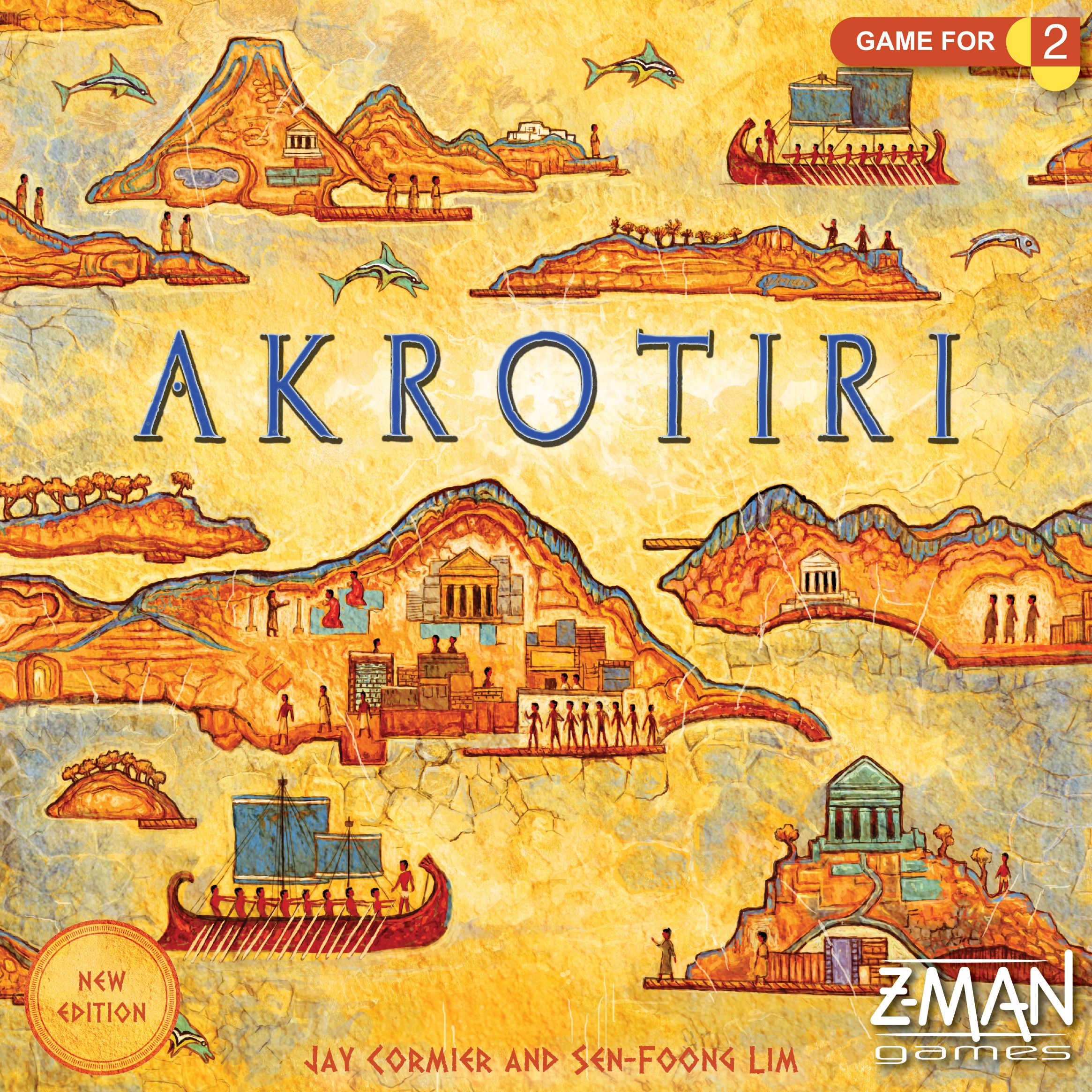
official art · asmodee
the rules in 60 seconds▶ auto · 1/6
🧩
01
Setup
Place the island of Thera in the center, the market board with resource tokens, give each player a boat, six temples, two drachmas, and a player board, then shuffle and deal map cards and objective cards.
The rules, step by step
Setup
To set up Akrotiri, first place the island of Thera in the center of the playing area, ensuring there's enough space around it for expansion. Next, place the market board nearby and arrange the resource tokens of each color on their corresponding spaces. Each player receives a basic set of components: one boat, six temples, two drachmas, and a player board. The temples are placed on the player board, covering all but the leftmost action space. Shuffle the terrain tiles to form a draw pile, and each player draws one tile to place on the board, connecting it orthogonally to an existing tile and aligning the coastlines. After placing a tile, players add resources to its islands according to the tile's icons. Shuffle the bronze, silver, and gold map cards into three separate piles, then deal one bronze and one silver map card to each player. Players also receive two objective cards, choose one to keep, and return the other to the bottom of the objective deck. Finally, players place their boats on a dock of the central island and draw one terrain tile from the pile.
Objective
The primary objective in Akrotiri is to accumulate the most victory points by excavating temples and fulfilling objective cards. Players achieve this by strategically exploring the islands, gathering resources, and using these resources to fund excavations. Each excavated temple provides victory points based on the level of the map card used, and objective cards offer additional points for specific island configurations or resource collections. Players must carefully manage their actions and resources to efficiently meet these goals, while also considering their opponent's progress and potential moves.
On your turn
A turn in Akrotiri consists of two main phases: the placement phase and the action phase. In the placement phase, the current player places the terrain tile they drew at the end of the previous turn, connecting it orthogonally to an existing tile and adding resources to its islands as indicated. Then, in the action phase, players can perform a number of actions determined by the number of uncovered temple spaces on their player board. Available actions include moving their boat between docks (costing one action for two movements if empty, or one movement if loaded), loading up to three resources from the current island onto their boat, excavating a temple by playing a map card that matches the island's features and paying drachmas, buying new map cards from the three levels (bronze, silver, gold), or consulting the oracle to search for a specific resource icon on a terrain tile. Additionally, players can perform two free actions: selling resources from their boat to the market to earn drachmas, or unloading resources onto an island (excluding Thera). After performing actions, players draw a new terrain tile, unless they consulted the oracle, in which case they keep the tile found by the oracle.
Scoring
At the end of the game, players calculate their final score by summing up several components. They earn victory points from each map card used to excavate a temple, with higher-level map cards (gold) typically providing more points than lower-level ones (bronze or silver). Additionally, players score points for fulfilling their secret objective cards, which often require specific island layouts or resource combinations. Finally, players receive one additional victory point for every ten drachmas they possess at the end of the game. In case of a tie, the player with the most drachmas wins.
Game end
The game concludes when a player places their sixth and final temple on the board. Once this happens, the current round is completed, ensuring that all players have had an equal number of turns. After the round finishes, players proceed to the final scoring phase to determine the winner. The player with the highest total victory points from excavated temples, fulfilled objective cards, and remaining drachmas is declared the winner.
Tips
Akrotiri encourages strategic thinking and adaptability. A key tip is to balance resource acquisition with temple excavation, as resources are crucial for paying for map cards and temples. Pay close attention to the market prices of resources; selling when prices are high can provide a significant advantage. Also, observe your opponent's moves and try to anticipate their needs, potentially placing tiles or collecting resources that benefit you while hindering them. Don't neglect your objective cards, as they can provide substantial end-game points. Finally, while the oracle can be useful for finding specific tiles, consider its cost and the potential for analysis paralysis, as it can slow down the game.
🔬 game anatomy
Complexity2.6 / 5
BGG rating7.2 / 10
Vibe
CouplesStrategy
Language dependence
No in-game text needed
🌐 plays without English
Play time
45 min
Players
2
Recommended age
13+ yrs
BGG rank
#1.119
✨ from Trișache · verified
Frequently asked questions
Q1What is the goal of the game?
The primary objective in Akrotiri is to accumulate the most victory points by excavating temples and fulfilling objective cards. Players achieve this by strategically exploring the islands, gathering resources, and using these resources to fund excavations. Each excavated temple provides victory points based on the level of the map card used, and objective cards offer additional points for specific island configurations or resource collections. Players must carefully manage their actions and resources to efficiently meet these goals, while also considering their opponent's progress and potential moves.
Q2How do you set up the game?
To set up Akrotiri, first place the island of Thera in the center of the playing area, ensuring there's enough space around it for expansion. Next, place the market board nearby and arrange the resource tokens of each color on their corresponding spaces. Each player receives a basic set of components: one boat, six temples, two drachmas, and a player board. The temples are placed on the player board, covering all but the leftmost action space. Shuffle the terrain tiles to form a draw pile, and each player draws one tile to place on the board, connecting it orthogonally to an existing tile and aligning the coastlines. After placing a tile, players add resources to its islands according to the tile's icons. Shuffle the bronze, silver, and gold map cards into three separate piles, then deal one bronze and one silver map card to each player. Players also receive two objective cards, choose one to keep, and return the other to the bottom of the objective deck. Finally, players place their boats on a dock of the central island and draw one terrain tile from the pile.
Q3How does a turn work?
A turn in Akrotiri consists of two main phases: the placement phase and the action phase. In the placement phase, the current player places the terrain tile they drew at the end of the previous turn, connecting it orthogonally to an existing tile and adding resources to its islands as indicated. Then, in the action phase, players can perform a number of actions determined by the number of uncovered temple spaces on their player board. Available actions include moving their boat between docks (costing one action for two movements if empty, or one movement if loaded), loading up to three resources from the current island onto their boat, excavating a temple by playing a map card that matches the island's features and paying drachmas, buying new map cards from the three levels (bronze, silver, gold), or consulting the oracle to search for a specific resource icon on a terrain tile. Additionally, players can perform two free actions: selling resources from their boat to the market to earn drachmas, or unloading resources onto an island (excluding Thera). After performing actions, players draw a new terrain tile, unless they consulted the oracle, in which case they keep the tile found by the oracle.
Q4How is scoring calculated?
At the end of the game, players calculate their final score by summing up several components. They earn victory points from each map card used to excavate a temple, with higher-level map cards (gold) typically providing more points than lower-level ones (bronze or silver). Additionally, players score points for fulfilling their secret objective cards, which often require specific island layouts or resource combinations. Finally, players receive one additional victory point for every ten drachmas they possess at the end of the game. In case of a tie, the player with the most drachmas wins.
Q5When and how does the game end?
The game concludes when a player places their sixth and final temple on the board. Once this happens, the current round is completed, ensuring that all players have had an equal number of turns. After the round finishes, players proceed to the final scoring phase to determine the winner. The player with the highest total victory points from excavated temples, fulfilled objective cards, and remaining drachmas is declared the winner.
Q6What tips are there for beginners?
Akrotiri encourages strategic thinking and adaptability. A key tip is to balance resource acquisition with temple excavation, as resources are crucial for paying for map cards and temples. Pay close attention to the market prices of resources; selling when prices are high can provide a significant advantage. Also, observe your opponent's moves and try to anticipate their needs, potentially placing tiles or collecting resources that benefit you while hindering them. Don't neglect your objective cards, as they can provide substantial end-game points. Finally, while the oracle can be useful for finding specific tiles, consider its cost and the potential for analysis paralysis, as it can slow down the game.
Q7How much does Akrotiri cost?
No store is currently tracking Akrotiri. Check the Prices tab — you can set a price alert to be notified when it appears.
Q8Where can I buy Akrotiri cheapest?
Check the Prices tab — howtoplay.ro aggregates offers from 7+ Romanian board-game stores and tracks price history.
Q9How do you play Akrotiri?
Akrotiri is a ancient game, for 2 players, taking ~45 minutes, featuring action points. Check the Rules tab for setup, gameplay, and scoring, or ask Trișache anything about Akrotiri — our AI assistant built by howtoplay.ro and trained specifically on board game rulebooks.

%2Fpic3539688.jpg)
%2Fpic3539688.jpg)