The primary objective in Amun-Re is to accumulate the most prestige points over the course of six rounds, which are divided into two distinct periods. Players achieve this by strategically acquiring control of provinces, constructing pyramids within these provinces, and making offerings to the god Amun-Re. Prestige points are awarded at the end of each period (after rounds 3 and 6), and the player with the highest total prestige points at the end of the second period (after round 6) is declared the winner.
To find the best price for Amun-Re, howtoplay.ro compares deals from Romanian shops every day.
FromRON 230
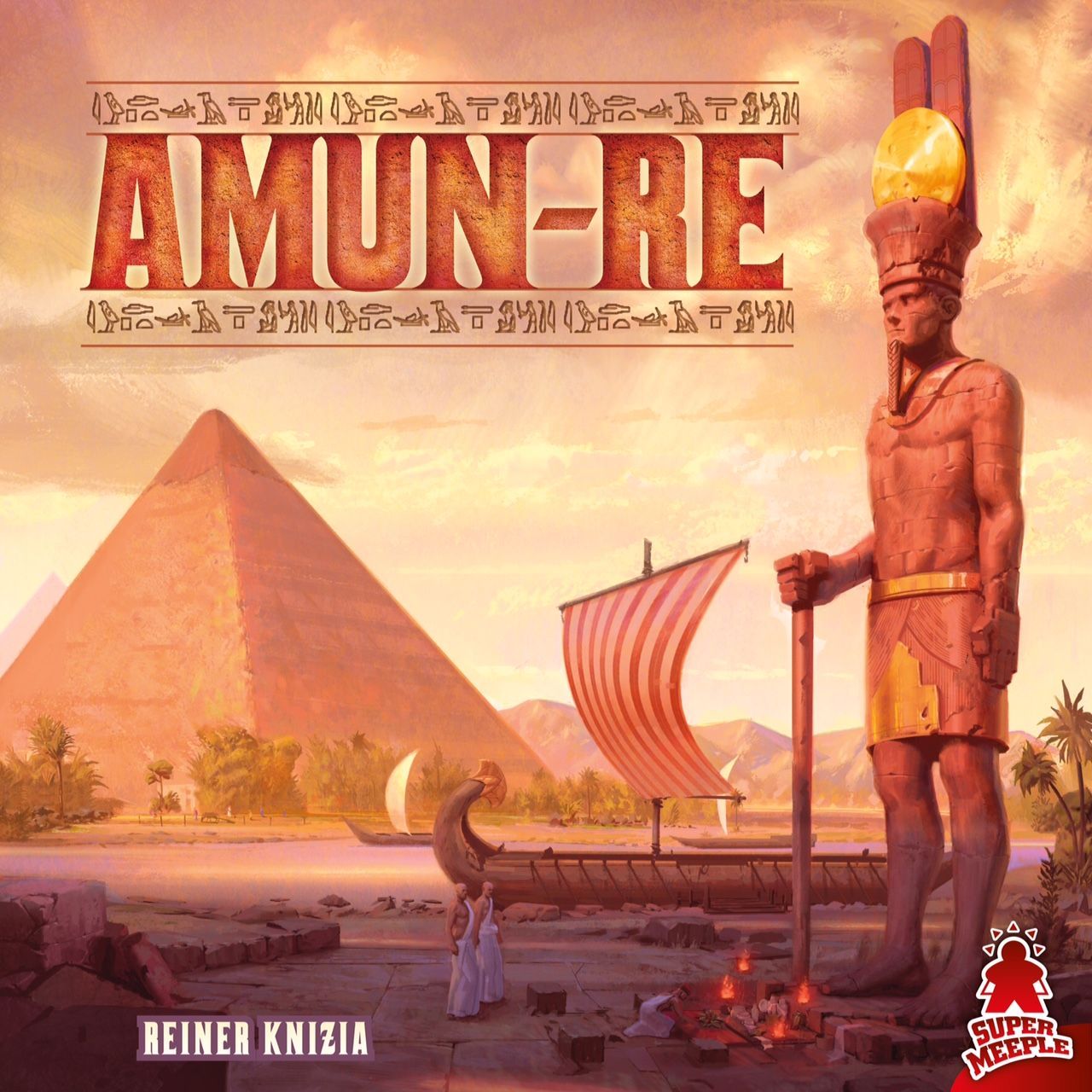
official art · Hans im Glück
the rules in 60 seconds▶ auto · 1/6
🧩
01
Setup
Place the game board, arrange money cards, game elements (peasants, building stones, pyramids), and the Amun-Re temple; each player receives a summary board, corresponding markers, 20 coins, and a -3 card; deal 'Master Builder' power cards to players, shuffle the rest, and place them on the board; shuffle province cards and place them on the board.
The rules, step by step
Setup
To set up Amun-Re, first place the game board in the center of the playing area. Next, organize the money cards by value and place them face-up to one side of the board. Arrange the various game elements, including peasants, building stones, and pyramids, to another side of the board. Assemble and place the Amun-Re temple on its designated spot. Each player receives a summary board, their corresponding player markers, 20 coins, and a -3 card. Identify and deal one 'Master Builder' power card to each player, then shuffle the remaining power cards and place them face-down on the board. Finally, shuffle the province cards and place them face-down on the board as well. The game is now ready to begin.
Objective
The primary objective in Amun-Re is to accumulate the most prestige points over the course of six rounds, which are divided into two distinct periods. Players achieve this by strategically acquiring control of provinces, constructing pyramids within these provinces, and making offerings to the god Amun-Re. Prestige points are awarded at the end of each period (after rounds 3 and 6), and the player with the highest total prestige points at the end of the second period (after round 6) is declared the winner.
On your turn
Each round in Amun-Re is structured into six distinct phases. Phase 1 involves revealing province cards, where a number of cards equal to the number of players are revealed. Phase 2 is for acquiring provinces through a bidding process, starting with the initial player. Phase 3 allows players to take actions, such as buying power cards, peasants, or building stones, in a specific order. Phase 4 is dedicated to making offerings to Amun-Re, which influences the harvest. Phase 5 covers the harvest and income generation from controlled provinces and trade caravans. Finally, Phase 6 is the scoring phase, which only occurs at the end of rounds 3 and 6, marking the conclusion of each period.
Scoring
Scoring in Amun-Re occurs at the end of rounds 3 and 6. Pyramids contribute prestige points: small pyramids are worth 1 point each, and large pyramids are worth 2 points each. A 'set of pyramids' is formed when a player has at least one pyramid in each of their controlled provinces, granting 3 points. The player who controls the province with the most pyramids on either the east or west side of the Nile receives 5 points for each side they dominate. Additionally, certain power cards can be used in Phase 6 to score extra points if their specific requirements are met. At the very end of the game, after the sixth round, players' final wealth is measured: the wealthiest player receives 6 prestige points, the second wealthiest gets 4, and the third wealthiest receives 2. In case of a tie for wealth, tied players receive the full points for their position, but the next lower rank's points are skipped.
Game end
The game of Amun-Re concludes after six rounds of play. These six rounds are divided into two periods, with each period consisting of three rounds. Scoring takes place at the end of the third round, marking the end of the first period (the Old Kingdom), and again at the end of the sixth round, which signifies the end of the second period (the New Kingdom) and the entire game. The player who has accumulated the most prestige points across both scoring periods is declared the winner.
Tips
To gain an edge, consider using 'Local Support' power cards to increase the bidding cost for other players on a province, or 'Administrative Support' to allow yourself to overbid on a card you've already placed a marker on. Unwanted power cards can be discarded at any time for 1 coin each. The 'Priest Support' card allows you to adjust the range of offerings to Amun-Re by three, either up or down, to secure better harvest outcomes. At the start of the game, 'Architect' cards can be dealt randomly, providing unique powers and additional starting coins. For a two-player variant, each player controls two colors and makes two offerings to Amun-Re, one for each color, but manages a single hand of coins and power cards. Turns alternate between players and then between their controlled colors. All players will end up controlling one province, and offerings from both colors contribute to a single hand of coins. Each color is scored separately for wealth, with the wealthiest color receiving 2 points, and the other receiving none.
🔬 game anatomy
Complexity3.0 / 5
BGG rating7.3 / 10
Vibe
Strategy
Language dependence
No in-game text needed
🌐 plays without English
Play time
90 min
Players
3–5
Recommended age
12+ yrs
BGG rank
#606
✨ from Trișache · verified
Frequently asked questions
Q1What is the goal of the game?
The primary objective in Amun-Re is to accumulate the most prestige points over the course of six rounds, which are divided into two distinct periods. Players achieve this by strategically acquiring control of provinces, constructing pyramids within these provinces, and making offerings to the god Amun-Re. Prestige points are awarded at the end of each period (after rounds 3 and 6), and the player with the highest total prestige points at the end of the second period (after round 6) is declared the winner.
Q2How do you set up the game?
To set up Amun-Re, first place the game board in the center of the playing area. Next, organize the money cards by value and place them face-up to one side of the board. Arrange the various game elements, including peasants, building stones, and pyramids, to another side of the board. Assemble and place the Amun-Re temple on its designated spot. Each player receives a summary board, their corresponding player markers, 20 coins, and a -3 card. Identify and deal one 'Master Builder' power card to each player, then shuffle the remaining power cards and place them face-down on the board. Finally, shuffle the province cards and place them face-down on the board as well. The game is now ready to begin.
Q3How does a turn work?
Each round in Amun-Re is structured into six distinct phases. Phase 1 involves revealing province cards, where a number of cards equal to the number of players are revealed. Phase 2 is for acquiring provinces through a bidding process, starting with the initial player. Phase 3 allows players to take actions, such as buying power cards, peasants, or building stones, in a specific order. Phase 4 is dedicated to making offerings to Amun-Re, which influences the harvest. Phase 5 covers the harvest and income generation from controlled provinces and trade caravans. Finally, Phase 6 is the scoring phase, which only occurs at the end of rounds 3 and 6, marking the conclusion of each period.
Q4How is scoring calculated?
Scoring in Amun-Re occurs at the end of rounds 3 and 6. Pyramids contribute prestige points: small pyramids are worth 1 point each, and large pyramids are worth 2 points each. A 'set of pyramids' is formed when a player has at least one pyramid in each of their controlled provinces, granting 3 points. The player who controls the province with the most pyramids on either the east or west side of the Nile receives 5 points for each side they dominate. Additionally, certain power cards can be used in Phase 6 to score extra points if their specific requirements are met. At the very end of the game, after the sixth round, players' final wealth is measured: the wealthiest player receives 6 prestige points, the second wealthiest gets 4, and the third wealthiest receives 2. In case of a tie for wealth, tied players receive the full points for their position, but the next lower rank's points are skipped.
Q5When and how does the game end?
The game of Amun-Re concludes after six rounds of play. These six rounds are divided into two periods, with each period consisting of three rounds. Scoring takes place at the end of the third round, marking the end of the first period (the Old Kingdom), and again at the end of the sixth round, which signifies the end of the second period (the New Kingdom) and the entire game. The player who has accumulated the most prestige points across both scoring periods is declared the winner.
Q6What tips are there for beginners?
To gain an edge, consider using 'Local Support' power cards to increase the bidding cost for other players on a province, or 'Administrative Support' to allow yourself to overbid on a card you've already placed a marker on. Unwanted power cards can be discarded at any time for 1 coin each. The 'Priest Support' card allows you to adjust the range of offerings to Amun-Re by three, either up or down, to secure better harvest outcomes. At the start of the game, 'Architect' cards can be dealt randomly, providing unique powers and additional starting coins. For a two-player variant, each player controls two colors and makes two offerings to Amun-Re, one for each color, but manages a single hand of coins and power cards. Turns alternate between players and then between their controlled colors. All players will end up controlling one province, and offerings from both colors contribute to a single hand of coins. Each color is scored separately for wealth, with the wealthiest color receiving 2 points, and the other receiving none.
Q7How much does Amun-Re cost?
Amun-Re costs around 230 RON in Romania.
Q8Where can I buy Amun-Re cheapest?
The lowest price for Amun-Re right now is 230 RON at Red Goblin. The Prices tab lists every store currently tracking it.
Q9How do you play Amun-Re?
Amun-Re is a ancient game, for 3–5 players, taking ~90 minutes, featuring area majority / influence. Check the Rules tab for setup, gameplay, and scoring, or ask Trișache anything about Amun-Re — our AI assistant built by howtoplay.ro and trained specifically on board game rulebooks.

%2Fpic2748305.jpg)
%2Fpic2748305.jpg)