The primary objective in Barcelona is to accumulate the most victory points by the end of the game. Players achieve this by strategically developing the Eixample district. This involves attracting citizens to the city, constructing various elements like cobblestone footpaths, streets, and intersections, and building residential and public service buildings. Players also earn points by advancing on the Cerdà track, which represents impressing the chief urban planner, and by completing personal Modernisme objectives. The player who best balances these aspects of urban development and scores the highest total of victory points will be declared the winner.
To find the best price for Barcelona, howtoplay.ro compares deals from Romanian shops every day.
FromRON 177· 7 shops
🔥Good time to buy-23% vs 90-day avg
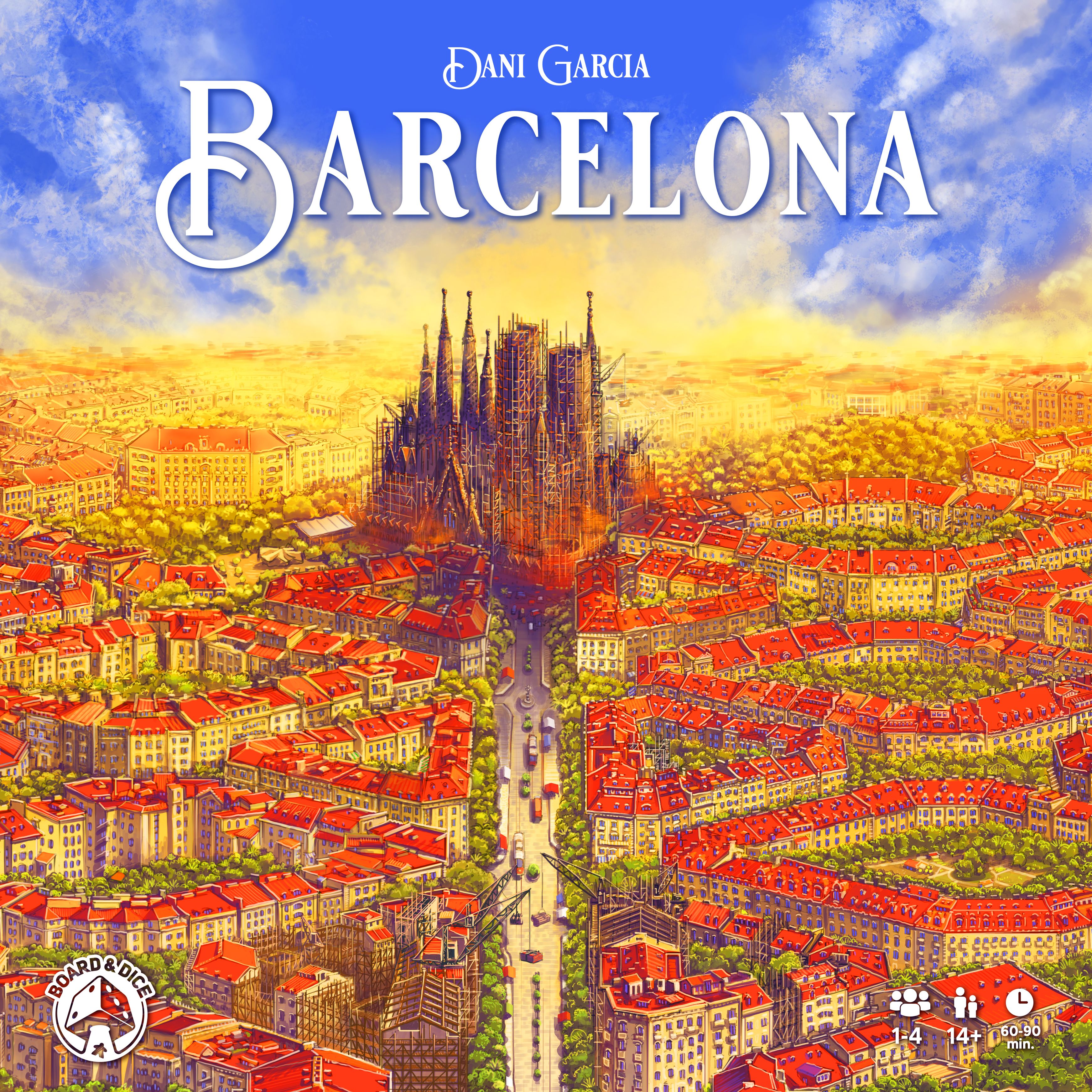
official art · Board&Dice
the rules in 60 seconds▶ auto · 1/6
🧩
01
Setup
Set up the main board with scoring tracks, empty Barcelona blocks, and action spaces. Prepare the Modernisme tiles, Public Service stacks, Building tiles, Sagrada Familia tiles, and Citizen tiles. Each player receives a player board, colored pieces, and two secret Citizen tiles.
The rules, step by step
Setup
To set up, place the main game board, which includes the central Barcelona map, the Cerdà track, and the main victory point track. Place the square building bonus tiles around the Barcelona map and the rectangular action tiles on their designated spaces. Prepare the Modernisme tiles by removing those corresponding to the Cerdà scoring tiles and creating a draw deck and market. Stack the Public Service tiles randomly, ensuring the cost 3/10 points tile is on top, followed by the 2/6 points tile, and the 1/3 points tile at the bottom. For 2-player games, remove the cheapest Public Service tile. Place the Building tiles (corners, level 1, 2, and 3) in separate stacks. Arrange the Sagrada Familia tiles by level. Each player takes a player board, all their colored pieces (discs, tram, and passenger cubes), and draws two Citizen tiles from the bag, keeping them secret.
Objective
The primary objective in Barcelona is to accumulate the most victory points by the end of the game. Players achieve this by strategically developing the Eixample district. This involves attracting citizens to the city, constructing various elements like cobblestone footpaths, streets, and intersections, and building residential and public service buildings. Players also earn points by advancing on the Cerdà track, which represents impressing the chief urban planner, and by completing personal Modernisme objectives. The player who best balances these aspects of urban development and scores the highest total of victory points will be declared the winner.
On your turn
A turn consists of four mandatory steps. First, you must place your two Citizen tiles on an empty intersection space on the main board, paying any visible coin cost. The chosen intersection determines which 2 or 3 adjacent action spaces become available for you to optionally take in any order. Second, if you are able to construct a building (by having the required Citizen tiles on adjacent intersections), you must do so. Third, if placing citizens or constructing a building causes any of the three Citizen tracks to fill up or exceed its current section, Cerdà's scoring is triggered for all players. Finally, draw two new Citizen tiles from the bag to replenish your hand, keeping them secret from other players.
Scoring
Victory points are scored both during the game and at its conclusion. During the game, points are gained by taking certain actions, such as gaining cloth and victory points directly, or by building streets, which award points based on the length of the connected street tiles. Cerdà's scoring occurs three times during the game when a Citizen track section is filled, awarding points based on players' positions on the Cerdà track and the current Cerdà scoring tile. At the end of the game, additional points are awarded for Modernisme tiles based on their objectives and any upgraded multipliers, for positions on the passenger track, and for cleared cobblestone spaces on your player board.
Game end
The game concludes immediately when the third Cerdà scoring objective is triggered. After this, all players complete the current round so that everyone has had an equal number of turns. Following the completion of the final round, players proceed to final scoring. During final scoring, players tally all their accumulated victory points from various sources, including Modernisme tiles, passenger tracks, and cleared cobblestone spaces. The player with the highest total victory points wins. In case of a tie, the player highest on the Cerdà track wins. If still tied, the player who placed the most building markers on the board wins. If a tie persists, victory is shared.
Tips
To succeed in Barcelona, strategic planning and adaptability are key. When placing Citizen tiles, consider not only the immediate actions they unlock but also how they position you for future building constructions and Cerdà's scoring. Upgrading Modernisme slots early can significantly boost end-game scoring for specific objectives. Efficiently managing your warehouse for resources and cobblestones is crucial, as discarded resources can free up space, and clearing cobblestones can reveal valuable end-game points. Pay close attention to your opponents' progress on the Citizen tracks to anticipate Cerdà's scoring phases and maximize your gains during these critical moments. Balancing immediate gains with long-term strategic objectives is essential for victory.
🔬 game anatomy
Complexity3.4 / 5
BGG rating7.7 / 10
Vibe
Strategy
Language dependence
No in-game text needed
🌐 plays without English
Play time
60–90 min
Players
1–4
Recommended age
14+ yrs
BGG rank
#561
✨ from Trișache · verified
Frequently asked questions
Q1What is the goal of the game?
The primary objective in Barcelona is to accumulate the most victory points by the end of the game. Players achieve this by strategically developing the Eixample district. This involves attracting citizens to the city, constructing various elements like cobblestone footpaths, streets, and intersections, and building residential and public service buildings. Players also earn points by advancing on the Cerdà track, which represents impressing the chief urban planner, and by completing personal Modernisme objectives. The player who best balances these aspects of urban development and scores the highest total of victory points will be declared the winner.
Q2How do you set up the game?
To set up, place the main game board, which includes the central Barcelona map, the Cerdà track, and the main victory point track. Place the square building bonus tiles around the Barcelona map and the rectangular action tiles on their designated spaces. Prepare the Modernisme tiles by removing those corresponding to the Cerdà scoring tiles and creating a draw deck and market. Stack the Public Service tiles randomly, ensuring the cost 3/10 points tile is on top, followed by the 2/6 points tile, and the 1/3 points tile at the bottom. For 2-player games, remove the cheapest Public Service tile. Place the Building tiles (corners, level 1, 2, and 3) in separate stacks. Arrange the Sagrada Familia tiles by level. Each player takes a player board, all their colored pieces (discs, tram, and passenger cubes), and draws two Citizen tiles from the bag, keeping them secret.
Q3How does a turn work?
A turn consists of four mandatory steps. First, you must place your two Citizen tiles on an empty intersection space on the main board, paying any visible coin cost. The chosen intersection determines which 2 or 3 adjacent action spaces become available for you to optionally take in any order. Second, if you are able to construct a building (by having the required Citizen tiles on adjacent intersections), you must do so. Third, if placing citizens or constructing a building causes any of the three Citizen tracks to fill up or exceed its current section, Cerdà's scoring is triggered for all players. Finally, draw two new Citizen tiles from the bag to replenish your hand, keeping them secret from other players.
Q4How is scoring calculated?
Victory points are scored both during the game and at its conclusion. During the game, points are gained by taking certain actions, such as gaining cloth and victory points directly, or by building streets, which award points based on the length of the connected street tiles. Cerdà's scoring occurs three times during the game when a Citizen track section is filled, awarding points based on players' positions on the Cerdà track and the current Cerdà scoring tile. At the end of the game, additional points are awarded for Modernisme tiles based on their objectives and any upgraded multipliers, for positions on the passenger track, and for cleared cobblestone spaces on your player board.
Q5When and how does the game end?
The game concludes immediately when the third Cerdà scoring objective is triggered. After this, all players complete the current round so that everyone has had an equal number of turns. Following the completion of the final round, players proceed to final scoring. During final scoring, players tally all their accumulated victory points from various sources, including Modernisme tiles, passenger tracks, and cleared cobblestone spaces. The player with the highest total victory points wins. In case of a tie, the player highest on the Cerdà track wins. If still tied, the player who placed the most building markers on the board wins. If a tie persists, victory is shared.
Q6What tips are there for beginners?
To succeed in Barcelona, strategic planning and adaptability are key. When placing Citizen tiles, consider not only the immediate actions they unlock but also how they position you for future building constructions and Cerdà's scoring. Upgrading Modernisme slots early can significantly boost end-game scoring for specific objectives. Efficiently managing your warehouse for resources and cobblestones is crucial, as discarded resources can free up space, and clearing cobblestones can reveal valuable end-game points. Pay close attention to your opponents' progress on the Citizen tracks to anticipate Cerdà's scoring phases and maximize your gains during these critical moments. Balancing immediate gains with long-term strategic objectives is essential for victory.
Q7How much does Barcelona cost?
Barcelona costs between 177 and 403 RON across Romanian stores.
Q8Where can I buy Barcelona cheapest?
The lowest price for Barcelona right now is 177 RON at ozone.ro. The Prices tab lists every store currently tracking it.
Q9How do you play Barcelona?
Barcelona is a city building game, for 1–4 players, taking ~60–90 minutes, featuring end game bonuses. Check the Rules tab for setup, gameplay, and scoring, or ask Trișache anything about Barcelona — our AI assistant built by howtoplay.ro and trained specifically on board game rulebooks.

%2Fpic7442376.jpg)
%2Fpic7442376.jpg)