Prices updated today
%2Fpic759154.jpg)
Biblios
Dr. Finn's Games · 2007
2–430 min10+ yrs1.7/5 complexity7.2 BGG#526 BGG22,6 KFamily
⚡ short answer
How do you play Biblios?
In Biblios, players aim to assemble the most illustrious library by collecting various cards. These cards represent different resources and will contribute to their final score. Players also need to strategically manage their gold and influence the value of different card categories to gain the most points and ultimately win the game.
To find the best price for Biblios, howtoplay.ro compares deals from Romanian shops every day.
Watch It Played · Biblios - How To Play
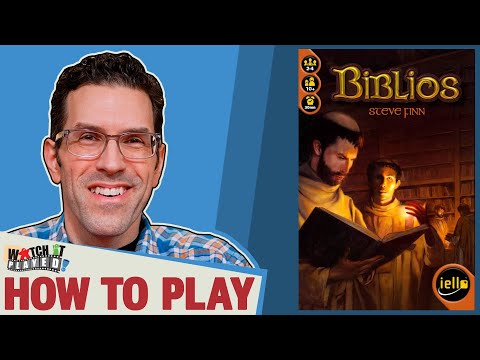
Biblios - How To Play
Watch It Played· 11 min· published Apr 23, 2019Community
the rules in 60 seconds▶ auto · 1/6
🧩
01
Setup
Place the Scriptorium board, set dice to 3, separate gold cards, remove cards based on player count, shuffle remaining cards, and deal the deck.
The rules, step by step
Setup
To set up, place the Scriptorium board in the center of the play area. Place one die of each color on its matching space on the Scriptorium, setting each die to a value of 3. Separate the cards into two piles: one for gold cards (values 1, 2, and 3) and one for all other cards. Based on the number of players, remove a certain number of gold cards from the game (2-player: two of each value; 3-player: one of each value; 4-player: none). Shuffle all remaining cards together to form the main deck. If playing with 2 players, randomly remove 21 cards unseen from the deck; for 3 players, remove 12 cards; for 4 players, remove 7 cards. Place the final shuffled deck face-down by the Scriptorium. Finally, pick a random person to be the first player.
Objective
In Biblios, players aim to assemble the most illustrious library by collecting various cards. These cards represent different resources and will contribute to their final score. Players also need to strategically manage their gold and influence the value of different card categories to gain the most points and ultimately win the game.
On your turn
The game is played in two halves: the Gift Phase and the Auction Phase. In the Gift Phase, the active player draws a number of cards equal to the number of players plus one, one at a time. After drawing each card, the active player secretly examines it and must immediately allocate it to one of three places: to their hand (face-down, only one card can be allocated here per turn), to the public space (face-up, visible to all players), or to the auction pile (face-down, for the second phase of the game, exactly one card must be allocated here per turn). Once the active player has allocated all cards, starting with the player to their left and going clockwise, each opponent chooses one card from the public space to add to their hand. In the Auction Phase, the auction pile is shuffled and becomes the new draw deck. The player who was first in the Gift Phase is also the first active player in this phase. They reveal the top card of the deck, and players bid gold cards from their hand to acquire it. Bidding proceeds clockwise, with each player bidding higher than the previous bid or passing. The highest bidder pays their bid by discarding gold cards from their hand. If a player cannot or chooses not to pay, they are penalized. The winner takes the auctioned card into their hand. The active player's turn ends, and the deck is passed to the next player in clockwise order, who then reveals the next card for auction.
Scoring
At the end of the game, players will go through all the cards they have collected and total the value they have in each of the five color categories (Holy Books, Manuscripts, Forbidden Tomes, Pigments, and Monks). For each category, the player with the highest total value wins points equal to the number showing on the matching die on the Scriptorium board. If there's a tie for the highest total in a category, the tied player with the most gold cards remaining in their hand wins. If there's still a tie, the tied player with the highest total value in Monk cards wins. If a tie persists, the tie-breaking letters on the Monk cards (A, B, C, D) are used, with the letter closest to 'A' winning. If still tied, use the next category in the Scriptorium to break the tie in the same way, and so on, until a winner is found.
Game end
The game ends when the original deck is empty, signifying the end of the Gift Phase. All cards allocated to the auction pile are then shuffled to form the Auction Phase deck. The Auction Phase continues until this deck is also exhausted, meaning all cards have been auctioned and acquired by players. At this point, final scoring occurs to determine the winner.
Tips
Strategic play involves carefully considering which cards to keep for yourself, which to offer to opponents, and which to save for the auction. Understanding the distribution of card values within each color category (e.g., some colors have higher maximum values) and the impact of Church cards on die values is crucial. During the Gift Phase, balance giving less desirable cards to opponents with saving valuable cards for yourself or the auction. In the Auction Phase, manage your gold carefully, as it is both a resource for bidding and a tie-breaker. Knowing when to overbid or when to pass can significantly impact your final score.
game anatomy
Complexity1.7 / 5
BGG rating7.2 / 10
Vibe
Family
Language dependence
No in-game text needed
Play time
30 min
Players
2–4
Recommended age
10+ yrs
BGG rank
#526
from Trișache · verified
Frequently asked questions
Q1What is the goal of the game?
In Biblios, players aim to assemble the most illustrious library by collecting various cards. These cards represent different resources and will contribute to their final score. Players also need to strategically manage their gold and influence the value of different card categories to gain the most points and ultimately win the game.
Q2How do you set up the game?
To set up, place the Scriptorium board in the center of the play area. Place one die of each color on its matching space on the Scriptorium, setting each die to a value of 3. Separate the cards into two piles: one for gold cards (values 1, 2, and 3) and one for all other cards. Based on the number of players, remove a certain number of gold cards from the game (2-player: two of each value; 3-player: one of each value; 4-player: none). Shuffle all remaining cards together to form the main deck. If playing with 2 players, randomly remove 21 cards unseen from the deck; for 3 players, remove 12 cards; for 4 players, remove 7 cards. Place the final shuffled deck face-down by the Scriptorium. Finally, pick a random person to be the first player.
Q3How does a turn work?
The game is played in two halves: the Gift Phase and the Auction Phase. In the Gift Phase, the active player draws a number of cards equal to the number of players plus one, one at a time. After drawing each card, the active player secretly examines it and must immediately allocate it to one of three places: to their hand (face-down, only one card can be allocated here per turn), to the public space (face-up, visible to all players), or to the auction pile (face-down, for the second phase of the game, exactly one card must be allocated here per turn). Once the active player has allocated all cards, starting with the player to their left and going clockwise, each opponent chooses one card from the public space to add to their hand. In the Auction Phase, the auction pile is shuffled and becomes the new draw deck. The player who was first in the Gift Phase is also the first active player in this phase. They reveal the top card of the deck, and players bid gold cards from their hand to acquire it. Bidding proceeds clockwise, with each player bidding higher than the previous bid or passing. The highest bidder pays their bid by discarding gold cards from their hand. If a player cannot or chooses not to pay, they are penalized. The winner takes the auctioned card into their hand. The active player's turn ends, and the deck is passed to the next player in clockwise order, who then reveals the next card for auction.
Q4How is scoring calculated?
At the end of the game, players will go through all the cards they have collected and total the value they have in each of the five color categories (Holy Books, Manuscripts, Forbidden Tomes, Pigments, and Monks). For each category, the player with the highest total value wins points equal to the number showing on the matching die on the Scriptorium board. If there's a tie for the highest total in a category, the tied player with the most gold cards remaining in their hand wins. If there's still a tie, the tied player with the highest total value in Monk cards wins. If a tie persists, the tie-breaking letters on the Monk cards (A, B, C, D) are used, with the letter closest to 'A' winning. If still tied, use the next category in the Scriptorium to break the tie in the same way, and so on, until a winner is found.
Q5When and how does the game end?
The game ends when the original deck is empty, signifying the end of the Gift Phase. All cards allocated to the auction pile are then shuffled to form the Auction Phase deck. The Auction Phase continues until this deck is also exhausted, meaning all cards have been auctioned and acquired by players. At this point, final scoring occurs to determine the winner.
Q6What tips are there for beginners?
Strategic play involves carefully considering which cards to keep for yourself, which to offer to opponents, and which to save for the auction. Understanding the distribution of card values within each color category (e.g., some colors have higher maximum values) and the impact of Church cards on die values is crucial. During the Gift Phase, balance giving less desirable cards to opponents with saving valuable cards for yourself or the auction. In the Auction Phase, manage your gold carefully, as it is both a resource for bidding and a tie-breaker. Knowing when to overbid or when to pass can significantly impact your final score.
Q7How much does Biblios cost?
No store is currently tracking Biblios. Check the Prices tab — you can set a price alert to be notified when it appears.
Q8Where can I buy Biblios cheapest?
Check the Prices tab — howtoplay.ro aggregates offers from 7+ Romanian board-game stores and tracks price history.
Q9How do you play Biblios?
Biblios is a card game game, for 2–4 players, taking ~30 minutes, featuring auction / bidding. Check the Rules tab for setup, gameplay, and scoring, or ask Trișache anything about Biblios — our AI assistant built by howtoplay.ro and trained specifically on board game rulebooks.
Q10How many players does Biblios support?
Biblios is played by 2–4 players.
1 shop
All prices
1 shop · sorted by priceupdated today
Regatul JocurilorENeasyboxCultural voucher
Biblios (English Edition)
○ out of stock
RON 124
Buy →out of stock
affiliate links · prices include VAT · independent platform, no hidden sponsorships
Currently unavailable in all shops
Price history
See price by edition
Price trend over the last 90 days: minimum 80 lei, maximum 124 lei, now 80 lei.
Mechanics & categories