The ultimate objective of Chaos in the Old World is for each player to claim dominance over the Old World in the name of their chosen Chaos God. Players strive to achieve this by spreading corruption across different regions, winning battles against enemies and peasants, managing their threat levels to advance on the threat dial, and completing specific advancement conditions unique to their god. Victory can be achieved by reaching fifty victory points, advancing your threat dial to the winning space, or being the leader when five regions become permanently ruined.
To find the best price for Chaos in the Old World, howtoplay.ro compares deals from Romanian shops every day.
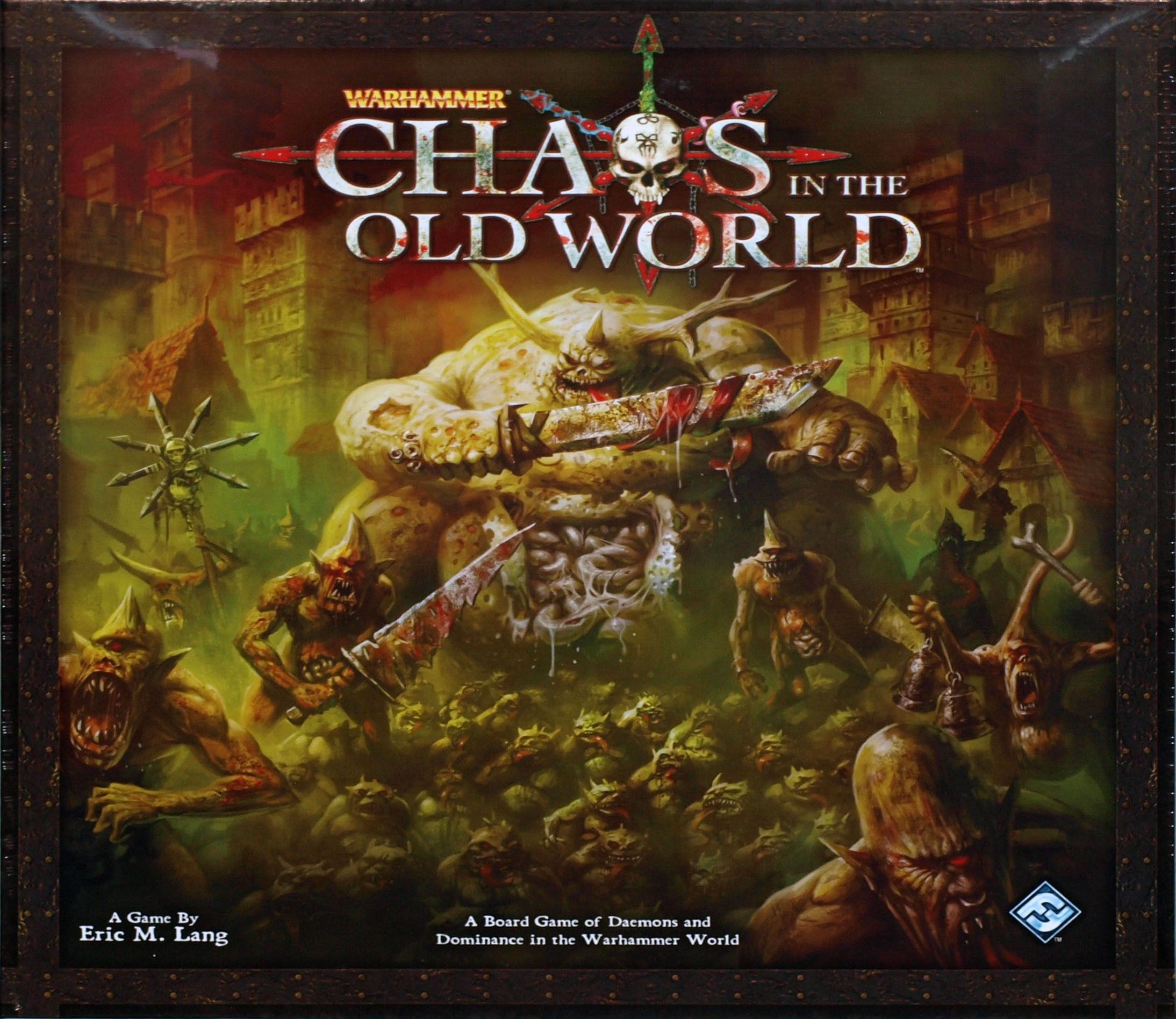
official art · Fantasy Flight Games
the rules in 60 seconds▶ auto · 1/6
🧩
01
Setup
Place the board, choose chaos gods, hand out matching power sheets, threat dials, starting cards, and markers. Distribute old world and ruination cards and region tokens.
The rules, step by step
Setup
Setting up Chaos in the Old World involves placing the main game board in the center of the table and ensuring all players can easily reach it. Each participant selects one of the four Chaos Gods (Khorne, Nurgle, Tzeentch, or Slaanesh) and receives the corresponding power sheet, plastic figures, corruption tokens, chaos card deck, and upgrade cards. Threat dials are set to their starting positions, and victory point markers are placed at zero on the board track. Five ruination cards are sorted numerically and placed on their designated space, while the old world deck is shuffled and dealt into a stack based on player count. Finally, old world tokens (noble, peasant, and warpstone) are randomly distributed across the nine regions, and players draw their starting hands of three chaos cards.
Objective
The ultimate objective of Chaos in the Old World is for each player to claim dominance over the Old World in the name of their chosen Chaos God. Players strive to achieve this by spreading corruption across different regions, winning battles against enemies and peasants, managing their threat levels to advance on the threat dial, and completing specific advancement conditions unique to their god. Victory can be achieved by reaching fifty victory points, advancing your threat dial to the winning space, or being the leader when five regions become permanently ruined.
On your turn
A full game round is played across six distinct phases: 1. Old World Phase, where the player with the lowest threat draws and resolves an Old World card. 2. Draw Phase, where players draw chaos cards according to their power sheets. 3. Summoning Phase, where players take turns spending power points to summon followers or play chaos cards into regions. 4. Battle Phase, where players resolve combat in regions containing opposing figures. 5. Corruption Phase, where players calculate region domination, score victory points, and place corruption tokens. 6. End Phase, where players remove chaos cards, resolve hero tokens, advance threat dials, and check for end game conditions.
Scoring
Scoring occurs primarily during the corruption phase. Players calculate their domination value in each region by summing their figure quantities (or modified attack values) and any card bonuses. The player with the highest domination value compares it against the region's resistance value. If domination exceeds resistance, that player immediately scores victory points equal to the region's conquest value. Additionally, players score points during the end phase of ruined regions if they hold the most corruption tokens, and advance their threat dials by fulfilling specific god-specific conditions.
Game end
The game can end in several ways during the end phase of any round. First, if any player's threat dial reaches the final victory space, they win instantly. Second, if any player reaches or exceeds 50 victory points on the main board track, they win the game. Third, if five regions on the map become permanently ruined due to accumulating twelve or more corruption tokens, the game ends immediately, and the player with the most victory points wins. If there is a tie, the player with the highest threat wins.
Tips
To succeed in Chaos in the Old World, carefully balance your focus between direct combat and spreading corruption. Pay close attention to turn order, as going first or last can drastically impact your summoning and battle options. Utilize your unique god abilities and upgrade cards wisely to manipulate region values and surprise your opponents. Always keep an eye on your opponents' threat dials and victory points so you can pivot your strategy to block their win conditions before it is too late.
🔬 game anatomy
Complexity3.2 / 5
BGG rating7.7 / 10
Vibe
Strategy
Language dependence
Extensive text — heavy translation needed
Play time
60–120 min
Players
3–4
Recommended age
13+ yrs
BGG rank
#218
✨ from Trișache · verified
Frequently asked questions
Q1What is the goal of the game?
The ultimate objective of Chaos in the Old World is for each player to claim dominance over the Old World in the name of their chosen Chaos God. Players strive to achieve this by spreading corruption across different regions, winning battles against enemies and peasants, managing their threat levels to advance on the threat dial, and completing specific advancement conditions unique to their god. Victory can be achieved by reaching fifty victory points, advancing your threat dial to the winning space, or being the leader when five regions become permanently ruined.
Q2How do you set up the game?
Setting up Chaos in the Old World involves placing the main game board in the center of the table and ensuring all players can easily reach it. Each participant selects one of the four Chaos Gods (Khorne, Nurgle, Tzeentch, or Slaanesh) and receives the corresponding power sheet, plastic figures, corruption tokens, chaos card deck, and upgrade cards. Threat dials are set to their starting positions, and victory point markers are placed at zero on the board track. Five ruination cards are sorted numerically and placed on their designated space, while the old world deck is shuffled and dealt into a stack based on player count. Finally, old world tokens (noble, peasant, and warpstone) are randomly distributed across the nine regions, and players draw their starting hands of three chaos cards.
Q3How does a turn work?
A full game round is played across six distinct phases: 1. Old World Phase, where the player with the lowest threat draws and resolves an Old World card. 2. Draw Phase, where players draw chaos cards according to their power sheets. 3. Summoning Phase, where players take turns spending power points to summon followers or play chaos cards into regions. 4. Battle Phase, where players resolve combat in regions containing opposing figures. 5. Corruption Phase, where players calculate region domination, score victory points, and place corruption tokens. 6. End Phase, where players remove chaos cards, resolve hero tokens, advance threat dials, and check for end game conditions.
Q4How is scoring calculated?
Scoring occurs primarily during the corruption phase. Players calculate their domination value in each region by summing their figure quantities (or modified attack values) and any card bonuses. The player with the highest domination value compares it against the region's resistance value. If domination exceeds resistance, that player immediately scores victory points equal to the region's conquest value. Additionally, players score points during the end phase of ruined regions if they hold the most corruption tokens, and advance their threat dials by fulfilling specific god-specific conditions.
Q5When and how does the game end?
The game can end in several ways during the end phase of any round. First, if any player's threat dial reaches the final victory space, they win instantly. Second, if any player reaches or exceeds 50 victory points on the main board track, they win the game. Third, if five regions on the map become permanently ruined due to accumulating twelve or more corruption tokens, the game ends immediately, and the player with the most victory points wins. If there is a tie, the player with the highest threat wins.
Q6What tips are there for beginners?
To succeed in Chaos in the Old World, carefully balance your focus between direct combat and spreading corruption. Pay close attention to turn order, as going first or last can drastically impact your summoning and battle options. Utilize your unique god abilities and upgrade cards wisely to manipulate region values and surprise your opponents. Always keep an eye on your opponents' threat dials and victory points so you can pivot your strategy to block their win conditions before it is too late.
Q7How much does Chaos in the Old World cost?
No store is currently tracking Chaos in the Old World. Check the Prices tab — you can set a price alert to be notified when it appears.
Q8Where can I buy Chaos in the Old World cheapest?
Check the Prices tab — howtoplay.ro aggregates offers from 7+ Romanian board-game stores and tracks price history.
Q9How do you play Chaos in the Old World?
Chaos in the Old World is a fantasy game, for 3–4 players, taking ~60–120 minutes, featuring action points. Check the Rules tab for setup, gameplay, and scoring, or ask Trișache anything about Chaos in the Old World — our AI assistant built by howtoplay.ro and trained specifically on board game rulebooks.
Q10How many players does Chaos in the Old World support?

%2Fpic1318481.jpg)
%2Fpic1318481.jpg)