The main objective in Coimbra is to accumulate the highest number of victory points by the end of the game. Players achieve this by strategically drafting dice to gain influence on various tracks, acquiring character cards that provide immediate or end-game bonuses, investing in expeditions for additional points, and managing their resources effectively. The game rewards players who can create synergistic combinations between their acquired cards and influence positions.
To find the best price for Coimbra, howtoplay.ro compares deals from Romanian shops every day.
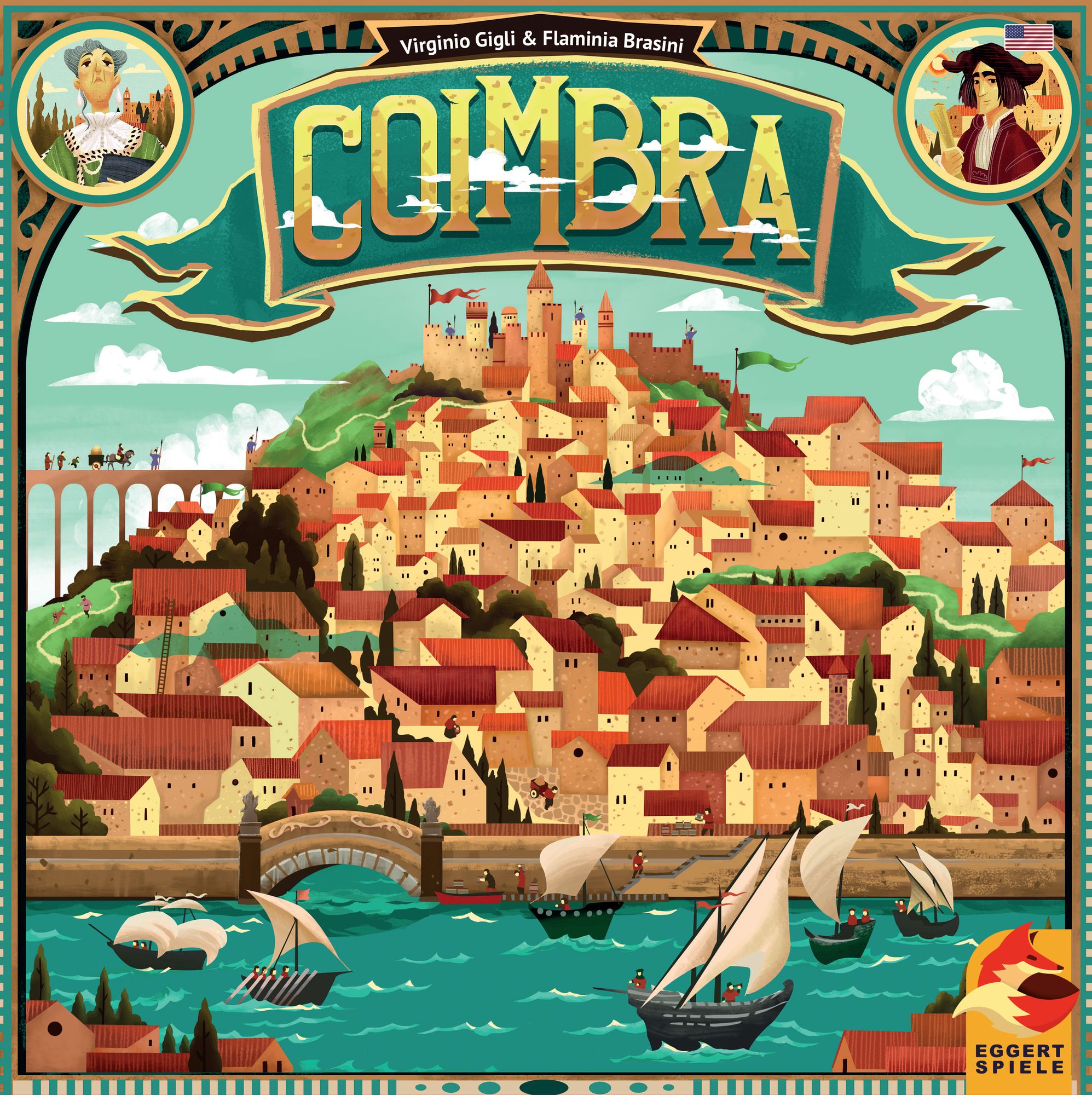
official art · eggertspiele
the rules in 60 seconds▶ auto · 1/6
🧩
01
Setup
Set up the game board with monastery tokens, scoring tokens, expedition cards, dice, player boards, and character cards according to player count.
The rules, step by step
Setup
To set up Coimbra, first, shuffle the monastery tokens for each of the three levels (I, II, III) and randomly place them on their corresponding spaces on the main board. Any unused monastery tokens are returned to the box. Next, select the appropriate scoring tokens for the influence tracks based on the number of players (4-player, 3-player, or 2-player game), shuffle them, and place one randomly on each influence track. Prepare the dice by removing specific colors based on player count (e.g., for a 3-player game, remove one purple and one green die; for a 2-player game, remove two purple, two green, one orange, and one gray die). Each player takes a player board, three dice holders, two small cubes (placed on space 7 of the coin track and space 7 of the guard track), one pilgrim pawn, and 25 influence discs in their chosen color. Place one influence disc from each player on the '0' space of each of the four influence tracks and stack all player score markers on the '0' space of the victory point track. Randomly determine the starting player order and place player pawns on the initiative track accordingly. Shuffle the three decks of character cards (I, II, III) separately. Place deck II on top of deck III to form the main draw pile, keeping deck I separate for now. Deal four character cards from the draw pile to each of the three city districts (upper, central, lower) and place a crown token on the leftmost character card in each column, following specific color-matching rules (e.g., a purple crown token goes on the first purple character card encountered when moving down the rightmost column). Finally, deal six expedition cards face-up to the designated spaces on the board.
Objective
The main objective in Coimbra is to accumulate the highest number of victory points by the end of the game. Players achieve this by strategically drafting dice to gain influence on various tracks, acquiring character cards that provide immediate or end-game bonuses, investing in expeditions for additional points, and managing their resources effectively. The game rewards players who can create synergistic combinations between their acquired cards and influence positions.
On your turn
A game of Coimbra unfolds over four rounds, with each round comprising six distinct phases: A) Roll Dice: The first player rolls all the dice (13 for 4 players, 11 for 3 players, 9 for 2 players). B) Dice Draft: In player order, each player drafts one die and places it in one of the four city districts (Castle, Upper City, Central City, Lower City). Dice are placed in ascending order in the Castle and descending order in the other three districts. Players continue drafting until all dice are placed. C) Collect Dice and Take Actions: In order of dice placement (left to right within each district, starting with the Castle), players retrieve their dice. For each retrieved die, the player takes an action: either gaining a favor token (which provides immediate bonuses and crown symbols for initiative) or acquiring a character card (paying its cost in coins or guards, gaining influence, and activating immediate or end-game effects). D) Determine New Player Order: Players count their total crown symbols (from favor tokens and their current position on the initiative track). The player with the most crowns becomes the first player for the next round, and ties are broken by the player with the highest current position on the initiative track. E) Income: Players receive income (coins or guards) based on their current position on the influence tracks. The specific income amount is determined by the color of the die they drafted for that track. F) Invest in Expeditions: In the new player order, players may invest in one expedition card by paying the indicated cost in coins or guards. Each expedition card can only be invested in once per player, but multiple players can invest in the same expedition. Expeditions provide end-game victory points.
Scoring
At the end of the fourth round, a final scoring takes place. Players score victory points from several sources: 1) Expedition Cards: Points are awarded based on the number of expedition cards collected and the specific conditions on each card. 2) Influence Tracks: Players earn points based on their final position on each of the four influence tracks, as indicated by the scoring tokens placed during setup. 3) Diplomas: Players score points for collecting sets of unique diploma symbols on their character cards. A set of five different colored diplomas is worth 12 points, four different colors is 8 points, three is 4 points, and two is 2 points. A wild diploma symbol can be used to complete any set. 4) End-Game Character Card Bonuses: Some character cards provide additional victory points based on specific conditions met at the end of the game. 5) Remaining Resources: Players convert their remaining coins, guards, and crown symbols into victory points. The total sum of these resources is divided by two and rounded down to determine additional victory points.
Game end
The game concludes immediately after the end of the fourth round. Following the completion of all six phases of the fourth round, players proceed to the final scoring phase. After all victory points from expeditions, influence tracks, diplomas, end-game character card bonuses, and remaining resources have been tallied, the player with the highest total victory points is declared the winner. In case of a tie, the tied player who is highest on the initiative track wins. If still tied, the tied player with the most remaining coins wins.
Tips
To succeed in Coimbra, it's crucial to balance your short-term gains with long-term strategies. Pay close attention to the dice values and colors, as they dictate both your influence gains and the cost of character cards. Don't underestimate the power of the pilgrim pawn; moving it efficiently can unlock valuable monastery bonuses. Keep an eye on your opponents' progress on the influence tracks and their collected character cards to anticipate their moves and deny them crucial points. Investing in expeditions early can secure valuable end-game points, but ensure you have enough resources to pay for them without hindering your immediate actions. Finally, remember that crown symbols are vital for determining player order in subsequent rounds, which can give you a significant advantage in drafting dice and selecting actions.
🔬 game anatomy
Complexity3.2 / 5
BGG rating7.6 / 10
Vibe
Strategy
Language dependence
Some text — easily memorized
🌐 plays without English
Play time
60–90 min
Players
2–4
Recommended age
14+ yrs
BGG rank
#270
✨ from Trișache · verified
Frequently asked questions
Q1What is the goal of the game?
The main objective in Coimbra is to accumulate the highest number of victory points by the end of the game. Players achieve this by strategically drafting dice to gain influence on various tracks, acquiring character cards that provide immediate or end-game bonuses, investing in expeditions for additional points, and managing their resources effectively. The game rewards players who can create synergistic combinations between their acquired cards and influence positions.
Q2How do you set up the game?
To set up Coimbra, first, shuffle the monastery tokens for each of the three levels (I, II, III) and randomly place them on their corresponding spaces on the main board. Any unused monastery tokens are returned to the box. Next, select the appropriate scoring tokens for the influence tracks based on the number of players (4-player, 3-player, or 2-player game), shuffle them, and place one randomly on each influence track. Prepare the dice by removing specific colors based on player count (e.g., for a 3-player game, remove one purple and one green die; for a 2-player game, remove two purple, two green, one orange, and one gray die). Each player takes a player board, three dice holders, two small cubes (placed on space 7 of the coin track and space 7 of the guard track), one pilgrim pawn, and 25 influence discs in their chosen color. Place one influence disc from each player on the '0' space of each of the four influence tracks and stack all player score markers on the '0' space of the victory point track. Randomly determine the starting player order and place player pawns on the initiative track accordingly. Shuffle the three decks of character cards (I, II, III) separately. Place deck II on top of deck III to form the main draw pile, keeping deck I separate for now. Deal four character cards from the draw pile to each of the three city districts (upper, central, lower) and place a crown token on the leftmost character card in each column, following specific color-matching rules (e.g., a purple crown token goes on the first purple character card encountered when moving down the rightmost column). Finally, deal six expedition cards face-up to the designated spaces on the board.
Q3How does a turn work?
A game of Coimbra unfolds over four rounds, with each round comprising six distinct phases: A) Roll Dice: The first player rolls all the dice (13 for 4 players, 11 for 3 players, 9 for 2 players). B) Dice Draft: In player order, each player drafts one die and places it in one of the four city districts (Castle, Upper City, Central City, Lower City). Dice are placed in ascending order in the Castle and descending order in the other three districts. Players continue drafting until all dice are placed. C) Collect Dice and Take Actions: In order of dice placement (left to right within each district, starting with the Castle), players retrieve their dice. For each retrieved die, the player takes an action: either gaining a favor token (which provides immediate bonuses and crown symbols for initiative) or acquiring a character card (paying its cost in coins or guards, gaining influence, and activating immediate or end-game effects). D) Determine New Player Order: Players count their total crown symbols (from favor tokens and their current position on the initiative track). The player with the most crowns becomes the first player for the next round, and ties are broken by the player with the highest current position on the initiative track. E) Income: Players receive income (coins or guards) based on their current position on the influence tracks. The specific income amount is determined by the color of the die they drafted for that track. F) Invest in Expeditions: In the new player order, players may invest in one expedition card by paying the indicated cost in coins or guards. Each expedition card can only be invested in once per player, but multiple players can invest in the same expedition. Expeditions provide end-game victory points.
Q4How is scoring calculated?
At the end of the fourth round, a final scoring takes place. Players score victory points from several sources: 1) Expedition Cards: Points are awarded based on the number of expedition cards collected and the specific conditions on each card. 2) Influence Tracks: Players earn points based on their final position on each of the four influence tracks, as indicated by the scoring tokens placed during setup. 3) Diplomas: Players score points for collecting sets of unique diploma symbols on their character cards. A set of five different colored diplomas is worth 12 points, four different colors is 8 points, three is 4 points, and two is 2 points. A wild diploma symbol can be used to complete any set. 4) End-Game Character Card Bonuses: Some character cards provide additional victory points based on specific conditions met at the end of the game. 5) Remaining Resources: Players convert their remaining coins, guards, and crown symbols into victory points. The total sum of these resources is divided by two and rounded down to determine additional victory points.
Q5When and how does the game end?
The game concludes immediately after the end of the fourth round. Following the completion of all six phases of the fourth round, players proceed to the final scoring phase. After all victory points from expeditions, influence tracks, diplomas, end-game character card bonuses, and remaining resources have been tallied, the player with the highest total victory points is declared the winner. In case of a tie, the tied player who is highest on the initiative track wins. If still tied, the tied player with the most remaining coins wins.
Q6What tips are there for beginners?
To succeed in Coimbra, it's crucial to balance your short-term gains with long-term strategies. Pay close attention to the dice values and colors, as they dictate both your influence gains and the cost of character cards. Don't underestimate the power of the pilgrim pawn; moving it efficiently can unlock valuable monastery bonuses. Keep an eye on your opponents' progress on the influence tracks and their collected character cards to anticipate their moves and deny them crucial points. Investing in expeditions early can secure valuable end-game points, but ensure you have enough resources to pay for them without hindering your immediate actions. Finally, remember that crown symbols are vital for determining player order in subsequent rounds, which can give you a significant advantage in drafting dice and selecting actions.
Q7How much does Coimbra cost?
No store is currently tracking Coimbra. Check the Prices tab — you can set a price alert to be notified when it appears.
Q8Where can I buy Coimbra cheapest?
Check the Prices tab — howtoplay.ro aggregates offers from 7+ Romanian board-game stores and tracks price history.
Q9How do you play Coimbra?
Coimbra is a dice game, for 2–4 players, taking ~60–90 minutes, featuring action drafting. Check the Rules tab for setup, gameplay, and scoring, or ask Trișache anything about Coimbra — our AI assistant built by howtoplay.ro and trained specifically on board game rulebooks.
Q10How many players does Coimbra support?
Coimbra is played by 2–4 players.
💰 3 shops
All prices
3 shops · sorted by priceupdated today
Regatul JocurilorEnglish editioneasyboxCultural voucher

%2Fpic3956079.jpg)
%2Fpic3956079.jpg)