3–560–90 min10+ yrs2.8/5 complexity7.2 BGG#715 BGG10,5 K
⚡ short answer
How do you play Colosseum?
The primary objective in Colosseum is to host the most spectacular event, measured by the highest single attendance score achieved in any of the five rounds. Players are not accumulating points throughout the game; rather, their score token on the track always reflects their personal best attendance score. The player who has achieved the highest personal best by the end of the fifth round is declared the winner.
To find the best price for Colosseum, howtoplay.ro compares deals from Romanian shops every day.
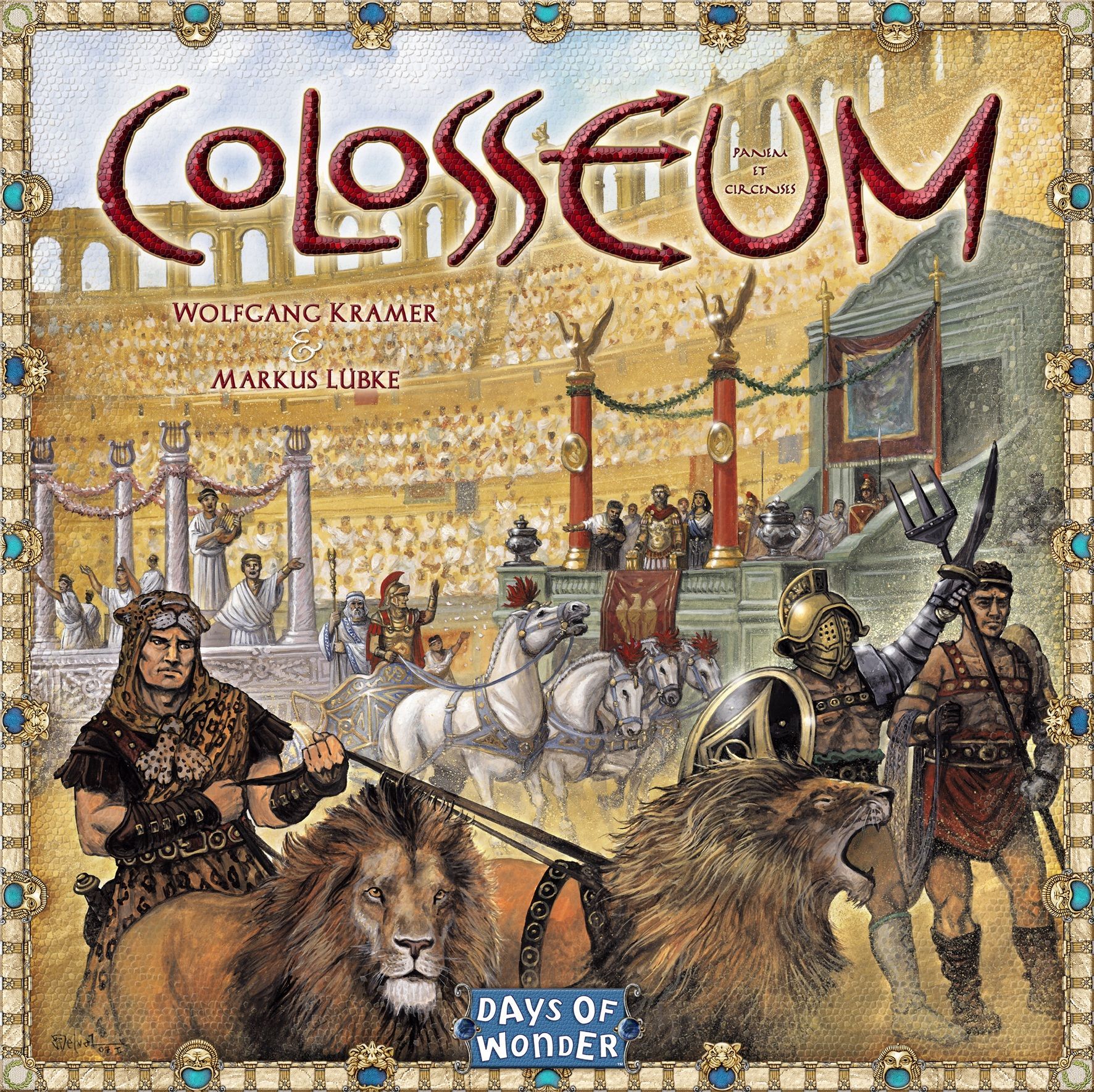
official art · Days of Wonder
the rules in 60 seconds▶ auto · 1/6
🧩
01
Setup
Lay out the game board, place score tokens on zero, set up Colosseums based on player count, distribute starting event programs and asset tiles, and create general supplies.
The rules, step by step
Setup
To set up Colosseum, first lay out the game board. Each player places their score token on the '0' space of the scoring track. Colosseums are assembled on the board according to the player count, with specific spots designated for 3, 4, or 5 players. Shuffle two stacks of starting event programs (numbered 1-5 and 6-10) and deal one from each stack to every player. Each player starts with 30 coins. Shuffle all starting asset tiles (blue and green backs) and deal a specific number to each player based on player count (8 for 3 players, 6 for 4 players, 5 for 5 players). Any remaining starting asset tiles are randomly placed into five groups of three on the board's market spaces. Star performer tokens are awarded to players who have at least three of a specific asset type and the most of that type among all players. The remaining normal asset tiles (yellow lion back) are placed into a draw bag. Finally, create general supplies for event program tiles, Colosseum expansions, season tickets, emperor's lodges, emperor medals, podium tiles, and coins. Place the turn marker on Round 1.
Objective
The primary objective in Colosseum is to host the most spectacular event, measured by the highest single attendance score achieved in any of the five rounds. Players are not accumulating points throughout the game; rather, their score token on the track always reflects their personal best attendance score. The player who has achieved the highest personal best by the end of the fifth round is declared the winner.
On your turn
Each round of Colosseum consists of five distinct phases, executed in turn order starting with the current first player. Phase 1: Investing – Players can buy new event programs, expand their arena, purchase season tickets, or construct an emperor's loge. Phase 2: Acquiring Event Asset Tokens – Players bid in auctions for groups of asset tiles from the market. Phase 3: Trading Event Asset Tokens – Players can freely trade asset tokens and money with each other. Phase 4: Producing an Event – Players roll dice to move nobles into their Colosseum, announce an event program, and calculate their attendance score. Phase 5: Closing Ceremony – The leading player earns a podium, players discard one asset token used in the latest event, and the last-place player steals an asset token from the leader. The turn marker advances, and the first player token rotates clockwise.
Scoring
During the 'Producing an Event' phase, players calculate their event's attendance score. This score is determined by the base value of the chosen event program (adjusted if missing required assets), plus 5 points for each previously produced event, 5 points for each season ticket owned, 4 points for each star performer award (if the corresponding asset type was used in the event), 7 points for the Emperor if present in the Colosseum, 5 points for each Consul in the Colosseum, 3 points for each Senator in the Colosseum, 3 points for each podium owned, and an additional 3 points for each Emperor Medal turned in. The total attendance score is immediately converted into coins from the bank, and the player's score token on the track is updated only if this new score surpasses their previous personal best.
Game end
The game concludes at the end of the fifth round. Unlike the preceding rounds, the 'Closing Ceremony' phase (Phase 5) is not executed in the final round. Instead, after all players have completed their 'Producing an Event' phase (Phase 4), the game immediately ends. The winner is the player whose score token is furthest along the scoring track, indicating the highest single event attendance score achieved throughout the game. In case of a tie for the highest score, the tied player with the most money wins. If still tied, the tied player with the most star performer tokens wins.
Tips
To excel in Colosseum, prioritize expanding your Colosseum early to accommodate larger, higher-scoring event programs and attract more nobles. Strategic acquisition of asset tokens during auctions is crucial; consider not only what you need but also what your opponents might be collecting to deny them star performer awards. Effective trading can secure vital assets or generate much-needed coin. Don't underestimate the power of Emperor Medals, as they offer flexibility in investments and provide bonus spectators. Finally, always be aware of your opponents' highest scores to gauge what you need to beat to claim victory.
🔬 game anatomy
Complexity2.8 / 5
BGG rating7.2 / 10
Language dependence
No in-game text needed
🌐 plays without English
Play time
60–90 min
Players
3–5
Recommended age
10+ yrs
BGG rank
#715
✨ from Trișache · verified
Frequently asked questions
Q1What is the goal of the game?
The primary objective in Colosseum is to host the most spectacular event, measured by the highest single attendance score achieved in any of the five rounds. Players are not accumulating points throughout the game; rather, their score token on the track always reflects their personal best attendance score. The player who has achieved the highest personal best by the end of the fifth round is declared the winner.
Q2How do you set up the game?
To set up Colosseum, first lay out the game board. Each player places their score token on the '0' space of the scoring track. Colosseums are assembled on the board according to the player count, with specific spots designated for 3, 4, or 5 players. Shuffle two stacks of starting event programs (numbered 1-5 and 6-10) and deal one from each stack to every player. Each player starts with 30 coins. Shuffle all starting asset tiles (blue and green backs) and deal a specific number to each player based on player count (8 for 3 players, 6 for 4 players, 5 for 5 players). Any remaining starting asset tiles are randomly placed into five groups of three on the board's market spaces. Star performer tokens are awarded to players who have at least three of a specific asset type and the most of that type among all players. The remaining normal asset tiles (yellow lion back) are placed into a draw bag. Finally, create general supplies for event program tiles, Colosseum expansions, season tickets, emperor's lodges, emperor medals, podium tiles, and coins. Place the turn marker on Round 1.
Q3How does a turn work?
Each round of Colosseum consists of five distinct phases, executed in turn order starting with the current first player. Phase 1: Investing – Players can buy new event programs, expand their arena, purchase season tickets, or construct an emperor's loge. Phase 2: Acquiring Event Asset Tokens – Players bid in auctions for groups of asset tiles from the market. Phase 3: Trading Event Asset Tokens – Players can freely trade asset tokens and money with each other. Phase 4: Producing an Event – Players roll dice to move nobles into their Colosseum, announce an event program, and calculate their attendance score. Phase 5: Closing Ceremony – The leading player earns a podium, players discard one asset token used in the latest event, and the last-place player steals an asset token from the leader. The turn marker advances, and the first player token rotates clockwise.
Q4How is scoring calculated?
During the 'Producing an Event' phase, players calculate their event's attendance score. This score is determined by the base value of the chosen event program (adjusted if missing required assets), plus 5 points for each previously produced event, 5 points for each season ticket owned, 4 points for each star performer award (if the corresponding asset type was used in the event), 7 points for the Emperor if present in the Colosseum, 5 points for each Consul in the Colosseum, 3 points for each Senator in the Colosseum, 3 points for each podium owned, and an additional 3 points for each Emperor Medal turned in. The total attendance score is immediately converted into coins from the bank, and the player's score token on the track is updated only if this new score surpasses their previous personal best.
Q5When and how does the game end?
The game concludes at the end of the fifth round. Unlike the preceding rounds, the 'Closing Ceremony' phase (Phase 5) is not executed in the final round. Instead, after all players have completed their 'Producing an Event' phase (Phase 4), the game immediately ends. The winner is the player whose score token is furthest along the scoring track, indicating the highest single event attendance score achieved throughout the game. In case of a tie for the highest score, the tied player with the most money wins. If still tied, the tied player with the most star performer tokens wins.
Q6What tips are there for beginners?
To excel in Colosseum, prioritize expanding your Colosseum early to accommodate larger, higher-scoring event programs and attract more nobles. Strategic acquisition of asset tokens during auctions is crucial; consider not only what you need but also what your opponents might be collecting to deny them star performer awards. Effective trading can secure vital assets or generate much-needed coin. Don't underestimate the power of Emperor Medals, as they offer flexibility in investments and provide bonus spectators. Finally, always be aware of your opponents' highest scores to gauge what you need to beat to claim victory.
Q7How much does Colosseum cost?
No store is currently tracking Colosseum. Check the Prices tab — you can set a price alert to be notified when it appears.
Q8Where can I buy Colosseum cheapest?
Check the Prices tab — howtoplay.ro aggregates offers from 7+ Romanian board-game stores and tracks price history.
Q9How do you play Colosseum?
Colosseum is a ancient game, for 3–5 players, taking ~60–90 minutes, featuring auction / bidding. Check the Rules tab for setup, gameplay, and scoring, or ask Trișache anything about Colosseum — our AI assistant built by howtoplay.ro and trained specifically on board game rulebooks.

%2Fpic182188.jpg)
%2Fpic182188.jpg)