The primary objective in Concordia is to accumulate the most victory points by the end of the game. Players achieve this by strategically expanding their Roman empire across the map, establishing colonies, producing and trading various goods, and acquiring a diverse set of personality cards. Each personality card, colonist, house, and type of good produced contributes to a player's final score, encouraging a balanced approach to empire building and resource management.
To find the best price for Concordia, howtoplay.ro compares deals from Romanian shops every day.
FromRON 199· 4 shops
🔥All-time low-11% vs 90-day avg
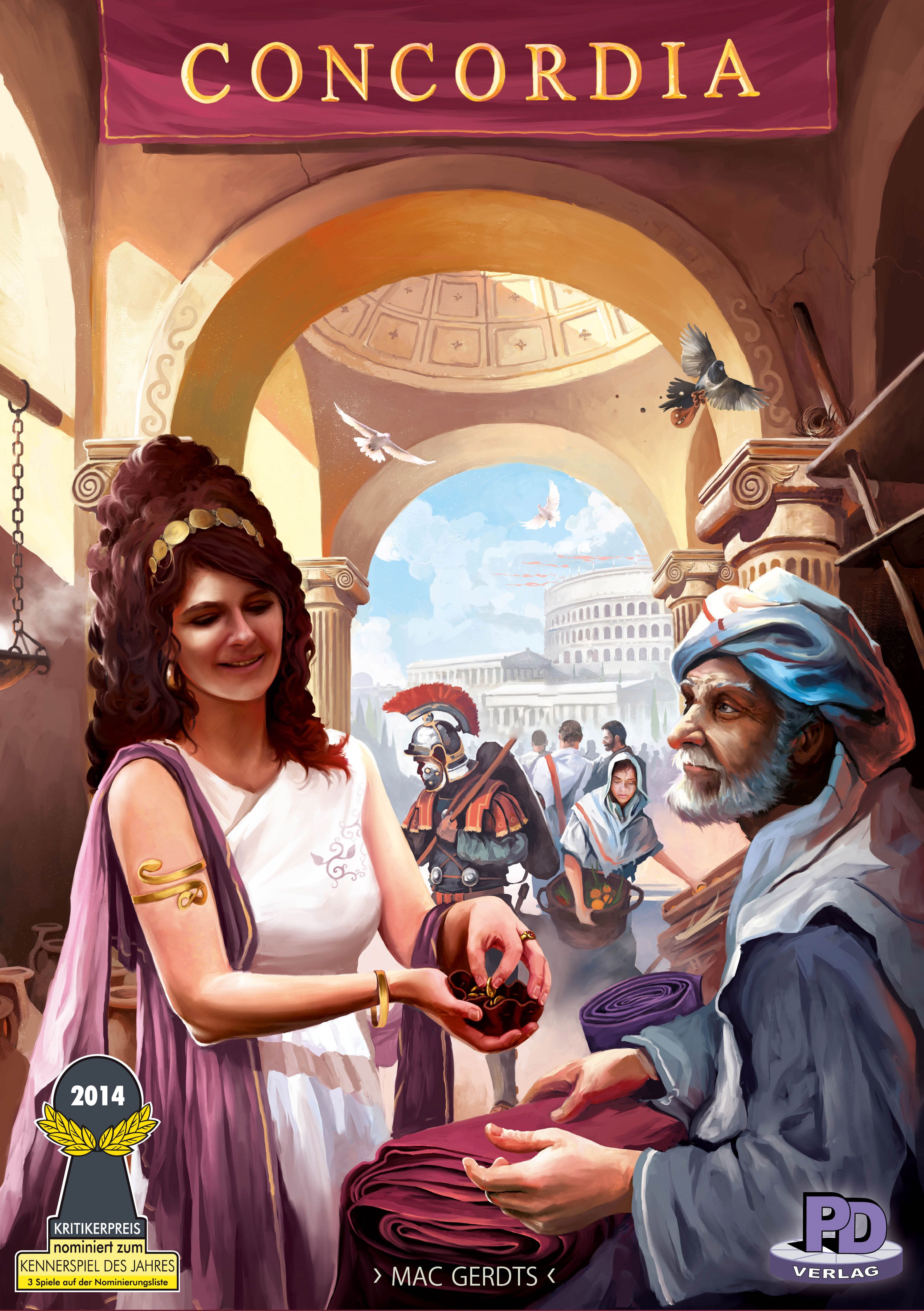
official art · PD-Verlag
the rules in 60 seconds▶ auto · 1/6
🧩
01
Setup
Place city tiles face down, match letters to the map, then flip them; place the most valuable good token for each province on the grid; each player gets a starting deck of personality cards, and the common deck is sorted, cut by player count, shuffled, and stacked; deal seven common personality cards to the board; each player chooses a color, fills their storehouse with specific goods and colonists, and takes 15 houses; determine the start player, who gets 5 sestertii, with subsequent players getting one more, and the last player receives the Praefectus Magnus card.
To set up Concordia, first, place all city tiles face down on their corresponding lettered spaces on the map. Then, flip all the city tiles face up. Next, for each province, identify the most valuable good produced there and place the corresponding good token on the designated space on the grid. Each player receives an identical starting deck of personality cards. The common deck of personality cards is sorted by Roman numeral, then cut down based on the number of players (e.g., for a three-player game, use stacks I, II, and III). Each Roman numeral stack is shuffled separately, and then piled with the highest-numbered stack at the bottom. Deal the top seven cards from this combined deck face-up onto the board. Each player chooses a color for their pieces and fills their storehouse with two land colonists, two sea colonists, two food, and one each of the remaining goods (brick, cloth, tool, wine). Each player also takes 15 houses in their chosen color. Randomly determine a start player, who receives 5 sestertii. Each subsequent player, moving clockwise around the table, receives one additional sestertius to start. The last player in turn order receives the Praefectus Magnus card.
Objective
The primary objective in Concordia is to accumulate the most victory points by the end of the game. Players achieve this by strategically expanding their Roman empire across the map, establishing colonies, producing and trading various goods, and acquiring a diverse set of personality cards. Each personality card, colonist, house, and type of good produced contributes to a player's final score, encouraging a balanced approach to empire building and resource management.
On your turn
During your turn, you must play one personality card from your hand. The card's action is immediately performed, allowing you to move colonists, produce goods, build houses, or gain money. After performing the action, the played card is placed face-up in your personal discard pile. You cannot play the same card two turns in a row unless you use the Tribune card to retrieve all your discarded cards back to your hand.
Scoring
Scoring in Concordia occurs only at the end of the game. Points are awarded based on the number of colonists you have on the board, the number of houses you've built, the variety of goods produced in your controlled cities, and the types of personality cards you have collected. Each personality card has a specific scoring condition tied to a Roman god, rewarding different aspects of your empire, such as the number of provinces you control, the number of specific goods you produce, or the number of colonists you have.
Game end
The game concludes when one of two conditions is met: either a player successfully builds their 15th and final house, or the last personality card is dealt from the common deck on the board. Once either of these conditions is triggered, the current round continues until all players have had an equal number of turns. After that, one final round is played, and then the game immediately ends, proceeding to final scoring.
Tips
To succeed in Concordia, it's crucial to develop a flexible strategy that adapts to the evolving board state and your opponents' actions. Prioritize building houses in provinces that produce goods you need or that offer valuable scoring opportunities. Don't underestimate the power of the Tribune card for refreshing your hand and optimizing your card plays. Also, pay close attention to the personality cards available for purchase, as they are key to maximizing your end-game victory points and can significantly influence your strategic direction.
🔬 game anatomy
Complexity3.0 / 5
BGG rating8.1 / 10
Vibe
Strategy
Language dependence
Moderate text — a crib sheet helps
Play time
100 min
Players
2–5
Recommended age
13+ yrs
BGG rank
#29
✨ from Trișache · verified
Frequently asked questions
Q1What is the goal of the game?
The primary objective in Concordia is to accumulate the most victory points by the end of the game. Players achieve this by strategically expanding their Roman empire across the map, establishing colonies, producing and trading various goods, and acquiring a diverse set of personality cards. Each personality card, colonist, house, and type of good produced contributes to a player's final score, encouraging a balanced approach to empire building and resource management.
Q2How do you set up the game?
To set up Concordia, first, place all city tiles face down on their corresponding lettered spaces on the map. Then, flip all the city tiles face up. Next, for each province, identify the most valuable good produced there and place the corresponding good token on the designated space on the grid. Each player receives an identical starting deck of personality cards. The common deck of personality cards is sorted by Roman numeral, then cut down based on the number of players (e.g., for a three-player game, use stacks I, II, and III). Each Roman numeral stack is shuffled separately, and then piled with the highest-numbered stack at the bottom. Deal the top seven cards from this combined deck face-up onto the board. Each player chooses a color for their pieces and fills their storehouse with two land colonists, two sea colonists, two food, and one each of the remaining goods (brick, cloth, tool, wine). Each player also takes 15 houses in their chosen color. Randomly determine a start player, who receives 5 sestertii. Each subsequent player, moving clockwise around the table, receives one additional sestertius to start. The last player in turn order receives the Praefectus Magnus card.
Q3How does a turn work?
During your turn, you must play one personality card from your hand. The card's action is immediately performed, allowing you to move colonists, produce goods, build houses, or gain money. After performing the action, the played card is placed face-up in your personal discard pile. You cannot play the same card two turns in a row unless you use the Tribune card to retrieve all your discarded cards back to your hand.
Q4How is scoring calculated?
Scoring in Concordia occurs only at the end of the game. Points are awarded based on the number of colonists you have on the board, the number of houses you've built, the variety of goods produced in your controlled cities, and the types of personality cards you have collected. Each personality card has a specific scoring condition tied to a Roman god, rewarding different aspects of your empire, such as the number of provinces you control, the number of specific goods you produce, or the number of colonists you have.
Q5When and how does the game end?
The game concludes when one of two conditions is met: either a player successfully builds their 15th and final house, or the last personality card is dealt from the common deck on the board. Once either of these conditions is triggered, the current round continues until all players have had an equal number of turns. After that, one final round is played, and then the game immediately ends, proceeding to final scoring.
Q6What tips are there for beginners?
To succeed in Concordia, it's crucial to develop a flexible strategy that adapts to the evolving board state and your opponents' actions. Prioritize building houses in provinces that produce goods you need or that offer valuable scoring opportunities. Don't underestimate the power of the Tribune card for refreshing your hand and optimizing your card plays. Also, pay close attention to the personality cards available for purchase, as they are key to maximizing your end-game victory points and can significantly influence your strategic direction.
Q7How much does Concordia cost?
Concordia costs between 199 and 224 RON across Romanian stores.
Q8Where can I buy Concordia cheapest?
The lowest price for Concordia right now is 199 RON at magazinuldesah.ro. The Prices tab lists every store currently tracking it.
Q9How do you play Concordia?
Concordia is a ancient game, for 2–5 players, taking ~100 minutes, featuring action retrieval. Check the Rules tab for setup, gameplay, and scoring, or ask Trișache anything about Concordia — our AI assistant built by howtoplay.ro and trained specifically on board game rulebooks.

%2Fpic3453267.jpg)
%2Fpic3453267.jpg)