The primary objective for the investigators is to correctly identify the murderer, the specific murder weapon, and the key piece of evidence used in the crime. The murderer's objective is to avoid detection by misleading the investigators. If an accomplice is present, they assist the murderer. If a witness is present, they know the murderer's identity and try to subtly guide the investigators without being too obvious.
To find the best price for Deception: Murder in Hong Kong, howtoplay.ro compares deals from Romanian shops every day.
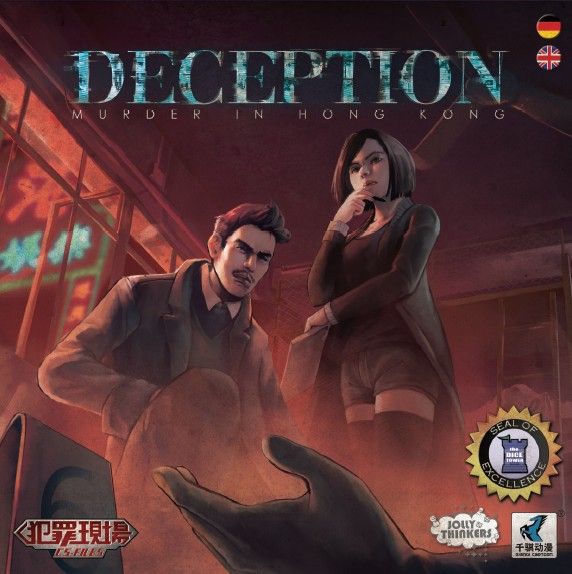
official art · Jolly Thinkers
the rules in 60 seconds▶ auto · 1/6
🧩
01
Setup
Players are assigned roles (forensic scientist, murderer, accomplice, witness, investigators) and receive four weapon and four evidence cards.
The rules, step by step
Setup
To set up the game, players are assigned secret roles: one forensic scientist, one murderer, and the rest are investigators. If playing with 6-10 players, an accomplice and a witness can be added as optional roles. Each investigator receives four weapon cards and four evidence cards, which are placed face-up in front of them. The forensic scientist receives special scene tiles and clue cards. The murderer secretly chooses one weapon and one evidence card from their hand as the murder weapon and key evidence.
Objective
The primary objective for the investigators is to correctly identify the murderer, the specific murder weapon, and the key piece of evidence used in the crime. The murderer's objective is to avoid detection by misleading the investigators. If an accomplice is present, they assist the murderer. If a witness is present, they know the murderer's identity and try to subtly guide the investigators without being too obvious.
On your turn
The game proceeds in rounds where the forensic scientist provides clues to the investigators. The forensic scientist uses special scene tiles, which have various categories (e.g., cause of death, location, situation), to give hints about the murder weapon and key evidence. They place markers on specific options on these tiles to guide the investigators. Investigators then discuss the clues, propose theories, and can use their badge token to make a formal accusation. The murderer and accomplice (if any) try to subtly steer the discussion away from the correct solution.
Scoring
Investigators win if one of them correctly identifies the murderer, the murder weapon, and the key evidence. If the accusation is correct, the murderer is exposed and the investigators celebrate their victory. The murderer wins if the investigators fail to make a correct accusation by the end of the game, or if they make two incorrect accusations, or if the witness is killed by the murderer.
Game end
The game ends in one of several ways: if an investigator makes a correct accusation, the investigators win. If an investigator makes an incorrect accusation, they are eliminated from making further accusations. If two incorrect accusations are made, the murderer wins. If the murderer is able to kill the witness (by correctly identifying them after being accused), the murderer wins. If all clues have been given and no correct accusation has been made, the murderer wins.
Tips
For the forensic scientist, it's crucial to choose clues that are helpful but not too obvious, balancing guidance with challenge. For the murderer, the key is to blend in and subtly misdirect, perhaps by agreeing with plausible but incorrect theories. Investigators should listen carefully to all discussions, consider all clues, and try to deduce the murderer's choices based on the forensic scientist's hints and the other players' cards. The witness must be extremely careful not to reveal their knowledge too overtly, as the murderer will try to identify and eliminate them.
🔬 game anatomy
Complexity1.6 / 5
BGG rating7.4 / 10
Vibe
Party
Language dependence
Moderate text — a crib sheet helps
Play time
20 min
Players
4–12
Recommended age
14+ yrs
BGG rank
#297
✨ from Trișache · verified
Frequently asked questions
Q1What is the goal of the game?
The primary objective for the investigators is to correctly identify the murderer, the specific murder weapon, and the key piece of evidence used in the crime. The murderer's objective is to avoid detection by misleading the investigators. If an accomplice is present, they assist the murderer. If a witness is present, they know the murderer's identity and try to subtly guide the investigators without being too obvious.
Q2How do you set up the game?
To set up the game, players are assigned secret roles: one forensic scientist, one murderer, and the rest are investigators. If playing with 6-10 players, an accomplice and a witness can be added as optional roles. Each investigator receives four weapon cards and four evidence cards, which are placed face-up in front of them. The forensic scientist receives special scene tiles and clue cards. The murderer secretly chooses one weapon and one evidence card from their hand as the murder weapon and key evidence.
Q3How does a turn work?
The game proceeds in rounds where the forensic scientist provides clues to the investigators. The forensic scientist uses special scene tiles, which have various categories (e.g., cause of death, location, situation), to give hints about the murder weapon and key evidence. They place markers on specific options on these tiles to guide the investigators. Investigators then discuss the clues, propose theories, and can use their badge token to make a formal accusation. The murderer and accomplice (if any) try to subtly steer the discussion away from the correct solution.
Q4How is scoring calculated?
Investigators win if one of them correctly identifies the murderer, the murder weapon, and the key evidence. If the accusation is correct, the murderer is exposed and the investigators celebrate their victory. The murderer wins if the investigators fail to make a correct accusation by the end of the game, or if they make two incorrect accusations, or if the witness is killed by the murderer.
Q5When and how does the game end?
The game ends in one of several ways: if an investigator makes a correct accusation, the investigators win. If an investigator makes an incorrect accusation, they are eliminated from making further accusations. If two incorrect accusations are made, the murderer wins. If the murderer is able to kill the witness (by correctly identifying them after being accused), the murderer wins. If all clues have been given and no correct accusation has been made, the murderer wins.
Q6What tips are there for beginners?
For the forensic scientist, it's crucial to choose clues that are helpful but not too obvious, balancing guidance with challenge. For the murderer, the key is to blend in and subtly misdirect, perhaps by agreeing with plausible but incorrect theories. Investigators should listen carefully to all discussions, consider all clues, and try to deduce the murderer's choices based on the forensic scientist's hints and the other players' cards. The witness must be extremely careful not to reveal their knowledge too overtly, as the murderer will try to identify and eliminate them.
Q7How much does Deception: Murder in Hong Kong cost?
No store is currently tracking Deception: Murder in Hong Kong. Check the Prices tab — you can set a price alert to be notified when it appears.
Q8Where can I buy Deception: Murder in Hong Kong cheapest?
Check the Prices tab — howtoplay.ro aggregates offers from 7+ Romanian board-game stores and tracks price history.
Q9How do you play Deception: Murder in Hong Kong?
Deception: Murder in Hong Kong is a bluffing game, for 4–12 players, taking ~20 minutes, featuring communication limits. Check the Rules tab for setup, gameplay, and scoring, or ask Trișache anything about Deception: Murder in Hong Kong — our AI assistant built by howtoplay.ro and trained specifically on board game rulebooks.
Q10How many players does Deception: Murder in Hong Kong support?
Deception: Murder in Hong Kong is played by 4–12 players.
💰 1 shop
All prices
1 shop · sorted by priceupdated today
Regatul JocuriloreasyboxCultural voucher
CS Files aka Deception: Murder in Hong Kong (EN/DE Edition)
%2Fpic3033330.jpg)
%2Fpic3033330.jpg)