Prices updated today
%2Fpic8082062.png)
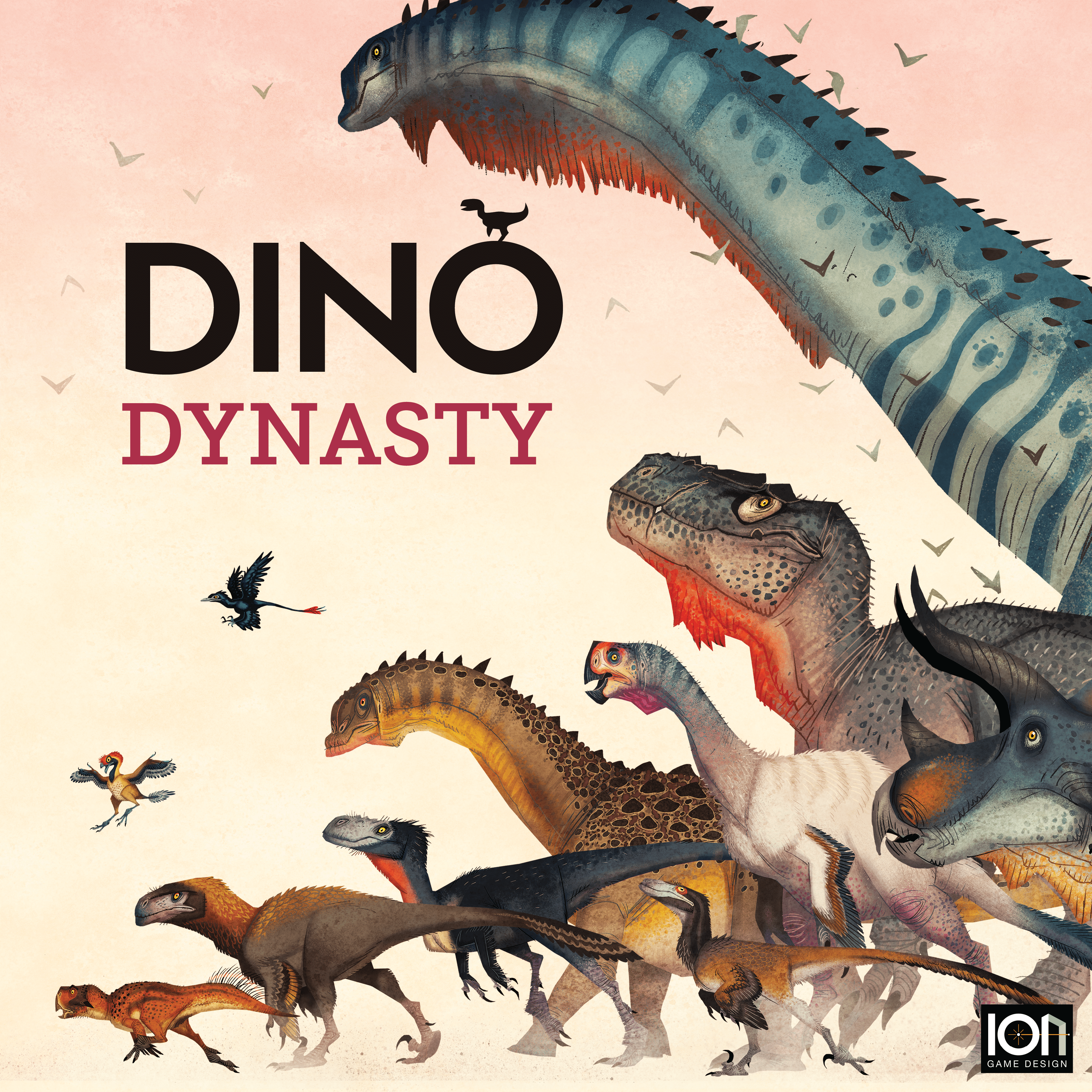
Dino Dynasty
Ion Game Design · 2025
1–630–60 min10+ yrs3.0/5 complexity6.7 BGG#16.721 BGG217Strategy
⚡ short answer
How do you play Dino Dynasty?
The objective of Dino Dynasty is to survive the prehistoric world and complete the most challenges by the end of the game. Players take on the role of a dinosaur from one of six dynasties, striving to outlast their rivals and adapt to the changing environment.
To find the best price for Dino Dynasty, howtoplay.ro compares deals from Romanian shops every day.
%2Fpic8082062.png)
the rules in 60 seconds▶ auto · 1/6
🧩
01
Setup
Players select a Dino board, place eggs and Dino meeples, set up map tiles, draw challenge cards, place morph tokens, determine the scenario, and place border and ocean tiles.
The rules, step by step
Setup
To set up Dino Dynasty, first determine the start player (the last player to read, watch, or listen to something dinosaur-related). Then, in player order, each player selects a Dino board, places the indicated number of eggs and Dino meeples on their board, and places evolve markers and action frames on their respective cross-sections. Next, separate the growing event tiles (those with a stone in the middle), shuffle them, and place them next to the main play area. Set aside the four ocean tiles, then shuffle the remaining map tiles and stack them in four equal stacks next to the growing events. Draw a number of challenge cards equal to the number of players plus one, and one more for a tie-breaker, placing them next to the play area. Shuffle the game-end cards and stack them next to the play area. Place all morph tokens in a bag. Decide the scenario by determining the map size (A through E) and randomly choosing a scenario card of that size. Set up the border using the border tiles and place the ocean tiles where indicated by wave spots. Finally, players take turns placing starting map tiles: choose to place a free territory tile (T), a biome event tile (E) where you roll the compete die for morph tiles, or a free starting tile (question mark) to place your starting herd in one of the biomes on that tile.
Objective
The objective of Dino Dynasty is to survive the prehistoric world and complete the most challenges by the end of the game. Players take on the role of a dinosaur from one of six dynasties, striving to outlast their rivals and adapt to the changing environment.
On your turn
A player's turn consists of four steps. Step 1: Hatch any eggs on your board. Step 2: Choose one of four main actions: Migrate (optionally draw and place a tile, then optionally move one herd one step; if a map tile was placed, the herd must move onto it; if an event is revealed, roll the biome die and resolve it). Spread (add Dinos to an existing herd or eggs one step away from your herd). Compete (move one herd one step into a rival biome and attack their herd or nest; nest eggs are stomped and returned to the player; for herds, compare power, which is herd size + compete action modification number + two compete dice rolls; the loser removes Dinos equal to the difference). Evolve (move one evolve marker one step, changing two linked action frames to their cross-sections). You must have a herd in a biome matching your action frame to take an action. Step 3: Get a morph tile if you are in a biome with a morph tile you can take. Step 4: Coexist (remove one Dino if you have a herd in a rival biome and did not compete).
Scoring
The player who successfully completes the most challenges by the end of the game is declared the winner of Dino Dynasty. Challenges are drawn at the beginning of the game and provide objectives for players to work towards throughout play.
Game end
The game concludes when the map is completely filled with tiles. At this point, a game-end condition card is drawn, and player turns continue until the specified condition on that card is met. Once the game-end condition is fulfilled, the game immediately ends, and players proceed to final scoring to determine the winner based on completed challenges.
Tips
When taking actions, always remember to check for any applicable action modifiers that may alter the outcome or cost of your chosen action. When placing map tiles, they must connect to at least one existing biome, unless the tile contains water, in which case it acts as a wild connection. If your dinosaur goes extinct, you will start over on your next turn by placing a new herd in an empty biome on the map. For permanent event effects like Floodplains, Dinos can always evolve with a herd. For Tundra, herds cannot use 'spread' and nests cannot spread. For Deserts, you can have a herd size equal to your starting herd size; if the current herd doesn't spread outside the biome, they reduce to their starting herd size. For one-time event effects like Craters, if you cannot flee, all Dinos and nests in the center and eight surrounding tiles are destroyed, and the eight surrounding tiles are flipped and adjusted by the active player. For Mountains, all nests and half of the Dinos that can't flee are destroyed, and the diagonal tiles are flipped. For Volcanoes, all nests and half of the Dinos that can't flee are destroyed, and the orthogonal tiles are flipped and oriented by the active player. When revealing an event card, follow four steps: 1) Placement (roll biome dice and place on a matching biome, discard if none exist). 2) Effect (resolve permanent or one-time effects). 3) Morph (roll one compete die and place morph tokens equal to the number of Dinos). 4) Aftermath (roll the aftermath dice and carry out its effect). Morph tokens must match the type and be less than or equal to your Dino's size to collect the ability.
game anatomy
Complexity3.0 / 5
BGG rating6.7 / 10
Vibe
Strategy
Play time
30–60 min
Players
1–6
Recommended age
10+ yrs
BGG rank
#16.721
from Trișache · verified
Frequently asked questions
Q1What is the goal of the game?
The objective of Dino Dynasty is to survive the prehistoric world and complete the most challenges by the end of the game. Players take on the role of a dinosaur from one of six dynasties, striving to outlast their rivals and adapt to the changing environment.
Q2How do you set up the game?
To set up Dino Dynasty, first determine the start player (the last player to read, watch, or listen to something dinosaur-related). Then, in player order, each player selects a Dino board, places the indicated number of eggs and Dino meeples on their board, and places evolve markers and action frames on their respective cross-sections. Next, separate the growing event tiles (those with a stone in the middle), shuffle them, and place them next to the main play area. Set aside the four ocean tiles, then shuffle the remaining map tiles and stack them in four equal stacks next to the growing events. Draw a number of challenge cards equal to the number of players plus one, and one more for a tie-breaker, placing them next to the play area. Shuffle the game-end cards and stack them next to the play area. Place all morph tokens in a bag. Decide the scenario by determining the map size (A through E) and randomly choosing a scenario card of that size. Set up the border using the border tiles and place the ocean tiles where indicated by wave spots. Finally, players take turns placing starting map tiles: choose to place a free territory tile (T), a biome event tile (E) where you roll the compete die for morph tiles, or a free starting tile (question mark) to place your starting herd in one of the biomes on that tile.
Q3How does a turn work?
A player's turn consists of four steps. Step 1: Hatch any eggs on your board. Step 2: Choose one of four main actions: Migrate (optionally draw and place a tile, then optionally move one herd one step; if a map tile was placed, the herd must move onto it; if an event is revealed, roll the biome die and resolve it). Spread (add Dinos to an existing herd or eggs one step away from your herd). Compete (move one herd one step into a rival biome and attack their herd or nest; nest eggs are stomped and returned to the player; for herds, compare power, which is herd size + compete action modification number + two compete dice rolls; the loser removes Dinos equal to the difference). Evolve (move one evolve marker one step, changing two linked action frames to their cross-sections). You must have a herd in a biome matching your action frame to take an action. Step 3: Get a morph tile if you are in a biome with a morph tile you can take. Step 4: Coexist (remove one Dino if you have a herd in a rival biome and did not compete).
Q4How is scoring calculated?
The player who successfully completes the most challenges by the end of the game is declared the winner of Dino Dynasty. Challenges are drawn at the beginning of the game and provide objectives for players to work towards throughout play.
Q5When and how does the game end?
The game concludes when the map is completely filled with tiles. At this point, a game-end condition card is drawn, and player turns continue until the specified condition on that card is met. Once the game-end condition is fulfilled, the game immediately ends, and players proceed to final scoring to determine the winner based on completed challenges.
Q6What tips are there for beginners?
When taking actions, always remember to check for any applicable action modifiers that may alter the outcome or cost of your chosen action. When placing map tiles, they must connect to at least one existing biome, unless the tile contains water, in which case it acts as a wild connection. If your dinosaur goes extinct, you will start over on your next turn by placing a new herd in an empty biome on the map. For permanent event effects like Floodplains, Dinos can always evolve with a herd. For Tundra, herds cannot use 'spread' and nests cannot spread. For Deserts, you can have a herd size equal to your starting herd size; if the current herd doesn't spread outside the biome, they reduce to their starting herd size. For one-time event effects like Craters, if you cannot flee, all Dinos and nests in the center and eight surrounding tiles are destroyed, and the eight surrounding tiles are flipped and adjusted by the active player. For Mountains, all nests and half of the Dinos that can't flee are destroyed, and the diagonal tiles are flipped. For Volcanoes, all nests and half of the Dinos that can't flee are destroyed, and the orthogonal tiles are flipped and oriented by the active player. When revealing an event card, follow four steps: 1) Placement (roll biome dice and place on a matching biome, discard if none exist). 2) Effect (resolve permanent or one-time effects). 3) Morph (roll one compete die and place morph tokens equal to the number of Dinos). 4) Aftermath (roll the aftermath dice and carry out its effect). Morph tokens must match the type and be less than or equal to your Dino's size to collect the ability.
Q7How much does Dino Dynasty cost?
No store is currently tracking Dino Dynasty. Check the Prices tab — you can set a price alert to be notified when it appears.
Q8Where can I buy Dino Dynasty cheapest?
Check the Prices tab — howtoplay.ro aggregates offers from 7+ Romanian board-game stores and tracks price history.
Q9How do you play Dino Dynasty?
Dino Dynasty is a exploration game, for 1–6 players, taking ~30–60 minutes, featuring scenario / mission / campaign game. Check the Rules tab for setup, gameplay, and scoring, or ask Trișache anything about Dino Dynasty — our AI assistant built by howtoplay.ro and trained specifically on board game rulebooks.
Q10How many players does Dino Dynasty support?
Dino Dynasty is played by 1–6 players.
1 shop
All prices
1 shop · sorted by priceupdated today
Regatul JocurilorEnglish editioneasyboxCultural voucher
Dino Dynasty (English Edition)
○ out of stock
RON 299
Buy →out of stock
affiliate links · prices include VAT · independent platform, no hidden sponsorships
Currently unavailable in all shops
Price history
See price by edition
Price trend over the last 90 days: minimum 299 lei, maximum 299 lei, now 299 lei.
Mechanics & categories