The objective of Evergreen is to cultivate the most thriving ecosystem on your planet. Players achieve this by strategically planting sprouts and growing them into small and big trees. Capturing sunlight with your trees, building large, interconnected forests, and growing big trees in the most fertile regions are key to accumulating the most points by the end of the game. The player with the highest total score after four seasons will be declared the winner.
To find the best price for Evergreen, howtoplay.ro compares deals from Romanian shops every day.
FromRON 209· 4 shops
🔥All-time low-8% vs 90-day avg
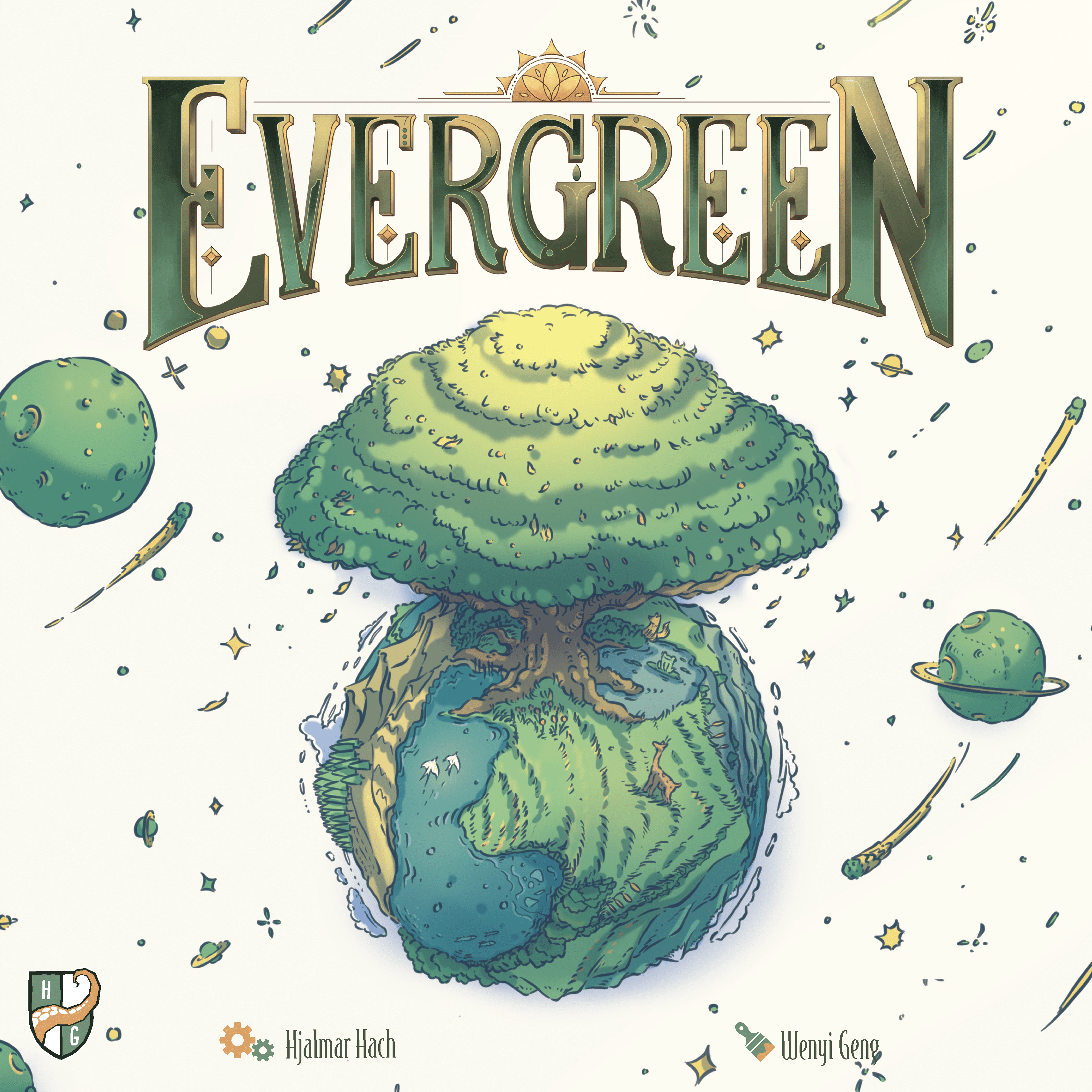
official art · Horrible Guild
the rules in 60 seconds▶ auto · 1/6
🧩
01
Setup
Each player gets a planet board, places cylinders on power and season tracks, and a sun marker; then, biome cards are revealed until at least five fertility icons are visible, stacked by type, and the remaining cards are shuffled into a deck.
Each player receives a planet board. Place one cylinder into each colored space on the board, one at the start of each power track at the top, one on zero points at the top of the planet, and one at the 50-point increment tracker to the right. The final cylinder goes at the top of the season track in the bottom left. Each player places a sun marker in the recess at the top of their board. A random start player is chosen and given the leaf token, starting with zero points, while subsequent players clockwise receive 1, 2, or 3 points respectively. Shuffle the biome cards and reveal them one at a time into the fertility zone until at least five fertility icons are showing, stacking cards by biome type with fertility icons visible. Shuffle any remaining cards without fertility symbols back into the deck.
Objective
The objective of Evergreen is to cultivate the most thriving ecosystem on your planet. Players achieve this by strategically planting sprouts and growing them into small and big trees. Capturing sunlight with your trees, building large, interconnected forests, and growing big trees in the most fertile regions are key to accumulating the most points by the end of the game. The player with the highest total score after four seasons will be declared the winner.
On your turn
Gameplay is divided into four seasons, each with a decreasing number of rounds, and played over three phases: Draft, Power and Actions, and Cleanup. In the Draft phase, biome cards equal to one more than the number of players are laid out. Players, starting with the first player, draft one card, keeping it face-up next to their board. The first player token is placed on the leftmost available card, and the player who takes it becomes the first player for the next round. If an undrafted card has fertility icons, it's added to the relevant biome in the fertility zone. If it has an aridity symbol, the last card in that biome is flipped face-down and added on top. If neither icon is present, the card is discarded. A promo wild card with fertility symbols allows the player who last picked a card to choose its biome. In the Power and Actions phase, players simultaneously perform one action (plant sprouts, grow trees) matching their drafted card's biome (wild cards match any biome) and activate the power shown on the bottom of their drafted card. Actions must be in different spaces, but powers can affect the same space as an action. Powers include planting sprouts, growing sprouts to small trees, growing small trees to big trees, placing lakes (followed by two generic growths on adjacent orthogonal spaces), placing bushes, or gaining points.
Scoring
At the end of each season, players first collect light. Trees collect light from the direction of the sun (top to bottom in the first season). Small trees hit by light collect 1 point, and big trees collect 2 points. Small trees cast a shadow of one space, and big trees cast a shadow of two spaces, blocking light for trees of the same height or smaller. Trees in a shadow do not gain points unless they are taller than the tree casting the shadow. Crevice spaces count as a space when calculating shadows but cannot hold pieces. After scoring light, players score for their biggest forest. Identify the largest area of orthogonally adjacent connected trees and bushes on your planet and score 1 point for each tree and bush within that area.
Game end
After all players have completed their actions and powers, the end-of-round cleanup begins. Players count how many cards they have drafted this season. If it's less than the number shown for the current season on the season track, play continues with a new round. If players have drafted and played an equal number of cards for the season, the season ends. Players then proceed to the end-of-season actions: collecting light and scoring for their biggest forest. After scoring, the season changes by moving the season track marker to the next season, and the sun marker is moved clockwise to the next edge of the board. Players discard the biome cards they drafted this season. The game ends after the fourth season. For additional end-game scoring, players score points for the number of big trees in each biome, multiplied by the number of fertility symbols on the cards in the fertility zone for that biome. The player with the most points wins, with ties broken by the current turn order.
Tips
To maximize your score, strategically choose biome cards that align with your planet's development and the current season's sunlight direction. Plan your tree placements carefully to ensure they receive sunlight and avoid being shadowed by other trees. Focus on creating large, interconnected forests to gain significant points at the end of each season. Prioritize growing big trees in biomes with many fertility symbols, as these will yield substantial end-game points. Remember that powers can be used flexibly across any biome, allowing you to adapt to changing conditions on your planet.
🔬 game anatomy
Complexity2.1 / 5
BGG rating7.5 / 10
Vibe
CouplesFamily
Language dependence
No in-game text needed
🌐 plays without English
Play time
45 min
Players
1–4
Recommended age
8+ yrs
BGG rank
#839
✨ from Trișache · verified
Frequently asked questions
Q1What is the goal of the game?
The objective of Evergreen is to cultivate the most thriving ecosystem on your planet. Players achieve this by strategically planting sprouts and growing them into small and big trees. Capturing sunlight with your trees, building large, interconnected forests, and growing big trees in the most fertile regions are key to accumulating the most points by the end of the game. The player with the highest total score after four seasons will be declared the winner.
Q2How do you set up the game?
Each player receives a planet board. Place one cylinder into each colored space on the board, one at the start of each power track at the top, one on zero points at the top of the planet, and one at the 50-point increment tracker to the right. The final cylinder goes at the top of the season track in the bottom left. Each player places a sun marker in the recess at the top of their board. A random start player is chosen and given the leaf token, starting with zero points, while subsequent players clockwise receive 1, 2, or 3 points respectively. Shuffle the biome cards and reveal them one at a time into the fertility zone until at least five fertility icons are showing, stacking cards by biome type with fertility icons visible. Shuffle any remaining cards without fertility symbols back into the deck.
Q3How does a turn work?
Gameplay is divided into four seasons, each with a decreasing number of rounds, and played over three phases: Draft, Power and Actions, and Cleanup. In the Draft phase, biome cards equal to one more than the number of players are laid out. Players, starting with the first player, draft one card, keeping it face-up next to their board. The first player token is placed on the leftmost available card, and the player who takes it becomes the first player for the next round. If an undrafted card has fertility icons, it's added to the relevant biome in the fertility zone. If it has an aridity symbol, the last card in that biome is flipped face-down and added on top. If neither icon is present, the card is discarded. A promo wild card with fertility symbols allows the player who last picked a card to choose its biome. In the Power and Actions phase, players simultaneously perform one action (plant sprouts, grow trees) matching their drafted card's biome (wild cards match any biome) and activate the power shown on the bottom of their drafted card. Actions must be in different spaces, but powers can affect the same space as an action. Powers include planting sprouts, growing sprouts to small trees, growing small trees to big trees, placing lakes (followed by two generic growths on adjacent orthogonal spaces), placing bushes, or gaining points.
Q4How is scoring calculated?
At the end of each season, players first collect light. Trees collect light from the direction of the sun (top to bottom in the first season). Small trees hit by light collect 1 point, and big trees collect 2 points. Small trees cast a shadow of one space, and big trees cast a shadow of two spaces, blocking light for trees of the same height or smaller. Trees in a shadow do not gain points unless they are taller than the tree casting the shadow. Crevice spaces count as a space when calculating shadows but cannot hold pieces. After scoring light, players score for their biggest forest. Identify the largest area of orthogonally adjacent connected trees and bushes on your planet and score 1 point for each tree and bush within that area.
Q5When and how does the game end?
After all players have completed their actions and powers, the end-of-round cleanup begins. Players count how many cards they have drafted this season. If it's less than the number shown for the current season on the season track, play continues with a new round. If players have drafted and played an equal number of cards for the season, the season ends. Players then proceed to the end-of-season actions: collecting light and scoring for their biggest forest. After scoring, the season changes by moving the season track marker to the next season, and the sun marker is moved clockwise to the next edge of the board. Players discard the biome cards they drafted this season. The game ends after the fourth season. For additional end-game scoring, players score points for the number of big trees in each biome, multiplied by the number of fertility symbols on the cards in the fertility zone for that biome. The player with the most points wins, with ties broken by the current turn order.
Q6What tips are there for beginners?
To maximize your score, strategically choose biome cards that align with your planet's development and the current season's sunlight direction. Plan your tree placements carefully to ensure they receive sunlight and avoid being shadowed by other trees. Focus on creating large, interconnected forests to gain significant points at the end of each season. Prioritize growing big trees in biomes with many fertility symbols, as these will yield substantial end-game points. Remember that powers can be used flexibly across any biome, allowing you to adapt to changing conditions on your planet.
Q7How much does Evergreen cost?
Evergreen costs between 209 and 279 RON across Romanian stores.
Q8Where can I buy Evergreen cheapest?
The lowest price for Evergreen right now is 209 RON at Regatul Jocurilor. The Prices tab lists every store currently tracking it.
Q9How do you play Evergreen?
Evergreen is a environmental game, for 1–4 players, taking ~45 minutes, featuring bias. Check the Rules tab for setup, gameplay, and scoring, or ask Trișache anything about Evergreen — our AI assistant built by howtoplay.ro and trained specifically on board game rulebooks.

%2Fpic6872745.png)
%2Fpic6872745.png)