Prices updated today
%2Fpic9225193.png)
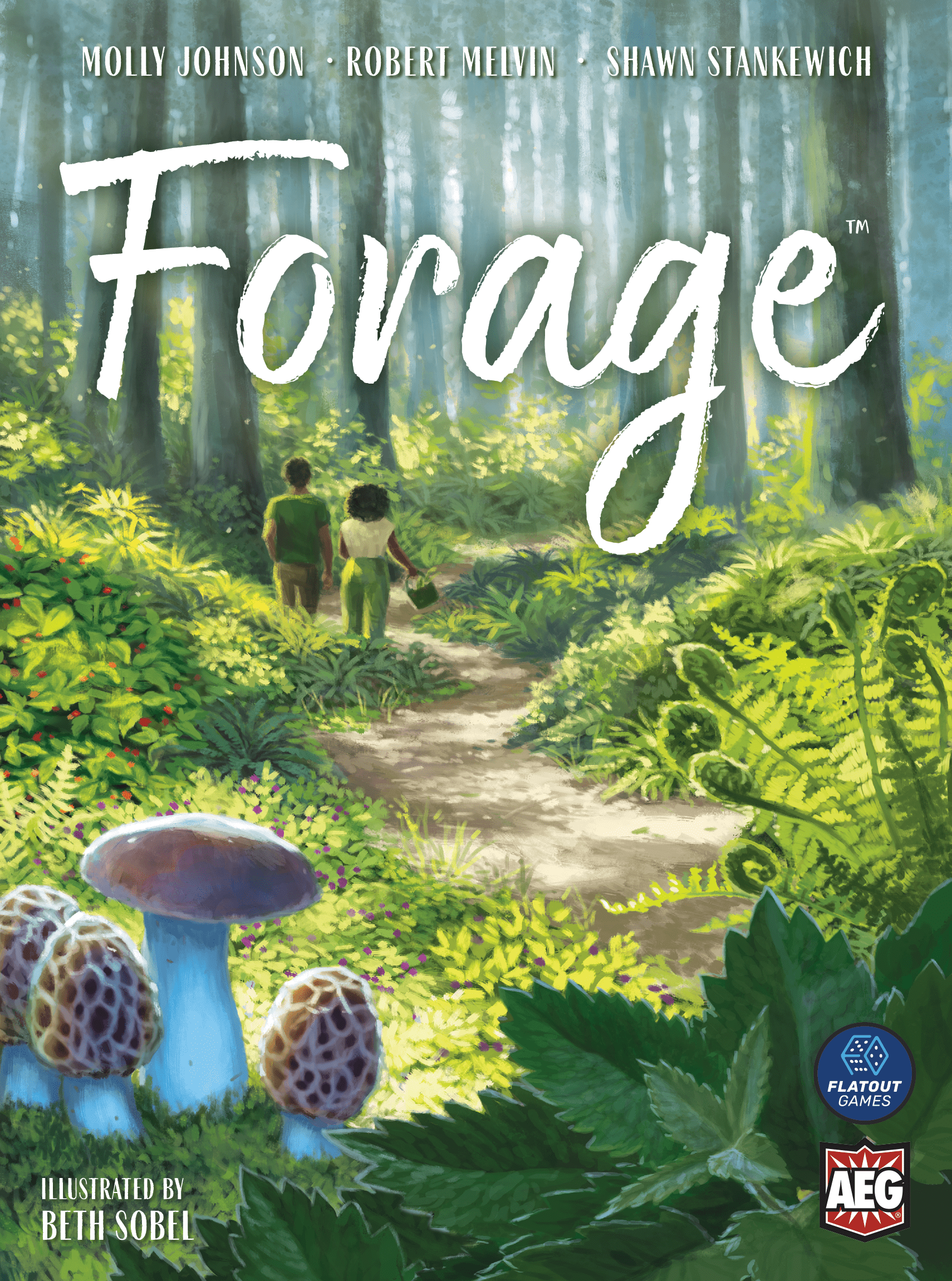
Forage
Flatout Games · 2026
1–615–30 min10+ yrs2.1/5 complexity7.3 BGG#7.590 BGG1,3 KFamily
⚡ short answer
How do you play Forage?
In Forage, players take on the role of foragers exploring the Pacific Northwest wilderness. The objective is to earn the most prestige points over 13 rounds by strategically collecting resources, completing foraging cards, achieving goals, and embarking on journeys. Players will use dice to perform actions, manage their time, and build combos to maximize their point-earning potential.
To find the best price for Forage, howtoplay.ro compares deals from Romanian shops every day.
FromRON 129
%2Fpic9225193.png)
the rules in 60 seconds▶ auto · 1/6
🧩
01
Setup
Each player gets a dry-erase marker, time tracker, scoring card, and one of each starter foraging card (exploration, gift-giving, pantry) to form their tableau.
The rules, step by step
Setup
To set up, each player receives a dry-erase marker, a time tracker card, and a scoring card. Players also receive one random starter foraging card of each type (exploration, gift-giving, and pantry) and arrange them into a tableau in front of themselves. The remaining foraging cards are shuffled into three separate face-down piles (pantry, gift-giving, exploration) in the center of the play area. The foraging basket card, seven regular forging dice, and one special forging die are placed below these piles. Three goal cards are drawn and placed face-up, using their A-sides for a first game. Three starter journey tiles are drawn and placed face-up adjacent to the goal cards. Ten regular journey tiles are shuffled and arranged face-down to form a trail, and three final round journey tiles are shuffled and placed face-down at the end of this trail. Any unused journey tiles are returned to the box.
Objective
In Forage, players take on the role of foragers exploring the Pacific Northwest wilderness. The objective is to earn the most prestige points over 13 rounds by strategically collecting resources, completing foraging cards, achieving goals, and embarking on journeys. Players will use dice to perform actions, manage their time, and build combos to maximize their point-earning potential.
On your turn
Each round consists of three phases: Roll & Walk, Dice Actions, and Round End. In Roll & Walk, all eight forging dice are rolled; the special die is placed on the foraging basket card, matching dice are grouped below the pantry pile, and non-matching dice are grouped below the exploration pile. A new journey tile is revealed and placed in the journey area. In Dice Actions, all players simultaneously choose one of three actions: Store (use matching dice to fill jars on pantry cards), Explore (use non-matching dice to cross off forgeables on exploration cards), or Gift (use any dice to complete items on gift-giving cards). Players can spend time tokens to enhance actions or take additional actions. After actions, players draft one new foraging card face-down. In Round End, any journey tiles used this round are discarded, earned goal card prestige points are crossed off, and drafted cards are revealed and added to the player's tableau or discarded for time.
Scoring
Prestige points are tallied at the end of the game. Points are earned from: completed goal cards (based on completion order), prestige points gained from journey tiles, completed gift-giving cards (based on their scoring conditions), items checked off on incomplete gift-giving cards, and points from pantry and exploration cards. For experience and knowledge icons, players score five points per pair and one point for any unpaired icon. The player with the highest total prestige points wins. In case of a tie, the player with the most remaining unspent time wins; if still tied, victory is shared.
Game end
The game concludes after 13 rounds. In the final round, players skip the Round End phase and proceed directly to scoring. Players tally their prestige points from various sources: goal cards, journey tiles, gift-giving cards (both completed and incomplete), pantry cards, and exploration cards. The player who has accumulated the highest total prestige points is declared the winner. If there's a tie in prestige points, the tied player with the most remaining unspent time tokens wins. If a tie still persists, the tied players share the victory.
Tips
Players can spend time tokens from their time log to modify dice actions (e.g., gaining an additional die of any type) or to take an additional dice action. Completing rows and columns on pantry cards or surrounding areas on exploration cards grants immediate bonuses, which must be used right away. Strategically choosing which foraging cards to draft is crucial, as they expand your tableau and provide new opportunities for combos and points. In solo mode, goal card points are awarded based on the current round number, encouraging faster completion. The rulebook also contains a list of achievements for players to strive for.
game anatomy
Complexity2.1 / 5
BGG rating7.3 / 10
Vibe
Family
Language dependence
Some text — easily memorized
Play time
15–30 min
Players
1–6
Recommended age
10+ yrs
BGG rank
#7.590
from Trișache · verified
Frequently asked questions
Q1What is the goal of the game?
In Forage, players take on the role of foragers exploring the Pacific Northwest wilderness. The objective is to earn the most prestige points over 13 rounds by strategically collecting resources, completing foraging cards, achieving goals, and embarking on journeys. Players will use dice to perform actions, manage their time, and build combos to maximize their point-earning potential.
Q2How do you set up the game?
To set up, each player receives a dry-erase marker, a time tracker card, and a scoring card. Players also receive one random starter foraging card of each type (exploration, gift-giving, and pantry) and arrange them into a tableau in front of themselves. The remaining foraging cards are shuffled into three separate face-down piles (pantry, gift-giving, exploration) in the center of the play area. The foraging basket card, seven regular forging dice, and one special forging die are placed below these piles. Three goal cards are drawn and placed face-up, using their A-sides for a first game. Three starter journey tiles are drawn and placed face-up adjacent to the goal cards. Ten regular journey tiles are shuffled and arranged face-down to form a trail, and three final round journey tiles are shuffled and placed face-down at the end of this trail. Any unused journey tiles are returned to the box.
Q3How does a turn work?
Each round consists of three phases: Roll & Walk, Dice Actions, and Round End. In Roll & Walk, all eight forging dice are rolled; the special die is placed on the foraging basket card, matching dice are grouped below the pantry pile, and non-matching dice are grouped below the exploration pile. A new journey tile is revealed and placed in the journey area. In Dice Actions, all players simultaneously choose one of three actions: Store (use matching dice to fill jars on pantry cards), Explore (use non-matching dice to cross off forgeables on exploration cards), or Gift (use any dice to complete items on gift-giving cards). Players can spend time tokens to enhance actions or take additional actions. After actions, players draft one new foraging card face-down. In Round End, any journey tiles used this round are discarded, earned goal card prestige points are crossed off, and drafted cards are revealed and added to the player's tableau or discarded for time.
Q4How is scoring calculated?
Prestige points are tallied at the end of the game. Points are earned from: completed goal cards (based on completion order), prestige points gained from journey tiles, completed gift-giving cards (based on their scoring conditions), items checked off on incomplete gift-giving cards, and points from pantry and exploration cards. For experience and knowledge icons, players score five points per pair and one point for any unpaired icon. The player with the highest total prestige points wins. In case of a tie, the player with the most remaining unspent time wins; if still tied, victory is shared.
Q5When and how does the game end?
The game concludes after 13 rounds. In the final round, players skip the Round End phase and proceed directly to scoring. Players tally their prestige points from various sources: goal cards, journey tiles, gift-giving cards (both completed and incomplete), pantry cards, and exploration cards. The player who has accumulated the highest total prestige points is declared the winner. If there's a tie in prestige points, the tied player with the most remaining unspent time tokens wins. If a tie still persists, the tied players share the victory.
Q6What tips are there for beginners?
Players can spend time tokens from their time log to modify dice actions (e.g., gaining an additional die of any type) or to take an additional dice action. Completing rows and columns on pantry cards or surrounding areas on exploration cards grants immediate bonuses, which must be used right away. Strategically choosing which foraging cards to draft is crucial, as they expand your tableau and provide new opportunities for combos and points. In solo mode, goal card points are awarded based on the current round number, encouraging faster completion. The rulebook also contains a list of achievements for players to strive for.
Q7How much does Forage cost?
Forage costs around 129 RON in Romania.
Q8Where can I buy Forage cheapest?
The lowest price for Forage right now is 129 RON at Pionul.ro. The Prices tab lists every store currently tracking it.
Q9How do you play Forage?
Forage is a card game game, for 1–6 players, taking ~15–30 minutes, featuring action drafting. Check the Rules tab for setup, gameplay, and scoring, or ask Trișache anything about Forage — our AI assistant built by howtoplay.ro and trained specifically on board game rulebooks.
Q10How many players does Forage support?
Forage is played by 1–6 players.
2 shops
All prices
2 shops · sorted by priceupdated today
Regatul JocurilorKickstarter (EN)easyboxCultural voucher
Forage (2026 Kickstarter English Edition)
○ out of stock
RON 119
Buy →out of stock
affiliate links · prices include VAT · independent platform, no hidden sponsorships
🚚 Free shipping over RON 250
Price history
See price by edition
Price trend over the last 90 days: minimum 119 lei, maximum 129 lei, now 129 lei.
Mechanics & categories