The primary objective in Free Market: NYC is to accumulate the most wealth by the end of the game. This is achieved through a combination of strategic buying and selling of goods, establishing profitable partnerships with factories and shops, and influencing politicians to gain advantages. Players must also manage their workforce and transportation effectively, while navigating market fluctuations and potential strikes or roadblocks. Ultimately, the player with the highest total value from money, goods, and successful ventures wins.
To find the best price for Free Market: NYC, howtoplay.ro compares deals from Romanian shops every day.
FromRON 179
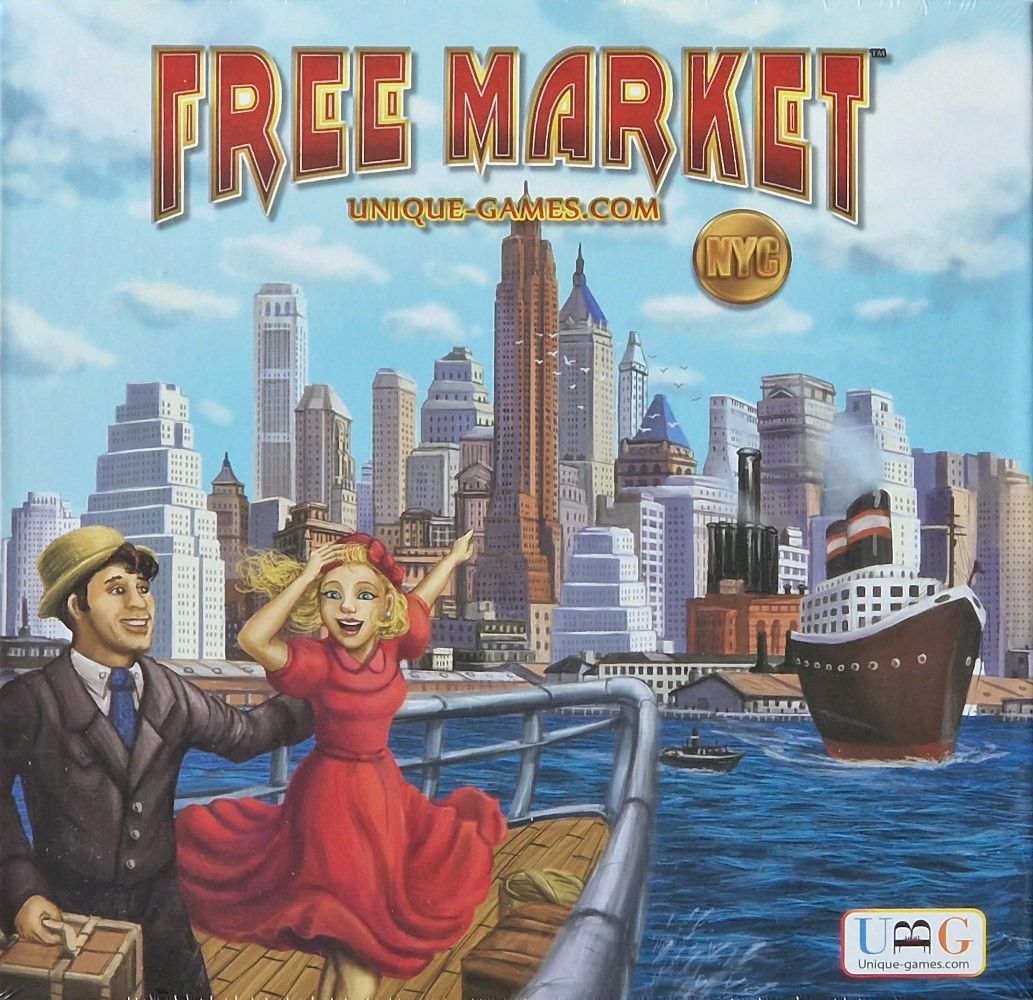
official art · Unique Board Games LTD (UBG)
the rules in 60 seconds▶ auto · 1/6
🧩
01
Setup
Place the game board, distribute starting money and player components, set up market indicators, and deal character cards.
The rules, step by step
Setup
To set up Free Market: NYC, first place the main game board in the center of the playing area. Each player receives a starting amount of money (coins and bills) and their chosen color of player components, including workers, managers, trucks, and buildings. Market indicators for various goods are placed on the market track, and initial prices are set. Character cards, which grant unique abilities, are dealt to each player, who chooses one to keep. Roadblock and strike tokens are also prepared and placed near the board. The first player marker is given to the starting player, and goods cubes are randomly placed in the container sites.
Objective
The primary objective in Free Market: NYC is to accumulate the most wealth by the end of the game. This is achieved through a combination of strategic buying and selling of goods, establishing profitable partnerships with factories and shops, and influencing politicians to gain advantages. Players must also manage their workforce and transportation effectively, while navigating market fluctuations and potential strikes or roadblocks. Ultimately, the player with the highest total value from money, goods, and successful ventures wins.
On your turn
A turn in Free Market: NYC consists of several phases. Players first check for market price changes based on dice rolls and political influence. Then, they can perform actions such as purchasing goods from container sites (often through auctions), selling goods to shops or factories, establishing partnerships with these businesses using their buildings, or moving workers and trucks to defend routes or factories from strikes and roadblocks. Players can also influence politicians to gain benefits or mitigate negative events. The order of actions and the strategic use of character abilities are crucial for maximizing efficiency and profit.
Scoring
Scoring in Free Market: NYC occurs primarily at the end of the game. Players convert all their remaining money into victory points. Additionally, points are awarded for goods still in possession, successful partnerships with factories and shops (which might provide ongoing income or end-game bonuses), and the level of political influence achieved. Certain character cards or special achievements might also contribute to the final score. The game emphasizes a balanced approach to accumulating wealth through various means, as different strategies can lead to victory.
Game end
The game concludes after a predetermined number of rounds, typically indicated by a round tracker on the board. Alternatively, the game might end if certain conditions are met, such as a player reaching a specific wealth threshold or a critical number of businesses being established. Once the final round or condition is triggered, players proceed to a final scoring phase where all assets are converted into victory points. The player with the highest total victory points is declared the winner.
Tips
To excel in Free Market: NYC, players should focus on several key strategies. Understanding and predicting market demand for goods is vital for profitable trading. Leveraging your chosen character's unique abilities at opportune moments can provide significant advantages. It's also important to strategically block opponents' transportation routes or factories to disrupt their supply chains, while simultaneously protecting your own. Building strong partnerships with businesses can ensure a steady income, and influencing politicians can offer crucial benefits or protection from adverse events. Adapting to the dynamic market and political landscape is essential for long-term success.
🔬 game anatomy
Complexity3.0 / 5
BGG rating7.2 / 10
Vibe
Strategy
Language dependence
Some text — easily memorized
🌐 plays without English
Play time
90–180 min
Players
2–5
Recommended age
12+ yrs
BGG rank
#18.287
✨ from Trișache · verified
Frequently asked questions
Q1What is the goal of the game?
The primary objective in Free Market: NYC is to accumulate the most wealth by the end of the game. This is achieved through a combination of strategic buying and selling of goods, establishing profitable partnerships with factories and shops, and influencing politicians to gain advantages. Players must also manage their workforce and transportation effectively, while navigating market fluctuations and potential strikes or roadblocks. Ultimately, the player with the highest total value from money, goods, and successful ventures wins.
Q2How do you set up the game?
To set up Free Market: NYC, first place the main game board in the center of the playing area. Each player receives a starting amount of money (coins and bills) and their chosen color of player components, including workers, managers, trucks, and buildings. Market indicators for various goods are placed on the market track, and initial prices are set. Character cards, which grant unique abilities, are dealt to each player, who chooses one to keep. Roadblock and strike tokens are also prepared and placed near the board. The first player marker is given to the starting player, and goods cubes are randomly placed in the container sites.
Q3How does a turn work?
A turn in Free Market: NYC consists of several phases. Players first check for market price changes based on dice rolls and political influence. Then, they can perform actions such as purchasing goods from container sites (often through auctions), selling goods to shops or factories, establishing partnerships with these businesses using their buildings, or moving workers and trucks to defend routes or factories from strikes and roadblocks. Players can also influence politicians to gain benefits or mitigate negative events. The order of actions and the strategic use of character abilities are crucial for maximizing efficiency and profit.
Q4How is scoring calculated?
Scoring in Free Market: NYC occurs primarily at the end of the game. Players convert all their remaining money into victory points. Additionally, points are awarded for goods still in possession, successful partnerships with factories and shops (which might provide ongoing income or end-game bonuses), and the level of political influence achieved. Certain character cards or special achievements might also contribute to the final score. The game emphasizes a balanced approach to accumulating wealth through various means, as different strategies can lead to victory.
Q5When and how does the game end?
The game concludes after a predetermined number of rounds, typically indicated by a round tracker on the board. Alternatively, the game might end if certain conditions are met, such as a player reaching a specific wealth threshold or a critical number of businesses being established. Once the final round or condition is triggered, players proceed to a final scoring phase where all assets are converted into victory points. The player with the highest total victory points is declared the winner.
Q6What tips are there for beginners?
To excel in Free Market: NYC, players should focus on several key strategies. Understanding and predicting market demand for goods is vital for profitable trading. Leveraging your chosen character's unique abilities at opportune moments can provide significant advantages. It's also important to strategically block opponents' transportation routes or factories to disrupt their supply chains, while simultaneously protecting your own. Building strong partnerships with businesses can ensure a steady income, and influencing politicians can offer crucial benefits or protection from adverse events. Adapting to the dynamic market and political landscape is essential for long-term success.
Q7How much does Free Market: NYC cost?
Free Market: NYC costs around 179 RON in Romania.
Q8Where can I buy Free Market: NYC cheapest?
The lowest price for Free Market: NYC right now is 179 RON at Gameology . The Prices tab lists every store currently tracking it.
Q9How do you play Free Market: NYC?
Free Market: NYC is a economic game, for 2–5 players, taking ~90–180 minutes, featuring action queue. Check the Rules tab for setup, gameplay, and scoring, or ask Trișache anything about Free Market: NYC — our AI assistant built by howtoplay.ro and trained specifically on board game rulebooks.
Q10How many players does Free Market: NYC support?

%2Fpic8485846.jpg)
%2Fpic8485846.jpg)