2–460 min10+ yrs2.6/5 complexity7.2 BGG#538 BGG16,8 K
⚡ short answer
How do you play Fresco?
The primary objective in Fresco is to accumulate the most victory points by the end of the game. Players achieve this by strategically restoring sections of the cathedral's fresco, which requires specific combinations of paint colors. Additional points can be earned by painting portraits, having leftover money, and maintaining high worker morale. The game encourages forward planning and adaptation to opponents' actions.
To find the best price for Fresco, howtoplay.ro compares deals from Romanian shops every day.
FromRON 209· 4 shops
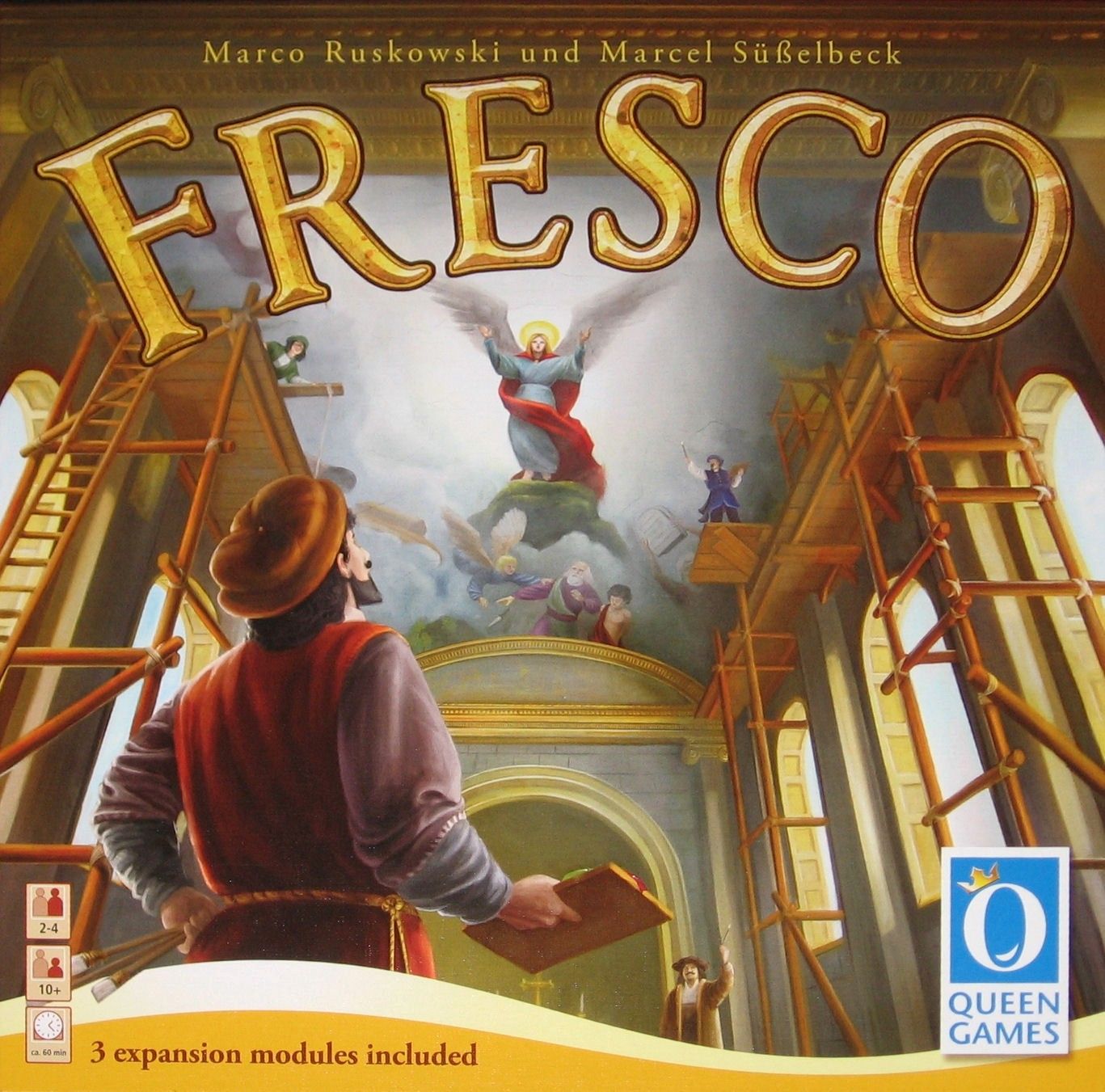
official art · Queen Games
the rules in 60 seconds▶ auto · 1/6
🧩
01
Setup
Players set up the game board, place fresco tiles randomly, distribute paint cubes, money, and player components, and set up their individual player screens and action boards.
The rules, step by step
Setup
To set up Fresco, first unfold the main game board, which has different sides for varying player counts (3 or 4 players). Randomly place the 25 fresco tiles face-down onto the designated spaces on the cathedral section of the board. Each player receives a player screen, an action board, five large worker pawns, and two small worker pawns in their chosen color. Distribute the paint cubes (red, yellow, blue, green, orange, purple) into their respective areas on the board. Place the money tokens (Thalers) in a general supply. The Bishop pawn is placed in the center fresco tile. Each player also receives a starting amount of money and a set of primary paint cubes behind their player screen.
Objective
The primary objective in Fresco is to accumulate the most victory points by the end of the game. Players achieve this by strategically restoring sections of the cathedral's fresco, which requires specific combinations of paint colors. Additional points can be earned by painting portraits, having leftover money, and maintaining high worker morale. The game encourages forward planning and adaptation to opponents' actions.
On your turn
A round in Fresco begins with players secretly choosing their wake-up time (5 AM, 6 AM, 7 AM, 8 AM, or 9 AM) behind their player screens. This choice determines turn order for market actions and affects worker morale. Earlier wake-up times grant first choice at the market but decrease morale, while later times improve morale but offer fewer market options. After wake-up times are revealed, players assign their five large worker pawns to various action spaces on their individual action boards, such as buying paint, mixing colors, restoring fresco sections, or visiting the theater. Actions are resolved in a specific order across all players: market actions first, then restoration, then mixing, and finally theater visits.
Scoring
Victory points are primarily awarded for restoring fresco sections. Each fresco tile has a point value, and players earn these points immediately upon restoration. If the Bishop pawn is on a fresco section when it is restored, the player receives bonus points. Players can also earn points by painting portraits, which are separate from the main fresco. At the end of the game, remaining money is converted into victory points (typically 1 point per 2 Thalers), and bonuses may be awarded for having a diverse collection of restored fresco sections or for achieving certain objectives from expansion modules if used.
Game end
The game concludes after a certain number of fresco tiles have been restored, typically when a specified number of rows or columns are completed. Once this condition is met, the current round is finished, and one final round is played. During this final round, players use the 'side 2' of their action boards, which may offer slightly different action benefits. After the final round, players calculate their total victory points from restored frescoes, painted portraits, remaining money, and any other end-game bonuses. The player with the highest total score is declared the winner.
Tips
Effective strategy in Fresco involves careful planning of worker assignments and wake-up times. Balancing the need for specific paint colors from the market with maintaining worker morale is crucial. Don't neglect the theater action, as boosting morale can prevent workers from becoming stressed and leaving your service. Pay attention to the Bishop's position on the fresco, as restoring sections he occupies yields significant bonus points. Observing opponents' paint supplies and planned actions can help you anticipate their moves and secure valuable fresco tiles or market opportunities before they do.
🔬 game anatomy
Complexity2.6 / 5
BGG rating7.2 / 10
Language dependence
No in-game text needed
🌐 plays without English
Play time
60 min
Players
2–4
Recommended age
10+ yrs
BGG rank
#538
✨ from Trișache · verified
Frequently asked questions
Q1What is the goal of the game?
The primary objective in Fresco is to accumulate the most victory points by the end of the game. Players achieve this by strategically restoring sections of the cathedral's fresco, which requires specific combinations of paint colors. Additional points can be earned by painting portraits, having leftover money, and maintaining high worker morale. The game encourages forward planning and adaptation to opponents' actions.
Q2How do you set up the game?
To set up Fresco, first unfold the main game board, which has different sides for varying player counts (3 or 4 players). Randomly place the 25 fresco tiles face-down onto the designated spaces on the cathedral section of the board. Each player receives a player screen, an action board, five large worker pawns, and two small worker pawns in their chosen color. Distribute the paint cubes (red, yellow, blue, green, orange, purple) into their respective areas on the board. Place the money tokens (Thalers) in a general supply. The Bishop pawn is placed in the center fresco tile. Each player also receives a starting amount of money and a set of primary paint cubes behind their player screen.
Q3How does a turn work?
A round in Fresco begins with players secretly choosing their wake-up time (5 AM, 6 AM, 7 AM, 8 AM, or 9 AM) behind their player screens. This choice determines turn order for market actions and affects worker morale. Earlier wake-up times grant first choice at the market but decrease morale, while later times improve morale but offer fewer market options. After wake-up times are revealed, players assign their five large worker pawns to various action spaces on their individual action boards, such as buying paint, mixing colors, restoring fresco sections, or visiting the theater. Actions are resolved in a specific order across all players: market actions first, then restoration, then mixing, and finally theater visits.
Q4How is scoring calculated?
Victory points are primarily awarded for restoring fresco sections. Each fresco tile has a point value, and players earn these points immediately upon restoration. If the Bishop pawn is on a fresco section when it is restored, the player receives bonus points. Players can also earn points by painting portraits, which are separate from the main fresco. At the end of the game, remaining money is converted into victory points (typically 1 point per 2 Thalers), and bonuses may be awarded for having a diverse collection of restored fresco sections or for achieving certain objectives from expansion modules if used.
Q5When and how does the game end?
The game concludes after a certain number of fresco tiles have been restored, typically when a specified number of rows or columns are completed. Once this condition is met, the current round is finished, and one final round is played. During this final round, players use the 'side 2' of their action boards, which may offer slightly different action benefits. After the final round, players calculate their total victory points from restored frescoes, painted portraits, remaining money, and any other end-game bonuses. The player with the highest total score is declared the winner.
Q6What tips are there for beginners?
Effective strategy in Fresco involves careful planning of worker assignments and wake-up times. Balancing the need for specific paint colors from the market with maintaining worker morale is crucial. Don't neglect the theater action, as boosting morale can prevent workers from becoming stressed and leaving your service. Pay attention to the Bishop's position on the fresco, as restoring sections he occupies yields significant bonus points. Observing opponents' paint supplies and planned actions can help you anticipate their moves and secure valuable fresco tiles or market opportunities before they do.
Q7How much does Fresco cost?
Fresco costs between 209 and 296 RON across Romanian stores.
Q8Where can I buy Fresco cheapest?
The lowest price for Fresco right now is 209 RON at Pionul.ro. The Prices tab lists every store currently tracking it.
Q9How do you play Fresco?
Fresco is a renaissance game, for 2–4 players, taking ~60 minutes, featuring action queue. Check the Rules tab for setup, gameplay, and scoring, or ask Trișache anything about Fresco — our AI assistant built by howtoplay.ro and trained specifically on board game rulebooks.

%2Fpic714398.jpg)
%2Fpic714398.jpg)