The primary objective of this scenario is to destroy all summoning stones and eliminate all enemies on the map. Summoning stones are considered objectives and have a health value of C+1 hit points, where 'C' is the number of characters participating in the game. They can only be targeted by melee attacks and cannot be affected by conditions (like poison or muddle) or push/pull effects. When a summoning stone is destroyed, place a rubble token on its hex. This hex then becomes traversable by figures, similar to an empty hex. Note that objectives are not considered obstacles for gameplay purposes, meaning abilities that specifically target or destroy obstacles cannot be used on summoning stones.
To find the best price for Gloomhaven: Jaws of the Lion, howtoplay.ro compares deals from Romanian shops every day.
FromRON 205· 5 shops
🔥All-time low-14% vs 90-day avg
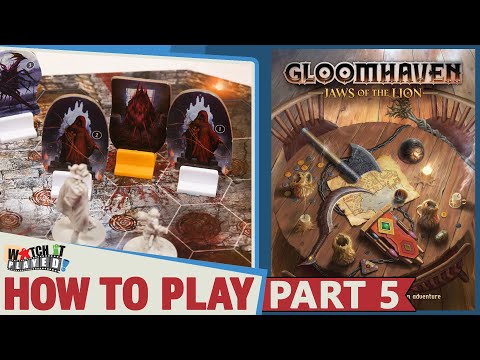
▶ Watch It Played · Gloomhaven: Jaws of the Lion - How To Play - Part 5
Gloomhaven: Jaws of the Lion - How To Play - Part 5
Watch It Played· 11 min· published Jul 7, 2020Community
the rules in 60 seconds▶ auto · 1/6
🧩
01
Setup
Set up the map using pages 8 and 9 of the Scenario Book, and page 3 of the Supplemental Scenario Book, placing monsters, damage traps, treasure tiles, and money tokens as indicated. Use the full 8-card ability decks for Stone Golems and Zealots, ignoring any 'Basic' monster cards. Place the Element Board with all six element tokens in the 'Inert' column. Each player receives two Battle Goal cards, keeps one, and returns the other to the box. Retrieve three ability cards marked with an 'X' from your character box and add them to your hand.
The rules, step by step
Setup
To set up the scenario, open the Scenario Book to pages 8 and 9, and the Supplemental Scenario Book to page 3. These pages combine to form the map for the scenario. Place all indicated monsters, damage traps, treasure tiles, and money tokens on the map as shown. For the monsters, use their full 8-card ability decks for Stone Golems and Zealots, discarding any 'Basic' monster cards. Place the Element Board in the play area, with all six element tokens (Sun, Ice, Fire, Night, Wind, Leaf) in the 'Inert' column. Each player then draws two Battle Goal cards, secretly chooses one to keep, and returns the other unseen to the box. Finally, each player retrieves the three ability cards marked with an 'X' from their character box and adds them to their hand. These cards will be available for the rest of the campaign.
Objective
The primary objective of this scenario is to destroy all summoning stones and eliminate all enemies on the map. Summoning stones are considered objectives and have a health value of C+1 hit points, where 'C' is the number of characters participating in the game. They can only be targeted by melee attacks and cannot be affected by conditions (like poison or muddle) or push/pull effects. When a summoning stone is destroyed, place a rubble token on its hex. This hex then becomes traversable by figures, similar to an empty hex. Note that objectives are not considered obstacles for gameplay purposes, meaning abilities that specifically target or destroy obstacles cannot be used on summoning stones.
On your turn
During the game, when new monsters are spawned (e.g., after destroying a summoning stone), they are placed on the marked locations. If a marked location is occupied, the monster spawns in the nearest unoccupied hex. Spawned monsters act immediately in the round they are added, following the standard monster activation rules. When a character performs an action (or part of an action) that has an element affinity symbol, the corresponding element token is moved to the 'Strong' column of the Element Board at the end of that character's turn. At the end of each round, after all characters and monsters have completed their turns, all element tokens currently in the 'Strong' column are moved to the 'Waning' column, and any tokens in the 'Waning' column are moved to the 'Inert' column.
Scoring
At the end of the scenario, after successfully completing the scenario goals, each player reveals their private Battle Goal card. If the player successfully completed the objective listed on their Battle Goal card, they gain a checkmark. These checkmarks are recorded by checking off the leftmost empty square in the 'Rows' section of their character notes. For every three checkmarks accumulated in a row, the player immediately checks off a bonus perk from the 'Perks' section of their character sheet. If a player fails to complete their Battle Goal, they do not gain a checkmark, but there is no other penalty for failure.
Game end
The scenario concludes successfully when all summoning stones have been destroyed and all enemies have been eliminated. Upon successful completion, each player gains 6 experience points, in addition to any experience earned during the scenario. The scenario also rewards a Mana Potion (Item 14), which is retrieved from the box. Players must collectively decide which single character will collect this item. In preparation for the next scenario, each player will now have 13 ability cards (their original 10 plus the 3 'X' cards retrieved earlier). However, for each new scenario, players can only bring a number of ability cards equal to the number listed on the top right of their character mat (typically 10). Players will choose which 10 cards to bring and which 3 to leave behind at the start of every future scenario.
Tips
The introduction of the Element Board adds a strategic layer to gameplay. Infusing an element (moving it to the 'Strong' column) makes it available for consumption by other abilities in subsequent turns. However, you cannot infuse an element and then consume that same element within the same turn. This encourages players to plan ahead and potentially coordinate with teammates to set up powerful elemental attacks or defenses. Monsters will also infuse and consume elements, so be mindful of their abilities. Wild elements (multicolored symbols) allow players to choose which specific element is infused or consumed, offering flexibility. Remember that objectives are not obstacles, so abilities that specifically affect obstacles will not work on summoning stones.
🔬 game anatomy
Complexity3.6 / 5
BGG rating8.3 / 10
Vibe
Co-opCouplesStrategy
Language dependence
Extensive text — heavy translation needed
Play time
30–120 min
Players
1–4
Recommended age
14+ yrs
BGG rank
#12
✨ from Trișache · verified
Frequently asked questions
Q1What is the goal of the game?
The primary objective of this scenario is to destroy all summoning stones and eliminate all enemies on the map. Summoning stones are considered objectives and have a health value of C+1 hit points, where 'C' is the number of characters participating in the game. They can only be targeted by melee attacks and cannot be affected by conditions (like poison or muddle) or push/pull effects. When a summoning stone is destroyed, place a rubble token on its hex. This hex then becomes traversable by figures, similar to an empty hex. Note that objectives are not considered obstacles for gameplay purposes, meaning abilities that specifically target or destroy obstacles cannot be used on summoning stones.
Q2How do you set up the game?
To set up the scenario, open the Scenario Book to pages 8 and 9, and the Supplemental Scenario Book to page 3. These pages combine to form the map for the scenario. Place all indicated monsters, damage traps, treasure tiles, and money tokens on the map as shown. For the monsters, use their full 8-card ability decks for Stone Golems and Zealots, discarding any 'Basic' monster cards. Place the Element Board in the play area, with all six element tokens (Sun, Ice, Fire, Night, Wind, Leaf) in the 'Inert' column. Each player then draws two Battle Goal cards, secretly chooses one to keep, and returns the other unseen to the box. Finally, each player retrieves the three ability cards marked with an 'X' from their character box and adds them to their hand. These cards will be available for the rest of the campaign.
Q3How does a turn work?
During the game, when new monsters are spawned (e.g., after destroying a summoning stone), they are placed on the marked locations. If a marked location is occupied, the monster spawns in the nearest unoccupied hex. Spawned monsters act immediately in the round they are added, following the standard monster activation rules. When a character performs an action (or part of an action) that has an element affinity symbol, the corresponding element token is moved to the 'Strong' column of the Element Board at the end of that character's turn. At the end of each round, after all characters and monsters have completed their turns, all element tokens currently in the 'Strong' column are moved to the 'Waning' column, and any tokens in the 'Waning' column are moved to the 'Inert' column.
Q4How is scoring calculated?
At the end of the scenario, after successfully completing the scenario goals, each player reveals their private Battle Goal card. If the player successfully completed the objective listed on their Battle Goal card, they gain a checkmark. These checkmarks are recorded by checking off the leftmost empty square in the 'Rows' section of their character notes. For every three checkmarks accumulated in a row, the player immediately checks off a bonus perk from the 'Perks' section of their character sheet. If a player fails to complete their Battle Goal, they do not gain a checkmark, but there is no other penalty for failure.
Q5When and how does the game end?
The scenario concludes successfully when all summoning stones have been destroyed and all enemies have been eliminated. Upon successful completion, each player gains 6 experience points, in addition to any experience earned during the scenario. The scenario also rewards a Mana Potion (Item 14), which is retrieved from the box. Players must collectively decide which single character will collect this item. In preparation for the next scenario, each player will now have 13 ability cards (their original 10 plus the 3 'X' cards retrieved earlier). However, for each new scenario, players can only bring a number of ability cards equal to the number listed on the top right of their character mat (typically 10). Players will choose which 10 cards to bring and which 3 to leave behind at the start of every future scenario.
Q6What tips are there for beginners?
The introduction of the Element Board adds a strategic layer to gameplay. Infusing an element (moving it to the 'Strong' column) makes it available for consumption by other abilities in subsequent turns. However, you cannot infuse an element and then consume that same element within the same turn. This encourages players to plan ahead and potentially coordinate with teammates to set up powerful elemental attacks or defenses. Monsters will also infuse and consume elements, so be mindful of their abilities. Wild elements (multicolored symbols) allow players to choose which specific element is infused or consumed, offering flexibility. Remember that objectives are not obstacles, so abilities that specifically affect obstacles will not work on summoning stones.
Q7How much does Gloomhaven: Jaws of the Lion cost?
Gloomhaven: Jaws of the Lion costs between 205 and 319 RON across Romanian stores.
Q8Where can I buy Gloomhaven: Jaws of the Lion cheapest?
The lowest price for Gloomhaven: Jaws of the Lion right now is 205 RON at ozone.ro. The Prices tab lists every store currently tracking it.
Q9How do you play Gloomhaven: Jaws of the Lion?
Gloomhaven: Jaws of the Lion is a adventure game, for 1–4 players, taking ~30–120 minutes, featuring action queue. Check the Rules tab for setup, gameplay, and scoring, or ask Trișache anything about Gloomhaven: Jaws of the Lion — our AI assistant built by howtoplay.ro and trained specifically on board game rulebooks.
Q10How many players does Gloomhaven: Jaws of the Lion support?
Gloomhaven: Jaws of the Lion is played by 1–4 players.

%2Fpic5055631.jpg)