In Kanagawa, Master Hokusai has decided to open an art school, and you are his students. By listening to the Master and developing your abilities, you will compete to create the most magnificent artwork. The goal is to earn the most harmony points by the end of the game.
To find the best price for Kanagawa, howtoplay.ro compares deals from Romanian shops every day.
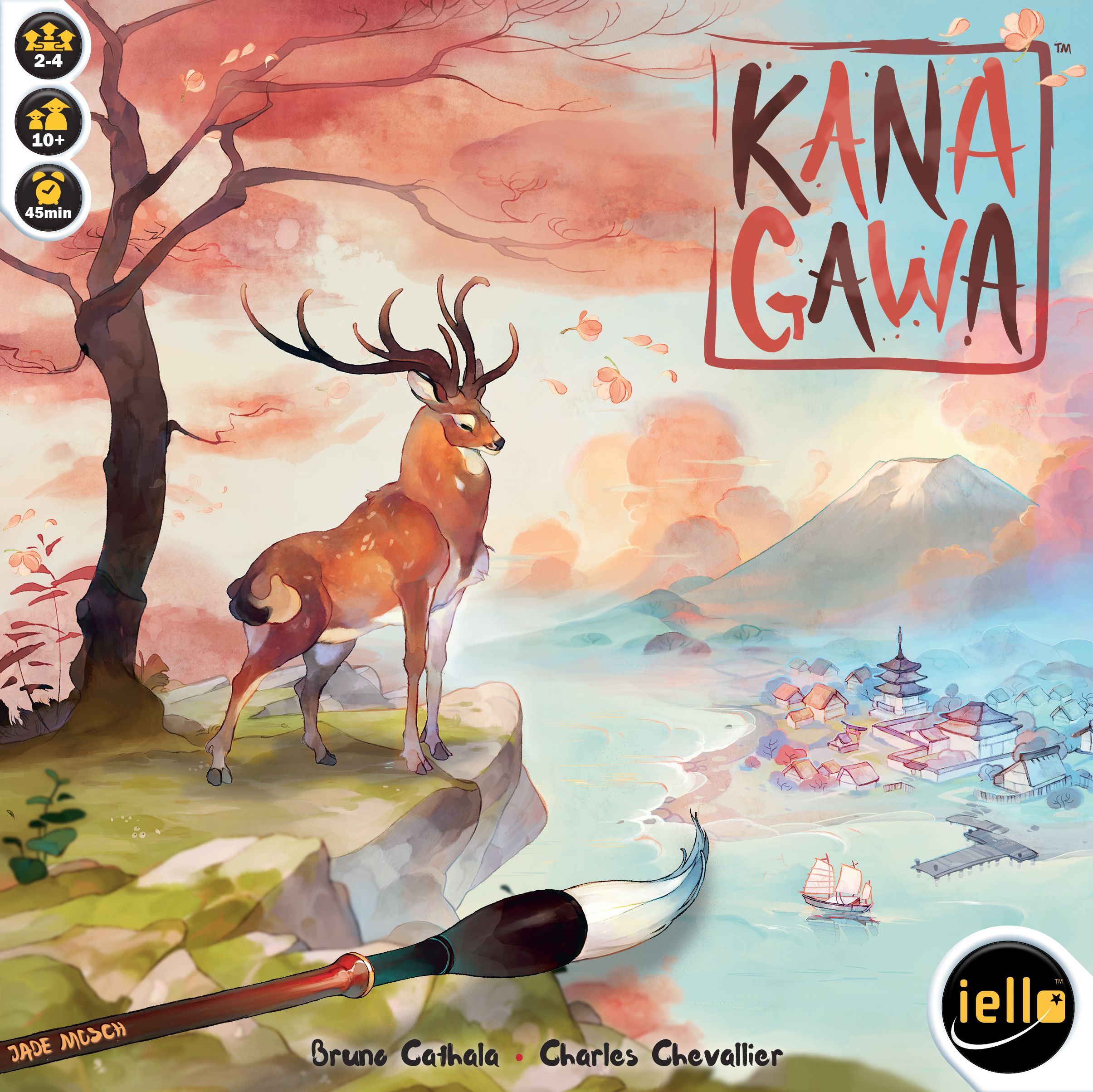
official art · IELLO
the rules in 60 seconds▶ auto · 1/6
🧩
01
Setup
Unroll the school mat, give the Master and Assistant pawns to the first player, deal one starting tile to each player, give two brush pots to each player, shuffle lesson cards into a face-down deck, and sort diploma tiles by color and value above the school mat.
The rules, step by step
Setup
To set up the game, first unroll the school mat in the center of the table. Randomly determine the first player and give them the Master pawn and the Assistant pawn. Deal one starting tile to each player. Each player also takes two brush pots and places them in front of themselves. Shuffle all lesson cards to form a face-down draw pile, placed next to the board. Finally, sort all diploma tiles by their colors and lay them face-up above the school mat in two rows, ensuring they are sorted by their harmony value.
Objective
In Kanagawa, Master Hokusai has decided to open an art school, and you are his students. By listening to the Master and developing your abilities, you will compete to create the most magnificent artwork. The goal is to earn the most harmony points by the end of the game.
On your turn
Each round consists of three steps. First, 'Listen to the Master': the first player draws lesson cards equal to the number of players and places them face-up on the first row of the school mat, or face-down if the space is red. Second, 'Expand or Use Your Knowledge': starting with the first player and going clockwise, each player chooses one of two actions. They can either pass to stay in school and expand their knowledge, or leave the school to use their knowledge by taking all cards in one column. If a player is the last one in school at the start of this step, they must take a column. When taking cards, they must immediately use all of them, either to improve their studio (no restrictions, always possible) or to continue their artwork (requires a brush and matching landscape icon). Third, 'Next Lesson': if there are still students in school, the first player draws more cards for the next row. This repeats for up to three rows. After the third row, any remaining players must take a column. The player with the Assistant pawn takes the Master pawn and becomes the first player for the next round.
Scoring
When the game ends, five things are counted to determine the winner. Each player gets one point per card in their artwork (including the starting tile). They also get one point per card in their longest sequence of cards with the same season. Players gain or lose points from harmony symbols on their studio cards. Points are awarded for collected diplomas. Finally, two points are given to the player holding the Master pawn. The player with the most harmony points wins. In case of a tie, tied players share the victory.
Game end
The game can end in two ways. The first way is when the lesson card deck runs out. The current round is completed, and then the game ends. The second way is when one or more players have completed at least 11 parts in their artwork. The current round is completed, and then the game ends.
Tips
It can be advantageous to look at the back of the next lesson card to see what the main motif will be. This can help you plan your strategy for expanding your knowledge or choosing which column of cards to take. Remember that if you are the last player remaining in the school at the beginning of step 2, you are not allowed to pass and must choose to take a column of cards. Storm tokens allow you to change the season of a landscape icon, which can help you extend your longest season sequence for more points.
🔬 game anatomy
Complexity2.0 / 5
BGG rating7.0 / 10
Vibe
Family
Language dependence
No in-game text needed
🌐 plays without English
Play time
45 min
Players
2–4
Recommended age
10+ yrs
BGG rank
#959
✨ from Trișache · verified
Frequently asked questions
Q1What is the goal of the game?
In Kanagawa, Master Hokusai has decided to open an art school, and you are his students. By listening to the Master and developing your abilities, you will compete to create the most magnificent artwork. The goal is to earn the most harmony points by the end of the game.
Q2How do you set up the game?
To set up the game, first unroll the school mat in the center of the table. Randomly determine the first player and give them the Master pawn and the Assistant pawn. Deal one starting tile to each player. Each player also takes two brush pots and places them in front of themselves. Shuffle all lesson cards to form a face-down draw pile, placed next to the board. Finally, sort all diploma tiles by their colors and lay them face-up above the school mat in two rows, ensuring they are sorted by their harmony value.
Q3How does a turn work?
Each round consists of three steps. First, 'Listen to the Master': the first player draws lesson cards equal to the number of players and places them face-up on the first row of the school mat, or face-down if the space is red. Second, 'Expand or Use Your Knowledge': starting with the first player and going clockwise, each player chooses one of two actions. They can either pass to stay in school and expand their knowledge, or leave the school to use their knowledge by taking all cards in one column. If a player is the last one in school at the start of this step, they must take a column. When taking cards, they must immediately use all of them, either to improve their studio (no restrictions, always possible) or to continue their artwork (requires a brush and matching landscape icon). Third, 'Next Lesson': if there are still students in school, the first player draws more cards for the next row. This repeats for up to three rows. After the third row, any remaining players must take a column. The player with the Assistant pawn takes the Master pawn and becomes the first player for the next round.
Q4How is scoring calculated?
When the game ends, five things are counted to determine the winner. Each player gets one point per card in their artwork (including the starting tile). They also get one point per card in their longest sequence of cards with the same season. Players gain or lose points from harmony symbols on their studio cards. Points are awarded for collected diplomas. Finally, two points are given to the player holding the Master pawn. The player with the most harmony points wins. In case of a tie, tied players share the victory.
Q5When and how does the game end?
The game can end in two ways. The first way is when the lesson card deck runs out. The current round is completed, and then the game ends. The second way is when one or more players have completed at least 11 parts in their artwork. The current round is completed, and then the game ends.
Q6What tips are there for beginners?
It can be advantageous to look at the back of the next lesson card to see what the main motif will be. This can help you plan your strategy for expanding your knowledge or choosing which column of cards to take. Remember that if you are the last player remaining in the school at the beginning of step 2, you are not allowed to pass and must choose to take a column of cards. Storm tokens allow you to change the season of a landscape icon, which can help you extend your longest season sequence for more points.
Q7How much does Kanagawa cost?
No store is currently tracking Kanagawa. Check the Prices tab — you can set a price alert to be notified when it appears.
Q8Where can I buy Kanagawa cheapest?
Check the Prices tab — howtoplay.ro aggregates offers from 7+ Romanian board-game stores and tracks price history.
Q9How do you play Kanagawa?
Kanagawa is a animals game, for 2–4 players, taking ~45 minutes, featuring hand management. Check the Rules tab for setup, gameplay, and scoring, or ask Trișache anything about Kanagawa — our AI assistant built by howtoplay.ro and trained specifically on board game rulebooks.
%2Fpic3105168.jpg)
%2Fpic3105168.jpg)