
Prices updated today
%2Fpic2278942.jpg)
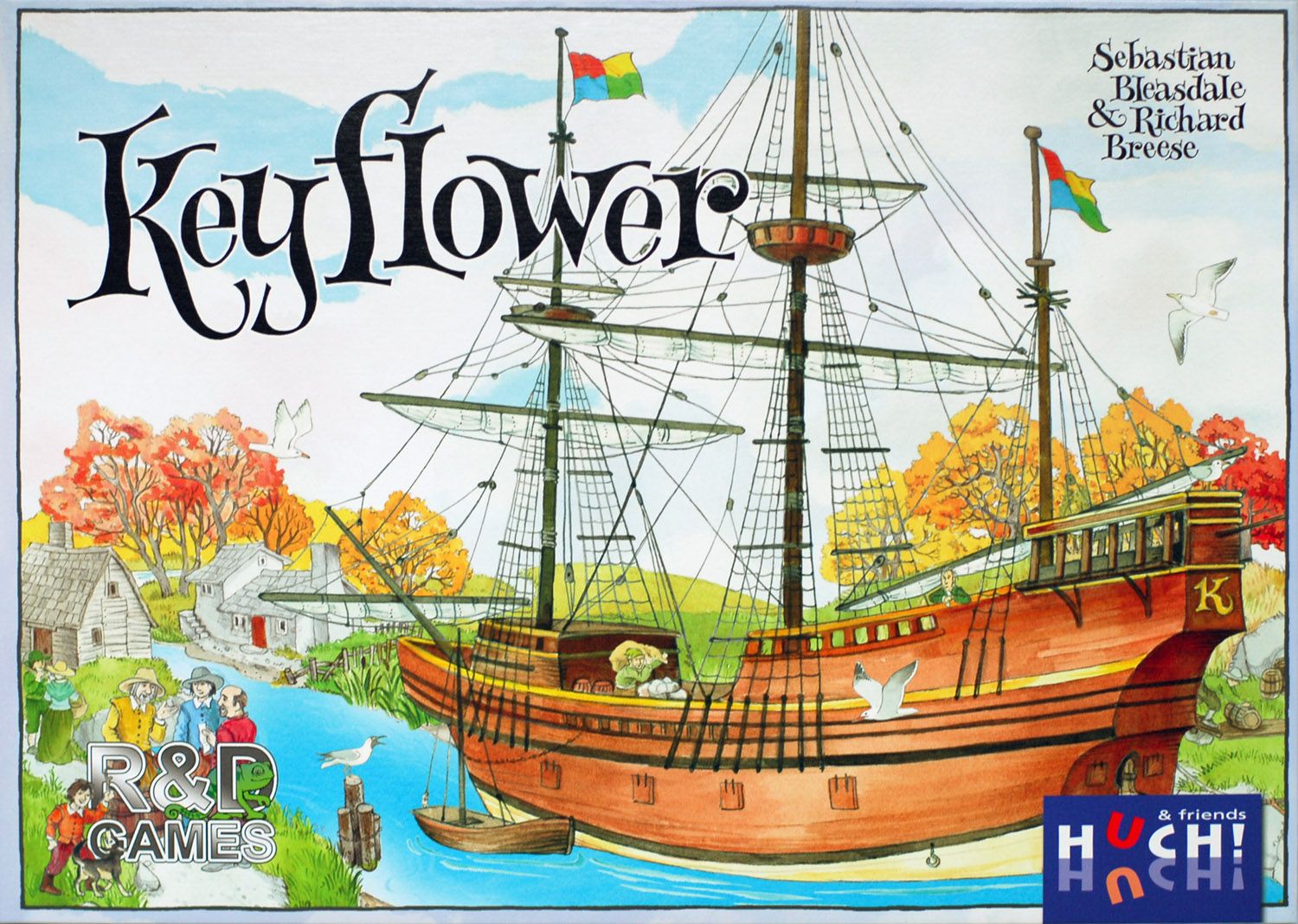
Keyflower
R&D Games · 2012
2–690–120 min12+ yrs3.3/5 complexity7.7 BGG#136 BGG28,7 KStrategy
⚡ short answer
How do you play Keyflower?
The objective of Keyflower is to accumulate the most victory points by building a thriving village over four rounds, each representing a season. Players achieve this by strategically acquiring and placing hexagonal tiles in their village, utilizing workers to gain resources and perform actions, and meeting specific scoring conditions on their tiles, especially those revealed during the winter round.
To find the best price for Keyflower, howtoplay.ro compares deals from Romanian shops every day.
FromRON 209· 3 shops
Normal price+2% vs 90-day avg
%2Fpic2278942.jpg)
the rules in 60 seconds▶ auto · 1/6
🧩
01
Setup
Players start with a home tile and eight random workers, with various resource, skill, boat, and village tiles laid out on the table.
The rules, step by step
Setup
To set up Keyflower, each player receives a single home tile and eight random workers drawn from a bag, kept secret behind their player screen. On the main playing area, various hexagonal tiles are laid out: resource tiles (iron, stone, wood, gold), skill tokens (anvils, pickaxes, saws), boat tiles with workers and skills, turn order tiles, and village tiles. The number and type of village tiles available are dictated by the current season, starting with spring. Green workers are rarer and typically acquired through specific actions rather than random draws.
Objective
The objective of Keyflower is to accumulate the most victory points by building a thriving village over four rounds, each representing a season. Players achieve this by strategically acquiring and placing hexagonal tiles in their village, utilizing workers to gain resources and perform actions, and meeting specific scoring conditions on their tiles, especially those revealed during the winter round.
On your turn
On a player's turn, starting with the player holding the purple starting player token, they can take one action. This involves using workers from behind their screen to either gain a benefit from an existing village tile (in their own or another player's village, or a central tile) or to bid on an available tile. When bidding, workers of the same color must be used on a single tile, and subsequent bids on that tile must be a higher amount of the same color. Losing bids allow workers to be moved to another action, while winning bids secure the tile for the player's village or determine turn order/boat selection.
Scoring
At the end of the winter round, players calculate their final scores. Points are awarded for the face value of tiles in their village. Additionally, players earn bonus points by fulfilling specific conditions indicated on certain tiles, such as having sets of different resources or skills. Some bonuses may require specific resources to be physically on the scoring tile, while others count resources from a player's general supply. Gold acts as a wild resource for both actions and scoring, and any unallocated gold at the end of the game is worth one additional point.
Game end
The game concludes after the winter round, following the final scoring. The four rounds represent spring, summer, fall, and winter. During the end-of-season cleanup, losing bid workers return to their owners, unbid tiles go back to the box, and winning bid tiles are added to the respective players' villages. Turn order tiles are resolved, determining boat selection and the next round's start player. Winter setup is unique, as players choose from a hand of winter tiles they received at the start of the game, which offer end-game scoring goals. The player with the highest total victory points wins; in case of a tie, all tied players share the victory.
Tips
Players should carefully examine the winter tiles received at the start of the game, as these can guide their long-term strategy for resource collection and tile acquisition. Paying close attention to the season icons on boat and village tiles is crucial, as some are only available or active during specific seasons. Understanding the worker placement and bidding mechanics, especially how worker colors restrict actions and how gold acts as a wild, is key to efficient play. Also, remember that tiles in your village allow workers used on them to return to your screen, providing a sustainable workforce.
game anatomy
Complexity3.3 / 5
BGG rating7.7 / 10
Vibe
Strategy
Language dependence
No in-game text needed
Play time
90–120 min
Players
2–6
Recommended age
12+ yrs
BGG rank
#136
from Trișache · verified
Frequently asked questions
Q1What is the goal of the game?
The objective of Keyflower is to accumulate the most victory points by building a thriving village over four rounds, each representing a season. Players achieve this by strategically acquiring and placing hexagonal tiles in their village, utilizing workers to gain resources and perform actions, and meeting specific scoring conditions on their tiles, especially those revealed during the winter round.
Q2How do you set up the game?
To set up Keyflower, each player receives a single home tile and eight random workers drawn from a bag, kept secret behind their player screen. On the main playing area, various hexagonal tiles are laid out: resource tiles (iron, stone, wood, gold), skill tokens (anvils, pickaxes, saws), boat tiles with workers and skills, turn order tiles, and village tiles. The number and type of village tiles available are dictated by the current season, starting with spring. Green workers are rarer and typically acquired through specific actions rather than random draws.
Q3How does a turn work?
On a player's turn, starting with the player holding the purple starting player token, they can take one action. This involves using workers from behind their screen to either gain a benefit from an existing village tile (in their own or another player's village, or a central tile) or to bid on an available tile. When bidding, workers of the same color must be used on a single tile, and subsequent bids on that tile must be a higher amount of the same color. Losing bids allow workers to be moved to another action, while winning bids secure the tile for the player's village or determine turn order/boat selection.
Q4How is scoring calculated?
At the end of the winter round, players calculate their final scores. Points are awarded for the face value of tiles in their village. Additionally, players earn bonus points by fulfilling specific conditions indicated on certain tiles, such as having sets of different resources or skills. Some bonuses may require specific resources to be physically on the scoring tile, while others count resources from a player's general supply. Gold acts as a wild resource for both actions and scoring, and any unallocated gold at the end of the game is worth one additional point.
Q5When and how does the game end?
The game concludes after the winter round, following the final scoring. The four rounds represent spring, summer, fall, and winter. During the end-of-season cleanup, losing bid workers return to their owners, unbid tiles go back to the box, and winning bid tiles are added to the respective players' villages. Turn order tiles are resolved, determining boat selection and the next round's start player. Winter setup is unique, as players choose from a hand of winter tiles they received at the start of the game, which offer end-game scoring goals. The player with the highest total victory points wins; in case of a tie, all tied players share the victory.
Q6What tips are there for beginners?
Players should carefully examine the winter tiles received at the start of the game, as these can guide their long-term strategy for resource collection and tile acquisition. Paying close attention to the season icons on boat and village tiles is crucial, as some are only available or active during specific seasons. Understanding the worker placement and bidding mechanics, especially how worker colors restrict actions and how gold acts as a wild, is key to efficient play. Also, remember that tiles in your village allow workers used on them to return to your screen, providing a sustainable workforce.
Q7How much does Keyflower cost?
Keyflower costs between 209 and 239 RON across Romanian stores.
Q8Where can I buy Keyflower cheapest?
The lowest price for Keyflower right now is 209 RON at Pionul.ro. The Prices tab lists every store currently tracking it.
Q9How do you play Keyflower?
Keyflower is a city building game, for 2–6 players, taking ~90–120 minutes, featuring auction / bidding. Check the Rules tab for setup, gameplay, and scoring, or ask Trișache anything about Keyflower — our AI assistant built by howtoplay.ro and trained specifically on board game rulebooks.
Q10How many players does Keyflower support?
Keyflower is played by 2–6 players.
6 shops
All prices
Normal price+2% vs 90-day avgHow we compute this →
6 shops · sorted by priceupdated today
ozone.roCHECKED 57 DAYS AGOaffiliateeasyboxFANbox
Joc de societate Keyflower (Core Set) - Strategie
○ out of stock
RON 165
Buy →out of stock
Regatul JocurilorEnglish/German second editioneasyboxCultural voucher
Keyflower (2013 Master Print Edition)
○ out of stock
RON 199
Buy →out of stock
07
ozone.roCHECKED 76 DAYS AGOaffiliateeasyboxFANbox
Joc de societate Keyflower (Core Set) - Strategie
○ out of stock
RON 236
Buy →out of stock
08
Regatul JocurilorEnglish edition 2017easyboxCultural voucher
Keyflower (2017 English Edition)
○ out of stock
RON 239
Buy →out of stock
affiliate links · prices include VAT · independent platform, no hidden sponsorships
🚚 Free shipping over RON 250
Price history
See price by edition
Price trend over the last 90 days: minimum 110 lei, maximum 239 lei, now 165 lei.
Mechanics & categories