2–560 min10+ yrs3.0/5 complexity7.4 BGG#575 BGG8,6 K
⚡ short answer
How do you play Lancaster?
The objective in Lancaster is to become the most influential noble in England by accumulating the most victory points over the course of the game. Players earn victory points through various actions such as controlling counties, winning conflicts against France, constructing parts of their castle, and influencing the passage of laws. Strategic planning and interaction with other players are crucial to maximize point gain and secure victory.
To find the best price for Lancaster, howtoplay.ro compares deals from Romanian shops every day.
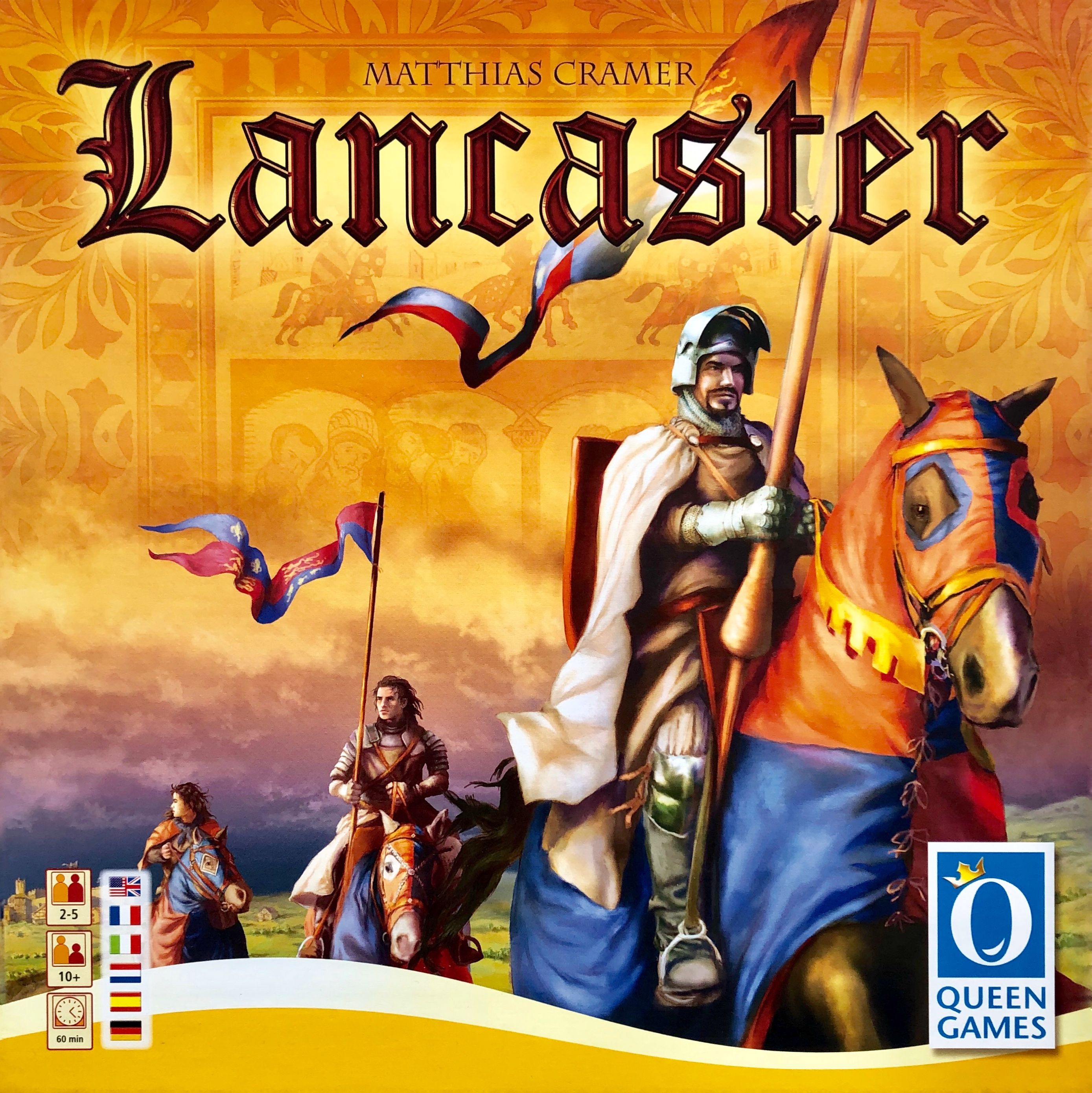
official art · Queen Games
the rules in 60 seconds▶ auto · 1/6
🧩
01
Setup
Place the main board, law board, and player boards; distribute starting resources and knights; stack castle parts and set up conflict and royal favor cards.
The rules, step by step
Setup
To set up Lancaster, place the main game board, the law board, and individual player boards on the table. Each player receives two knights (values 1 and 2), a vote marker, and a starting castle part, with remaining castle parts stacked nearby. Distribute starting coins and squires to each player, keeping them hidden behind their castle screen. Shuffle the royal favor cards and place them face down in their designated area. Prepare the conflict cards by shuffling them and placing them face down, revealing the top two. Arrange the law cards into a deck, placing the initial three laws face up on the law board. Place the score markers on the scoring track. Finally, determine the first player using the first player token.
Objective
The objective in Lancaster is to become the most influential noble in England by accumulating the most victory points over the course of the game. Players earn victory points through various actions such as controlling counties, winning conflicts against France, constructing parts of their castle, and influencing the passage of laws. Strategic planning and interaction with other players are crucial to maximize point gain and secure victory.
On your turn
On a player's turn, they must place one of their available knights onto an empty space in a county, a conflict zone, or their personal castle board. Knights have varying strengths (1-4), and players can secretly add squires from their reserve to increase a knight's strength by one per squire. If a player places a knight on a space already occupied by an opponent's knight, and their knight's total strength (knight + squires) is higher, the opponent's knight is displaced and returned to their reserve. After placing a knight, the player may claim a royal favor from the main board, choosing between options like gaining coins, squires, an emissary, or upgrading a knight. Placing knights on castle spaces allows players to build new castle parts, which provide ongoing benefits and end-game victory points.
Scoring
Victory points are awarded throughout the game and during final scoring. During the game, players earn points for controlling counties (based on knight strength), winning conflicts (based on knight strength and card values), and constructing castle parts. At the end of each round, players with knights in counties receive income and may build castle parts. After all five rounds are completed, final scoring occurs. Players receive points for their constructed castle parts, the number of different emissaries they have collected, and their remaining squires and coins. The player with the highest total victory points is declared the winner.
Game end
The game concludes after five full rounds of play. A round ends when all players have placed their knights or passed. The game also ends immediately if either the conflict card deck or the law card deck is depleted. Once the final round is completed, players proceed to the final scoring phase. During this phase, players tally their victory points from various sources: points accumulated on the scoring track, points from their constructed castle parts, points for the number of different emissaries collected, and points for any remaining coins and squires. The player with the highest total victory points wins the game.
Tips
To succeed in Lancaster, players should focus on a balanced strategy. It's crucial to manage your knights and squires effectively, as they are your primary resources for action. Don't underestimate the power of squires; they can turn the tide in contested locations. Pay close attention to the laws being voted on, as they can significantly impact gameplay and scoring. Controlling key counties provides consistent income, while winning conflicts offers substantial victory points. Building your castle provides long-term benefits, so plan your construction carefully. Observing opponents' moves and anticipating their actions is vital for strategic placement and avoiding being outmaneuvered.
🔬 game anatomy
Complexity3.0 / 5
BGG rating7.4 / 10
Language dependence
No in-game text needed
🌐 plays without English
Play time
60 min
Players
2–5
Recommended age
10+ yrs
BGG rank
#575
✨ from Trișache · verified
Frequently asked questions
Q1What is the goal of the game?
The objective in Lancaster is to become the most influential noble in England by accumulating the most victory points over the course of the game. Players earn victory points through various actions such as controlling counties, winning conflicts against France, constructing parts of their castle, and influencing the passage of laws. Strategic planning and interaction with other players are crucial to maximize point gain and secure victory.
Q2How do you set up the game?
To set up Lancaster, place the main game board, the law board, and individual player boards on the table. Each player receives two knights (values 1 and 2), a vote marker, and a starting castle part, with remaining castle parts stacked nearby. Distribute starting coins and squires to each player, keeping them hidden behind their castle screen. Shuffle the royal favor cards and place them face down in their designated area. Prepare the conflict cards by shuffling them and placing them face down, revealing the top two. Arrange the law cards into a deck, placing the initial three laws face up on the law board. Place the score markers on the scoring track. Finally, determine the first player using the first player token.
Q3How does a turn work?
On a player's turn, they must place one of their available knights onto an empty space in a county, a conflict zone, or their personal castle board. Knights have varying strengths (1-4), and players can secretly add squires from their reserve to increase a knight's strength by one per squire. If a player places a knight on a space already occupied by an opponent's knight, and their knight's total strength (knight + squires) is higher, the opponent's knight is displaced and returned to their reserve. After placing a knight, the player may claim a royal favor from the main board, choosing between options like gaining coins, squires, an emissary, or upgrading a knight. Placing knights on castle spaces allows players to build new castle parts, which provide ongoing benefits and end-game victory points.
Q4How is scoring calculated?
Victory points are awarded throughout the game and during final scoring. During the game, players earn points for controlling counties (based on knight strength), winning conflicts (based on knight strength and card values), and constructing castle parts. At the end of each round, players with knights in counties receive income and may build castle parts. After all five rounds are completed, final scoring occurs. Players receive points for their constructed castle parts, the number of different emissaries they have collected, and their remaining squires and coins. The player with the highest total victory points is declared the winner.
Q5When and how does the game end?
The game concludes after five full rounds of play. A round ends when all players have placed their knights or passed. The game also ends immediately if either the conflict card deck or the law card deck is depleted. Once the final round is completed, players proceed to the final scoring phase. During this phase, players tally their victory points from various sources: points accumulated on the scoring track, points from their constructed castle parts, points for the number of different emissaries collected, and points for any remaining coins and squires. The player with the highest total victory points wins the game.
Q6What tips are there for beginners?
To succeed in Lancaster, players should focus on a balanced strategy. It's crucial to manage your knights and squires effectively, as they are your primary resources for action. Don't underestimate the power of squires; they can turn the tide in contested locations. Pay close attention to the laws being voted on, as they can significantly impact gameplay and scoring. Controlling key counties provides consistent income, while winning conflicts offers substantial victory points. Building your castle provides long-term benefits, so plan your construction carefully. Observing opponents' moves and anticipating their actions is vital for strategic placement and avoiding being outmaneuvered.
Q7How much does Lancaster cost?
No store is currently tracking Lancaster. Check the Prices tab — you can set a price alert to be notified when it appears.
Q8Where can I buy Lancaster cheapest?
Check the Prices tab — howtoplay.ro aggregates offers from 7+ Romanian board-game stores and tracks price history.
Q9How do you play Lancaster?
Lancaster is a medieval game, for 2–5 players, taking ~60 minutes, featuring area majority / influence. Check the Rules tab for setup, gameplay, and scoring, or ask Trișache anything about Lancaster — our AI assistant built by howtoplay.ro and trained specifically on board game rulebooks.

%2Fpic4679004.jpg)
%2Fpic4679004.jpg)