The primary objective is to liberate the land by overthrowing the Atlantian Empire, Draconum, and Orcs. In most scenarios, including the solo conquest, players win by defeating a required number of cities (e.g., two cities: a level 5 and a level 8 city for the solo conquest). Successfully conquering these cities brings stability back to the land and signifies victory.
To find the best price for Mage Knight Board Game, howtoplay.ro compares deals from Romanian shops every day.
FromRON 419
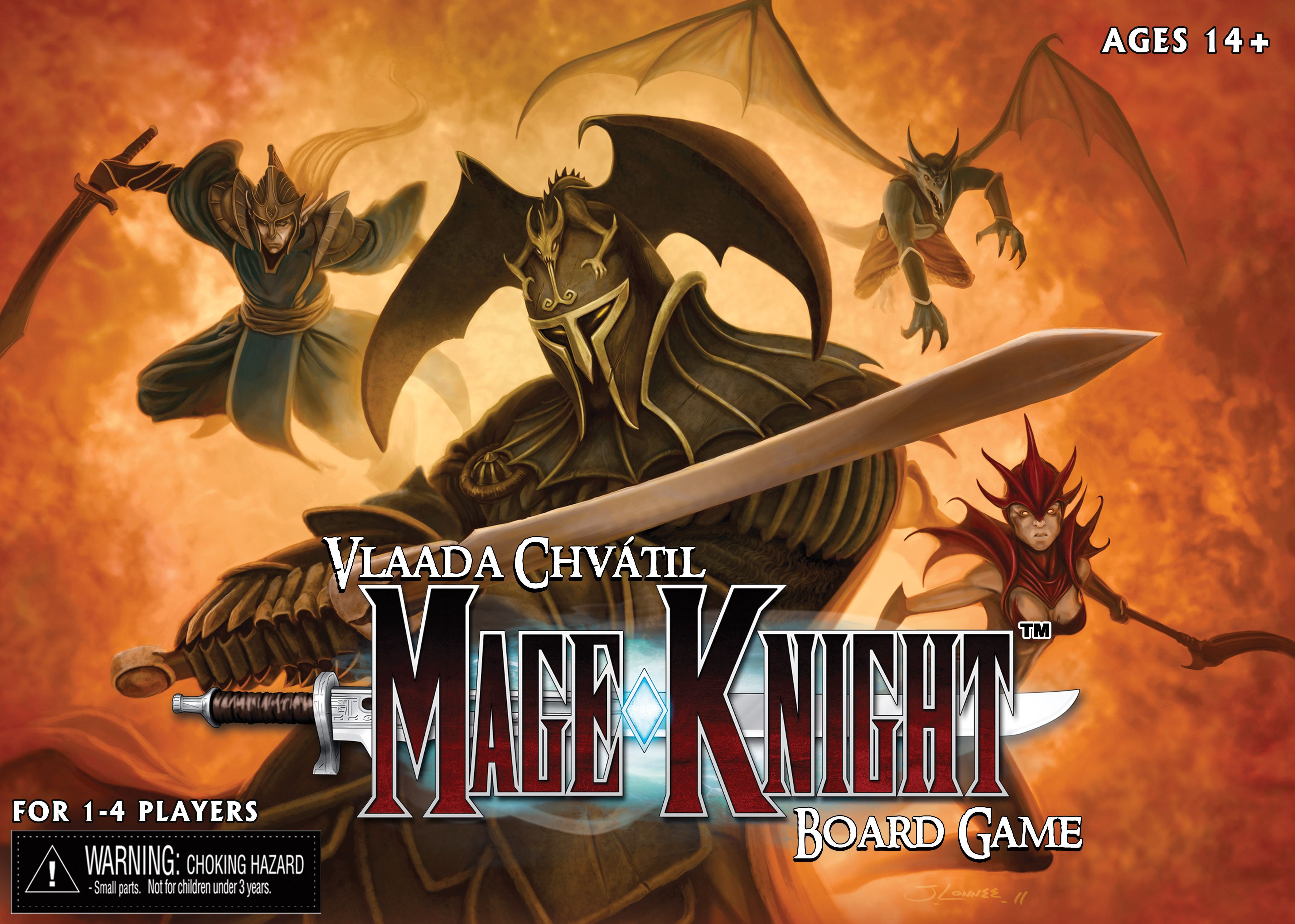
official art · WizKids (I)
the rules in 60 seconds▶ auto · 1/6
🧩
01
Setup
Place the fame and reputation board, day/night board, mana dice, tactics cards, enemy tokens, ruin tokens, advanced action cards, spell cards, wound cards, artifact cards, and unit cards. Assemble the tile deck and lay out the starting map tiles. Set up player areas with hero cards, level tokens, deed decks, shield tokens, hero miniatures, and skill description cards. For solo/cooperative games, set up a dummy player.
The rules, step by step
Setup
To set up Mage Knight, first place the fame and reputation board in the center of your designated table half, with the day/night board slightly below it, day side up. Take mana dice (two more than the number of players, e.g., three for a solo game) and roll them, ensuring at least half are basic colors (red, blue, green, white); re-roll black and gold dice if needed. Place any remaining black dice on the dark area of the day/night board. Separate tactics cards into day and night piles, placing night tactics next to the day/night board and spreading day tactics nearby. Separate and shuffle circular enemy tokens (green, gray, purple, brown, white, red) and hexagonal yellow ruin tokens, placing them above and to the right of the fame/reputation board, respectively. Sort Mage Knight cards into eight separate decks: four starting hero decks (identified by hero icons in the upper right corner), advanced action cards (gold border around text), spell cards (two text windows), wound cards (red blood drop), and artifact cards (gold accents in text corners). Place advanced action cards face down near the upper left of the fame/reputation board, drawing the top three for the advanced action offer. Place shuffled spell cards face down near the upper right, drawing the top three for the spell offer. Place wound cards next to the spell deck. Place shuffled unit cards (silver and gold backs) face down to the left of the advanced action offer, drawing two more than the number of players from the silver deck for the unit offer. Find site description cards and the scoring card, setting them aside. Assemble the tile deck by shuffling green-backed countryside tiles (seven for solo conquest) and brown-backed core tiles (two city, two non-city for solo conquest), then stacking the countryside tiles on top of the core tiles. Lay out the double-sided starting tile (side 'A' up) for the wedge map shape, ensuring space for expansion from non-coastline sides. Draw two tiles from the tile deck, positioning them next to the starting tile, matching star/circle shapes and number orientations. Resolve 'When Revealed' instructions for sites on the new tiles (e.g., place face-down violet enemy tokens on Mage Towers and Keeps, face-up green Orc enemy tokens on Marauding Orcs, and face-up yellow ruin tokens on Ancient Ruins during the day). Finally, set up each player's area with their chosen hero card, six octagonal level tokens (blank one in designated area, others stacked on hero card from highest to lowest level), shuffled starting deed deck, hero miniature, shield token (on 0 of fame and reputation tracks), and skill description card. For solo/cooperative games, randomly select a dummy player hero, taking only their hero card, round order token, and starting deed deck (shuffled and placed face down). Place one crystal of each color on the dummy player's hero card in the inventory area. Draw five cards from your deed deck to form your starting hand.
Objective
The primary objective is to liberate the land by overthrowing the Atlantian Empire, Draconum, and Orcs. In most scenarios, including the solo conquest, players win by defeating a required number of cities (e.g., two cities: a level 5 and a level 8 city for the solo conquest). Successfully conquering these cities brings stability back to the land and signifies victory.
On your turn
Each round consists of a series of turns, with six rounds (three day and three night) in the solo conquest scenario. During your turn, you have three options: take a regular turn, a resting turn, or forfeit. A regular turn has two optional parts: movement (where you can move your hero and/or explore new tiles) and action (such as exploring an adventure site, engaging in combat, or recruiting units). Movement must always precede action. A resting turn allows you to heal your hero but limits other actions. Forfeiting your turn ends it immediately without any further actions.
Scoring
At the end of the final round (or the turn after defeating the final city in some scenarios), players tally their fame using the scoring quick reference card. The player with the highest fame wins in competitive games. For solo conquest, your score is recorded to challenge your personal best in future games. Even if scenario objectives aren't fully met, you still record a score, though it will be lower.
Game end
A round concludes when one of two conditions is met: either a player has no more cards in their deed deck and no cards in their hand at the start of their turn, or a player announces the end of the round if they have no cards in their deed deck but still have cards in hand. For solo and cooperative games, the round also ends if the dummy player has no cards in their deed deck at the beginning of its turn. After the final round, scores are tallied to determine the winner based on fame.
Tips
To succeed in Mage Knight, prioritize leveling up your character quickly. Defeating enemies is a primary way to gain fame, which is essential for leveling up. Leveling up grants access to more powerful cards (advanced actions, spells, artifacts), increases your hero's armor and hand size, and allows you to recruit more units. Pay close attention to the specific setup and special rules outlined in the scenario description within the rulebook, as these can vary significantly between competitive, cooperative, and solo play. For solo players, focusing on the solo conquest scenario is an excellent way to become familiar with the game's complex mechanics without the pressure of a group. Understanding the interplay between day/night cycles, mana dice, and terrain movement costs is crucial for strategic planning.
🔬 game anatomy
Complexity4.4 / 5
BGG rating8.1 / 10
Vibe
Co-opStrategy
Language dependence
Extensive text — heavy translation needed
Play time
60–240 min
Players
1–4
Recommended age
14+ yrs
BGG rank
#39
✨ from Trișache · verified
Frequently asked questions
Q1What is the goal of the game?
The primary objective is to liberate the land by overthrowing the Atlantian Empire, Draconum, and Orcs. In most scenarios, including the solo conquest, players win by defeating a required number of cities (e.g., two cities: a level 5 and a level 8 city for the solo conquest). Successfully conquering these cities brings stability back to the land and signifies victory.
Q2How do you set up the game?
To set up Mage Knight, first place the fame and reputation board in the center of your designated table half, with the day/night board slightly below it, day side up. Take mana dice (two more than the number of players, e.g., three for a solo game) and roll them, ensuring at least half are basic colors (red, blue, green, white); re-roll black and gold dice if needed. Place any remaining black dice on the dark area of the day/night board. Separate tactics cards into day and night piles, placing night tactics next to the day/night board and spreading day tactics nearby. Separate and shuffle circular enemy tokens (green, gray, purple, brown, white, red) and hexagonal yellow ruin tokens, placing them above and to the right of the fame/reputation board, respectively. Sort Mage Knight cards into eight separate decks: four starting hero decks (identified by hero icons in the upper right corner), advanced action cards (gold border around text), spell cards (two text windows), wound cards (red blood drop), and artifact cards (gold accents in text corners). Place advanced action cards face down near the upper left of the fame/reputation board, drawing the top three for the advanced action offer. Place shuffled spell cards face down near the upper right, drawing the top three for the spell offer. Place wound cards next to the spell deck. Place shuffled unit cards (silver and gold backs) face down to the left of the advanced action offer, drawing two more than the number of players from the silver deck for the unit offer. Find site description cards and the scoring card, setting them aside. Assemble the tile deck by shuffling green-backed countryside tiles (seven for solo conquest) and brown-backed core tiles (two city, two non-city for solo conquest), then stacking the countryside tiles on top of the core tiles. Lay out the double-sided starting tile (side 'A' up) for the wedge map shape, ensuring space for expansion from non-coastline sides. Draw two tiles from the tile deck, positioning them next to the starting tile, matching star/circle shapes and number orientations. Resolve 'When Revealed' instructions for sites on the new tiles (e.g., place face-down violet enemy tokens on Mage Towers and Keeps, face-up green Orc enemy tokens on Marauding Orcs, and face-up yellow ruin tokens on Ancient Ruins during the day). Finally, set up each player's area with their chosen hero card, six octagonal level tokens (blank one in designated area, others stacked on hero card from highest to lowest level), shuffled starting deed deck, hero miniature, shield token (on 0 of fame and reputation tracks), and skill description card. For solo/cooperative games, randomly select a dummy player hero, taking only their hero card, round order token, and starting deed deck (shuffled and placed face down). Place one crystal of each color on the dummy player's hero card in the inventory area. Draw five cards from your deed deck to form your starting hand.
Q3How does a turn work?
Each round consists of a series of turns, with six rounds (three day and three night) in the solo conquest scenario. During your turn, you have three options: take a regular turn, a resting turn, or forfeit. A regular turn has two optional parts: movement (where you can move your hero and/or explore new tiles) and action (such as exploring an adventure site, engaging in combat, or recruiting units). Movement must always precede action. A resting turn allows you to heal your hero but limits other actions. Forfeiting your turn ends it immediately without any further actions.
Q4How is scoring calculated?
At the end of the final round (or the turn after defeating the final city in some scenarios), players tally their fame using the scoring quick reference card. The player with the highest fame wins in competitive games. For solo conquest, your score is recorded to challenge your personal best in future games. Even if scenario objectives aren't fully met, you still record a score, though it will be lower.
Q5When and how does the game end?
A round concludes when one of two conditions is met: either a player has no more cards in their deed deck and no cards in their hand at the start of their turn, or a player announces the end of the round if they have no cards in their deed deck but still have cards in hand. For solo and cooperative games, the round also ends if the dummy player has no cards in their deed deck at the beginning of its turn. After the final round, scores are tallied to determine the winner based on fame.
Q6What tips are there for beginners?
To succeed in Mage Knight, prioritize leveling up your character quickly. Defeating enemies is a primary way to gain fame, which is essential for leveling up. Leveling up grants access to more powerful cards (advanced actions, spells, artifacts), increases your hero's armor and hand size, and allows you to recruit more units. Pay close attention to the specific setup and special rules outlined in the scenario description within the rulebook, as these can vary significantly between competitive, cooperative, and solo play. For solo players, focusing on the solo conquest scenario is an excellent way to become familiar with the game's complex mechanics without the pressure of a group. Understanding the interplay between day/night cycles, mana dice, and terrain movement costs is crucial for strategic planning.
Q7How much does Mage Knight Board Game cost?
Mage Knight Board Game costs around 419 RON in Romania.
Q8Where can I buy Mage Knight Board Game cheapest?
The lowest price for Mage Knight Board Game right now is 419 RON at Pionul.ro. The Prices tab lists every store currently tracking it.
Q9How do you play Mage Knight Board Game?
Mage Knight Board Game is a adventure game, for 1–4 players, taking ~60–240 minutes, featuring card play conflict resolution. Check the Rules tab for setup, gameplay, and scoring, or ask Trișache anything about Mage Knight Board Game — our AI assistant built by howtoplay.ro and trained specifically on board game rulebooks.
Q10How many players does Mage Knight Board Game support?
%2Fpic1083380.jpg)
%2Fpic1083380.jpg)