The objective of Marrakesh is to become the wealthiest player by the end of the game. Players achieve this by strategically deploying their assistants to various districts, collecting valuable resources, activating powerful location abilities, and earning victory points through clever combinations and bonuses. Over three seasons, each comprising four rounds, players must manage their resources, fulfill demands, and make timely decisions to maximize their influence and prosperity in the city.
To find the best price for Marrakesh, howtoplay.ro compares deals from Romanian shops every day.
FromRON 343
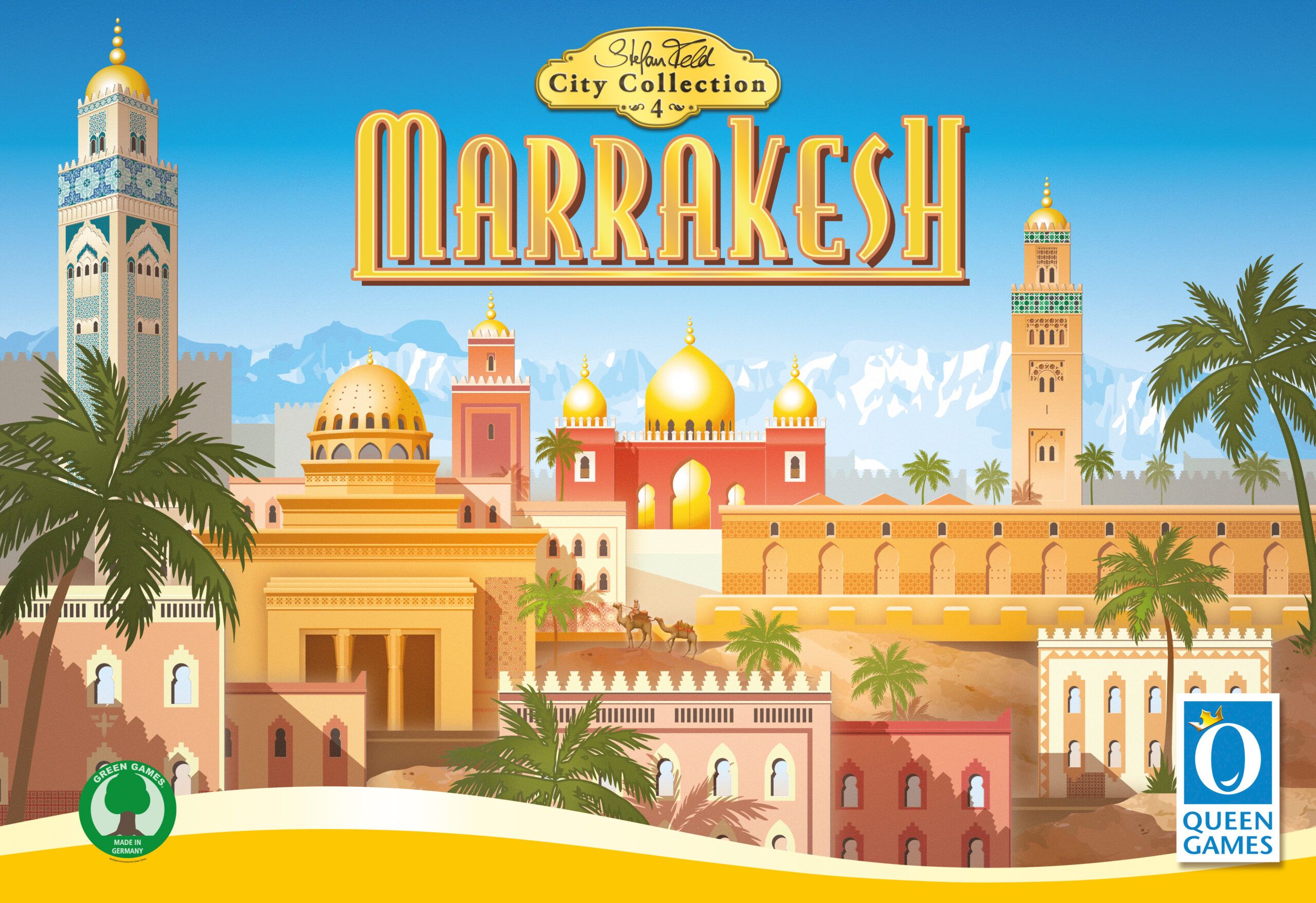
official art · Queen Games
the rules in 60 seconds▶ auto · 1/6
🧩
01
Setup
Place the game board, tower, and various game components, then each player sets up their personal board, takes starting resources, and places their pawns.
The rules, step by step
Setup
Place the main game board in the center, assemble and place the tower within reach. Sort parchment scrolls by their back, shuffle, and reveal three of each type. Randomly select three exchange office tiles, stack them face-up (light green side). Shuffle luxury goods, form a face-down stack, and reveal the top five. Sort river tiles by season, take one of each, place season 1 tile at the end of the river, and the others aside. Randomly place city gates near workshops. Place water, dates, dinars, and cash cubes (wooden) as general supply. Each player chooses a color, places their scoring marker on space 10, and their apprentice Imam and Sultan's courtier on the starting spaces of the mosque and palace tracks. Each player takes a player board, privacy screen, and supply board, placing them in front of them. Take a public disk, place it pink side up on the grand square. Mark starting spaces on tracks by taking corresponding cash cubes (cardboard) and placing them on space 0. Each player takes 1 water, 1 dinar, 1 date, and 12 wooden cash cubes (one of each color). Shuffle oasis tiles, each player takes six face-down to place on their Sahara fields; remaining oases are returned to the box. Place eight different cardboard cash cubes (all colors except yellow, purple, orange, and brown) into the bag. Each player draws two random cash cubes from the bag and places them on designated fields on their supply board. Shuffle provision tiles face-down, deal three to each player. Players choose one to play face-up for season 1. Each player places their fisher pawn at the start of the river and their three assistants next to their supply board. Finally, choose a starting player and give them the season marker and round marker.
Objective
The objective of Marrakesh is to become the wealthiest player by the end of the game. Players achieve this by strategically deploying their assistants to various districts, collecting valuable resources, activating powerful location abilities, and earning victory points through clever combinations and bonuses. Over three seasons, each comprising four rounds, players must manage their resources, fulfill demands, and make timely decisions to maximize their influence and prosperity in the city.
On your turn
A round begins with all players simultaneously selecting three cash cubes from behind their screen. Once selected, players place their assistants in districts corresponding to the colors of their chosen cash cubes. If a red cash cube is chosen, the player can place their assistant in any district. After all assistants are placed, one player collects all chosen cash cubes and drops them into the tower. The cash cubes that fall out are sorted by color and distributed among players in player order, starting with the first player. Each player chooses one or two cash cubes of the same color. This continues until no cash cubes remain. For each cash cube received, players advance their corresponding cash cube marker one step on their personal board. Green cash cubes provide immediate victory points. Other colored cash cubes are placed in their respective districts on the main board, potentially granting immediate placement bonuses. Brown cash cubes are placed from bottom to top on the camel track, revealing adjacent oasis tiles. Red water sellers are placed in any district without one. After cash cube distribution, players activate their three assistants one by one, starting with the first player and proceeding clockwise. Each assistant offers two options: either take a cash cube of the district's color (gaining immediate bonuses similar to distribution) or activate the district's special action. After activating an assistant, the next player takes their turn. Once all players have activated their three assistants, the round ends, and a river bonus is awarded.
Scoring
Players earn points in several ways. Immediate points are gained when advancing on the green cash cube track. Direct placement bonuses are awarded when placing certain colored cash cubes in districts. At the end of each round, players receive a river bonus based on their fisher's position. At the end of each season, players pay resources for their provision tiles; failure to pay results in losing all resources and points from those tiles. Players also choose one face-up provision tile to keep. Points are also gained from activated exchange offices. During the final scoring at the end of the third season, players receive 10 points for each fully completed district. They can also choose up to three activated oasis tiles to score points from. Finally, players divide their remaining resources by two to add to their total score.
Game end
The game concludes after the third season, which consists of four rounds. Once the fourth round of the third season is completed, the final scoring phase begins. During this phase, players tally their total victory points from various sources: completed districts, activated oasis tiles, and remaining resources. The player with the highest total victory points is declared the winner. In case of a tie, the player with the most remaining dinars wins. If there's still a tie, the tied players share the victory.
Tips
Strategic planning is crucial in Marrakesh. Consider whether to strengthen a district by adding more cash cubes, making its actions more potent for future turns, or to activate its current actions for immediate benefits. Balancing these choices is key to success. Also, pay attention to the parchment scrolls in the Madrasa, as they offer valuable bonuses. Decide if you want to invest in them early or focus on other areas. Similarly, managing your fisher's position on the river can secure important round and season bonuses. Don't forget to utilize the unique abilities of each district, such as the Souk for exchanging resources or luxury goods, and the Medina for acquiring city gates and extra cash cubes. The game also includes four modules that add more variety and depth, ensuring replayability and new strategic challenges.
🔬 game anatomy
Complexity3.5 / 5
BGG rating8.1 / 10
Vibe
Strategy
Language dependence
No in-game text needed
🌐 plays without English
Play time
120 min
Players
2–4
Recommended age
14+ yrs
BGG rank
#338
✨ from Trișache · verified
Frequently asked questions
Q1What is the goal of the game?
The objective of Marrakesh is to become the wealthiest player by the end of the game. Players achieve this by strategically deploying their assistants to various districts, collecting valuable resources, activating powerful location abilities, and earning victory points through clever combinations and bonuses. Over three seasons, each comprising four rounds, players must manage their resources, fulfill demands, and make timely decisions to maximize their influence and prosperity in the city.
Q2How do you set up the game?
Place the main game board in the center, assemble and place the tower within reach. Sort parchment scrolls by their back, shuffle, and reveal three of each type. Randomly select three exchange office tiles, stack them face-up (light green side). Shuffle luxury goods, form a face-down stack, and reveal the top five. Sort river tiles by season, take one of each, place season 1 tile at the end of the river, and the others aside. Randomly place city gates near workshops. Place water, dates, dinars, and cash cubes (wooden) as general supply. Each player chooses a color, places their scoring marker on space 10, and their apprentice Imam and Sultan's courtier on the starting spaces of the mosque and palace tracks. Each player takes a player board, privacy screen, and supply board, placing them in front of them. Take a public disk, place it pink side up on the grand square. Mark starting spaces on tracks by taking corresponding cash cubes (cardboard) and placing them on space 0. Each player takes 1 water, 1 dinar, 1 date, and 12 wooden cash cubes (one of each color). Shuffle oasis tiles, each player takes six face-down to place on their Sahara fields; remaining oases are returned to the box. Place eight different cardboard cash cubes (all colors except yellow, purple, orange, and brown) into the bag. Each player draws two random cash cubes from the bag and places them on designated fields on their supply board. Shuffle provision tiles face-down, deal three to each player. Players choose one to play face-up for season 1. Each player places their fisher pawn at the start of the river and their three assistants next to their supply board. Finally, choose a starting player and give them the season marker and round marker.
Q3How does a turn work?
A round begins with all players simultaneously selecting three cash cubes from behind their screen. Once selected, players place their assistants in districts corresponding to the colors of their chosen cash cubes. If a red cash cube is chosen, the player can place their assistant in any district. After all assistants are placed, one player collects all chosen cash cubes and drops them into the tower. The cash cubes that fall out are sorted by color and distributed among players in player order, starting with the first player. Each player chooses one or two cash cubes of the same color. This continues until no cash cubes remain. For each cash cube received, players advance their corresponding cash cube marker one step on their personal board. Green cash cubes provide immediate victory points. Other colored cash cubes are placed in their respective districts on the main board, potentially granting immediate placement bonuses. Brown cash cubes are placed from bottom to top on the camel track, revealing adjacent oasis tiles. Red water sellers are placed in any district without one. After cash cube distribution, players activate their three assistants one by one, starting with the first player and proceeding clockwise. Each assistant offers two options: either take a cash cube of the district's color (gaining immediate bonuses similar to distribution) or activate the district's special action. After activating an assistant, the next player takes their turn. Once all players have activated their three assistants, the round ends, and a river bonus is awarded.
Q4How is scoring calculated?
Players earn points in several ways. Immediate points are gained when advancing on the green cash cube track. Direct placement bonuses are awarded when placing certain colored cash cubes in districts. At the end of each round, players receive a river bonus based on their fisher's position. At the end of each season, players pay resources for their provision tiles; failure to pay results in losing all resources and points from those tiles. Players also choose one face-up provision tile to keep. Points are also gained from activated exchange offices. During the final scoring at the end of the third season, players receive 10 points for each fully completed district. They can also choose up to three activated oasis tiles to score points from. Finally, players divide their remaining resources by two to add to their total score.
Q5When and how does the game end?
The game concludes after the third season, which consists of four rounds. Once the fourth round of the third season is completed, the final scoring phase begins. During this phase, players tally their total victory points from various sources: completed districts, activated oasis tiles, and remaining resources. The player with the highest total victory points is declared the winner. In case of a tie, the player with the most remaining dinars wins. If there's still a tie, the tied players share the victory.
Q6What tips are there for beginners?
Strategic planning is crucial in Marrakesh. Consider whether to strengthen a district by adding more cash cubes, making its actions more potent for future turns, or to activate its current actions for immediate benefits. Balancing these choices is key to success. Also, pay attention to the parchment scrolls in the Madrasa, as they offer valuable bonuses. Decide if you want to invest in them early or focus on other areas. Similarly, managing your fisher's position on the river can secure important round and season bonuses. Don't forget to utilize the unique abilities of each district, such as the Souk for exchanging resources or luxury goods, and the Medina for acquiring city gates and extra cash cubes. The game also includes four modules that add more variety and depth, ensuring replayability and new strategic challenges.
Q7How much does Marrakesh cost?
Marrakesh costs around 343 RON in Romania.
Q8Where can I buy Marrakesh cheapest?
The lowest price for Marrakesh right now is 343 RON at Red Goblin. The Prices tab lists every store currently tracking it.
Q9How do you play Marrakesh?
Marrakesh is a city building game, for 2–4 players, taking ~120 minutes, featuring cube tower. Check the Rules tab for setup, gameplay, and scoring, or ask Trișache anything about Marrakesh — our AI assistant built by howtoplay.ro and trained specifically on board game rulebooks.
Q10How many players does Marrakesh support?
Marrakesh is played by 2–4 players.
💰 2 shops
All prices
2 shops · sorted by priceupdated today
Red GoblinCHEAPESTGerman "Essential" editioneasybox

%2Fpic7144309.jpg)
%2Fpic7144309.jpg)