The primary objective in Memoir '44 is to be the first player to earn a specific number of Victory Medals, which varies depending on the chosen scenario. Medals are typically awarded for eliminating enemy units, with each eliminated unit's last figure counting as one medal. Some scenarios may also offer additional ways to earn medals, such as capturing and holding specific objective hexes (e.g., towns or villages), as detailed in the scenario's 'Conditions of Victory' section. Players can also opt to play scenarios back-to-back, switching sides, and combine their medal counts to determine an overall winner, which helps balance out potential imbalances in specific scenarios.
To find the best price for Memoir '44, howtoplay.ro compares deals from Romanian shops every day.
FromRON 299
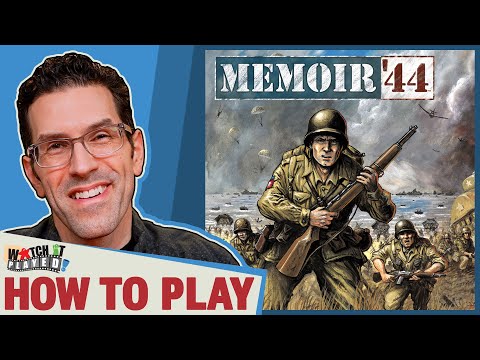
▶ Watch It Played · Memoir '44 - How To Play
Memoir '44 - How To Play
Watch It Played· 24 min· published Jun 19, 2019Community
the rules in 60 seconds▶ auto · 1/6
🧩
01
Setup
Choose a scenario, set up the game board with terrain and obstacles, place units, deal command cards, and assign sides.
To set up Memoir '44, first select one of the 16 included scenarios from the rulebook. Each scenario dictates the specific layout of the double-sided game board, including which side to use (beach or countryside). Place terrain tiles (forests, towns, villages, hills, rivers, etc.) and fixed obstacles (bunkers, hedgehogs, barbed wire, sandbags) onto the board as indicated by the scenario diagram. Next, position the miniature units (infantry, armor, artillery) for both the Axis and Allied forces according to the scenario's setup. Each player receives four battle dice and a card holder. The command deck is shuffled and placed face-down between players. Deal command cards to each player as specified by the scenario (typically 4 for Axis, 5 for Allies), which are kept secret in their card holders. The scenario also designates which player takes the first turn.
Objective
The primary objective in Memoir '44 is to be the first player to earn a specific number of Victory Medals, which varies depending on the chosen scenario. Medals are typically awarded for eliminating enemy units, with each eliminated unit's last figure counting as one medal. Some scenarios may also offer additional ways to earn medals, such as capturing and holding specific objective hexes (e.g., towns or villages), as detailed in the scenario's 'Conditions of Victory' section. Players can also opt to play scenarios back-to-back, switching sides, and combine their medal counts to determine an overall winner, which helps balance out potential imbalances in specific scenarios.
On your turn
A player's turn consists of five steps: 1) Play a Command Card: Select and play one card from your hand, announcing its type (Section or Tactics). Section cards activate units in specific battlefield sections (left, center, right, or combinations), while Tactics cards provide special actions or effects. 2) Order Units: Declare which specific units within the activated section(s) will receive orders for the turn, up to the number specified on the card. 3) Move Units: Move the ordered units one by one. Infantry can move 1 or 2 hexes (but cannot battle if moving 2), armored units move up to 3 hexes, and artillery moves 1 hex (cannot battle if moving). Movement is affected by terrain and obstacles (e.g., forests and towns stop movement, hedgehogs block armor/artillery). Units cannot move through occupied hexes. 4) Battle: Each ordered unit that did not forfeit its battle ability can attack an enemy unit within its range and line of sight. The number of battle dice rolled depends on the unit type and distance to the target, with terrain and obstacles potentially reducing dice. Hits are scored based on matching unit symbols or grenades on the dice. For each hit, an enemy figure is removed. Retreats (flags on dice) force the target unit to move back. 5) Draw a Command Card: Discard the played card and draw a new one from the command deck. If the deck runs out, reshuffle the discard pile to form a new deck. The turn then passes to the next player.
Scoring
Victory Medals are the primary scoring mechanism. A player earns one Victory Medal for each enemy unit completely eliminated (i.e., when the last figure of a unit is removed from the board). These figures are placed on the player's personal medal track. Additionally, certain scenarios may designate specific hexes (like towns or villages) as objectives. If a player's unit occupies such an objective hex and places an Objective Medal on it, that medal counts towards their victory total as long as their unit remains on that hex. If the unit moves off or is eliminated, the medal no longer counts. The first player to accumulate the number of Victory Medals specified by the scenario wins the game.
Game end
The game concludes immediately when one player successfully achieves the Victory Conditions outlined in the chosen scenario. This typically involves collecting a predetermined number of Victory Medals, either through eliminating enemy units or securing scenario-specific objectives. Once a player reaches this threshold, they are declared the winner, and the game ends.
Tips
Familiarize yourself with the scenario's specific rules, terrain effects, and victory conditions before playing. Use the provided summary cards as a quick reference for unit movement, combat dice, and terrain effects. Strategic use of command cards is crucial; decide whether to activate units for movement, battle, or special actions based on the current battlefield situation. Pay attention to line of sight and terrain protections, as these can significantly impact combat outcomes. Consider the balance between aggressive attacks to eliminate enemy units and defensive positioning to protect your own objectives and units. In two-player games, playing the same scenario twice, switching sides, and combining scores can offer a more balanced and comprehensive experience.
🔬 game anatomy
Complexity2.3 / 5
BGG rating7.5 / 10
Vibe
CouplesStrategy
Language dependence
Moderate text — a crib sheet helps
Play time
30–45 min
Players
2–4
Recommended age
8+ yrs
BGG rank
#226
✨ from Trișache · verified
Frequently asked questions
Q1What is the goal of the game?
The primary objective in Memoir '44 is to be the first player to earn a specific number of Victory Medals, which varies depending on the chosen scenario. Medals are typically awarded for eliminating enemy units, with each eliminated unit's last figure counting as one medal. Some scenarios may also offer additional ways to earn medals, such as capturing and holding specific objective hexes (e.g., towns or villages), as detailed in the scenario's 'Conditions of Victory' section. Players can also opt to play scenarios back-to-back, switching sides, and combine their medal counts to determine an overall winner, which helps balance out potential imbalances in specific scenarios.
Q2How do you set up the game?
To set up Memoir '44, first select one of the 16 included scenarios from the rulebook. Each scenario dictates the specific layout of the double-sided game board, including which side to use (beach or countryside). Place terrain tiles (forests, towns, villages, hills, rivers, etc.) and fixed obstacles (bunkers, hedgehogs, barbed wire, sandbags) onto the board as indicated by the scenario diagram. Next, position the miniature units (infantry, armor, artillery) for both the Axis and Allied forces according to the scenario's setup. Each player receives four battle dice and a card holder. The command deck is shuffled and placed face-down between players. Deal command cards to each player as specified by the scenario (typically 4 for Axis, 5 for Allies), which are kept secret in their card holders. The scenario also designates which player takes the first turn.
Q3How does a turn work?
A player's turn consists of five steps: 1) Play a Command Card: Select and play one card from your hand, announcing its type (Section or Tactics). Section cards activate units in specific battlefield sections (left, center, right, or combinations), while Tactics cards provide special actions or effects. 2) Order Units: Declare which specific units within the activated section(s) will receive orders for the turn, up to the number specified on the card. 3) Move Units: Move the ordered units one by one. Infantry can move 1 or 2 hexes (but cannot battle if moving 2), armored units move up to 3 hexes, and artillery moves 1 hex (cannot battle if moving). Movement is affected by terrain and obstacles (e.g., forests and towns stop movement, hedgehogs block armor/artillery). Units cannot move through occupied hexes. 4) Battle: Each ordered unit that did not forfeit its battle ability can attack an enemy unit within its range and line of sight. The number of battle dice rolled depends on the unit type and distance to the target, with terrain and obstacles potentially reducing dice. Hits are scored based on matching unit symbols or grenades on the dice. For each hit, an enemy figure is removed. Retreats (flags on dice) force the target unit to move back. 5) Draw a Command Card: Discard the played card and draw a new one from the command deck. If the deck runs out, reshuffle the discard pile to form a new deck. The turn then passes to the next player.
Q4How is scoring calculated?
Victory Medals are the primary scoring mechanism. A player earns one Victory Medal for each enemy unit completely eliminated (i.e., when the last figure of a unit is removed from the board). These figures are placed on the player's personal medal track. Additionally, certain scenarios may designate specific hexes (like towns or villages) as objectives. If a player's unit occupies such an objective hex and places an Objective Medal on it, that medal counts towards their victory total as long as their unit remains on that hex. If the unit moves off or is eliminated, the medal no longer counts. The first player to accumulate the number of Victory Medals specified by the scenario wins the game.
Q5When and how does the game end?
The game concludes immediately when one player successfully achieves the Victory Conditions outlined in the chosen scenario. This typically involves collecting a predetermined number of Victory Medals, either through eliminating enemy units or securing scenario-specific objectives. Once a player reaches this threshold, they are declared the winner, and the game ends.
Q6What tips are there for beginners?
Familiarize yourself with the scenario's specific rules, terrain effects, and victory conditions before playing. Use the provided summary cards as a quick reference for unit movement, combat dice, and terrain effects. Strategic use of command cards is crucial; decide whether to activate units for movement, battle, or special actions based on the current battlefield situation. Pay attention to line of sight and terrain protections, as these can significantly impact combat outcomes. Consider the balance between aggressive attacks to eliminate enemy units and defensive positioning to protect your own objectives and units. In two-player games, playing the same scenario twice, switching sides, and combining scores can offer a more balanced and comprehensive experience.
Q7How much does Memoir '44 cost?
Memoir '44 costs around 299 RON in Romania.
Q8Where can I buy Memoir '44 cheapest?
The lowest price for Memoir '44 right now is 299 RON at Regatul Jocurilor. The Prices tab lists every store currently tracking it.
Q9How do you play Memoir '44?
Memoir '44 is a miniatures game, for 2–4 players, taking ~30–45 minutes, featuring area majority / influence. Check the Rules tab for setup, gameplay, and scoring, or ask Trișache anything about Memoir '44 — our AI assistant built by howtoplay.ro and trained specifically on board game rulebooks.
Q10How many players does Memoir '44 support?
Memoir '44 is played by 2–4 players.
💰 2 shops
All prices
2 shops · sorted by priceupdated today
Regatul JocurilorCHEAPESTENeasyboxCultural voucher

%2Fpic9000036.png)