The objective of Navegador is to accumulate the most victory points by the end of the game. Victory points are primarily gained through a final calculation of privileges, which are earned by possessing colonies, factories, explorers, shipyards, and churches. Players also earn victory points for workers in Lisbon, ships on the game board, and accumulated Cruzados.
To find the best price for Navegador, howtoplay.ro compares deals from Romanian shops every day.
FromRON 219
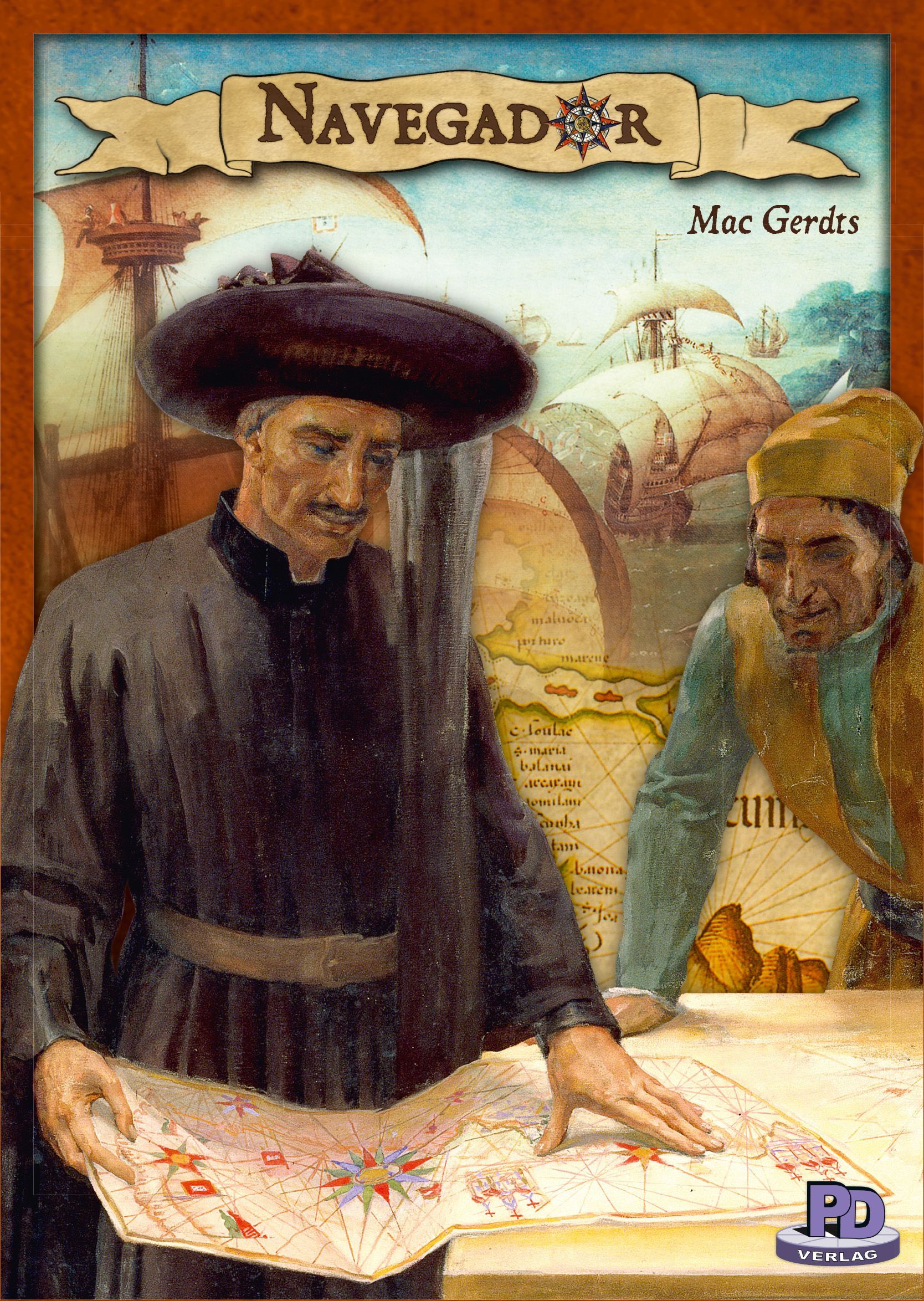
official art · PD-Verlag
the rules in 60 seconds▶ auto · 1/6
🧩
01
Setup
Place the main board, market, and privilege markers; each player gets two ships, an explorer, 200 Cruzados, a King's Privilege, five additional ships, and a personal board with a factory, shipyard, and church.
The rules, step by step
Setup
The main game board is placed, along with the market indicating starting resource prices (sugar, gold, spices) and privilege markers for each arch of the gallery. Each player receives two ships of their color, an explorer pawn, 200 Cruzados, a King's Privilege card, five additional ships, and a personal board equipped with an orange factory, a brown shipyard, and a gray church. Regions on the main board receive hidden stacks of colony tokens, shuffled according to the indicated number. Buildings (sugar, gold, spice factories, shipyards, and churches) are placed on the lower right corner of the board, arranged in rows from left to right. Each maritime region, except Portugal, receives a wooden turquoise exploration token.
Objective
The objective of Navegador is to accumulate the most victory points by the end of the game. Victory points are primarily gained through a final calculation of privileges, which are earned by possessing colonies, factories, explorers, shipyards, and churches. Players also earn victory points for workers in Lisbon, ships on the game board, and accumulated Cruzados.
On your turn
The game proceeds in turns, with players moving their pawn clockwise on the action wheel to choose an action. The first three spaces moved are free, but each additional space costs one personal ship, which is returned to the player's reserve. Actions include: recruiting workers (costing 50 Cruzados per church owned, or 100/200/300 Cruzados per phase for additional workers without churches, sold instantly for 100 Cruzados each), building ships (costing 50 Cruzados per shipyard owned, or 100/200/300 Cruzados per phase for additional ships without shipyards, sold instantly for 100 Cruzados each), founding colonies (by paying the indicated price on colony tokens, requiring at least one ship in the region and two workers in Lisbon), trading goods (selling commodities from colonies or transforming goods in factories), and taking a privilege (by sacrificing a worker from Lisbon to claim an available privilege marker).
Scoring
At the end of the game, each player counts their victory points. Players receive one victory point per worker in Lisbon, one point per ship on the game board, and one point for every 200 Cruzados they possess. Additionally, each player's personal board is evaluated by summing the values in the five columns (colonies, factories, explorers, shipyards, and churches). The printed numbers on the board are also counted and multiplied by the corresponding number of achievements. The player with the highest total victory points wins. In case of a tie, the player holding the Navegador card wins; if still tied, the player who would have received the card next wins.
Game end
The game can end in two ways: either the Nagasaki maritime region is discovered, or the last building token is taken from the main board. Once either of these conditions is met, each player, including the one who triggered the end, takes one final turn. After all players have completed their last turn, the final scoring phase begins to determine the winner.
Tips
During the early to mid-game, prioritize acquiring privileges as they significantly contribute to end-game scoring. Avoid directly competing with opponents who are already heavily invested in a particular strategy; instead, look for underrepresented strategies or counter their moves. For instance, if an opponent is focusing on sugar colonies, consider building spice factories. When founding colonies, always aim for the cheapest available colony tokens, as their value is primarily in their type, not their initial cost. Be mindful of your finances; buying too many ships early can leave you too poor to establish colonies. If you have the Navegador card at the start, consider recruiting workers in your first turn, then using the card in your second turn to navigate and found a colony. Remember that the market action allows you to sell or transform only a portion of your available units, enabling strategic manipulation of market prices for your benefit or to hinder opponents.
🔬 game anatomy
Complexity3.1 / 5
BGG rating7.5 / 10
Vibe
Strategy
Language dependence
No in-game text needed
🌐 plays without English
Play time
60–90 min
Players
2–5
Recommended age
12+ yrs
BGG rank
#379
✨ from Trișache · verified
Frequently asked questions
Q1What is the goal of the game?
The objective of Navegador is to accumulate the most victory points by the end of the game. Victory points are primarily gained through a final calculation of privileges, which are earned by possessing colonies, factories, explorers, shipyards, and churches. Players also earn victory points for workers in Lisbon, ships on the game board, and accumulated Cruzados.
Q2How do you set up the game?
The main game board is placed, along with the market indicating starting resource prices (sugar, gold, spices) and privilege markers for each arch of the gallery. Each player receives two ships of their color, an explorer pawn, 200 Cruzados, a King's Privilege card, five additional ships, and a personal board equipped with an orange factory, a brown shipyard, and a gray church. Regions on the main board receive hidden stacks of colony tokens, shuffled according to the indicated number. Buildings (sugar, gold, spice factories, shipyards, and churches) are placed on the lower right corner of the board, arranged in rows from left to right. Each maritime region, except Portugal, receives a wooden turquoise exploration token.
Q3How does a turn work?
The game proceeds in turns, with players moving their pawn clockwise on the action wheel to choose an action. The first three spaces moved are free, but each additional space costs one personal ship, which is returned to the player's reserve. Actions include: recruiting workers (costing 50 Cruzados per church owned, or 100/200/300 Cruzados per phase for additional workers without churches, sold instantly for 100 Cruzados each), building ships (costing 50 Cruzados per shipyard owned, or 100/200/300 Cruzados per phase for additional ships without shipyards, sold instantly for 100 Cruzados each), founding colonies (by paying the indicated price on colony tokens, requiring at least one ship in the region and two workers in Lisbon), trading goods (selling commodities from colonies or transforming goods in factories), and taking a privilege (by sacrificing a worker from Lisbon to claim an available privilege marker).
Q4How is scoring calculated?
At the end of the game, each player counts their victory points. Players receive one victory point per worker in Lisbon, one point per ship on the game board, and one point for every 200 Cruzados they possess. Additionally, each player's personal board is evaluated by summing the values in the five columns (colonies, factories, explorers, shipyards, and churches). The printed numbers on the board are also counted and multiplied by the corresponding number of achievements. The player with the highest total victory points wins. In case of a tie, the player holding the Navegador card wins; if still tied, the player who would have received the card next wins.
Q5When and how does the game end?
The game can end in two ways: either the Nagasaki maritime region is discovered, or the last building token is taken from the main board. Once either of these conditions is met, each player, including the one who triggered the end, takes one final turn. After all players have completed their last turn, the final scoring phase begins to determine the winner.
Q6What tips are there for beginners?
During the early to mid-game, prioritize acquiring privileges as they significantly contribute to end-game scoring. Avoid directly competing with opponents who are already heavily invested in a particular strategy; instead, look for underrepresented strategies or counter their moves. For instance, if an opponent is focusing on sugar colonies, consider building spice factories. When founding colonies, always aim for the cheapest available colony tokens, as their value is primarily in their type, not their initial cost. Be mindful of your finances; buying too many ships early can leave you too poor to establish colonies. If you have the Navegador card at the start, consider recruiting workers in your first turn, then using the card in your second turn to navigate and found a colony. Remember that the market action allows you to sell or transform only a portion of your available units, enabling strategic manipulation of market prices for your benefit or to hinder opponents.
Q7How much does Navegador cost?
Navegador costs around 219 RON in Romania.
Q8Where can I buy Navegador cheapest?
The lowest price for Navegador right now is 219 RON at Regatul Jocurilor. The Prices tab lists every store currently tracking it.
Q9How do you play Navegador?
Navegador is a economic game, for 2–5 players, taking ~60–90 minutes, featuring advantage token. Check the Rules tab for setup, gameplay, and scoring, or ask Trișache anything about Navegador — our AI assistant built by howtoplay.ro and trained specifically on board game rulebooks.
Q10How many players does Navegador support?
Navegador is played by 2–5 players.
💰 1 shop
All prices
1 shop · sorted by priceupdated today
Regatul JocurilorCHEAPESTEnglish second editioneasyboxCultural voucher

%2Fpic3246725.jpg)
%2Fpic3246725.jpg)