The primary objective in Notre Dame is to gather the most prestige points by the conclusion of the game. Players achieve this by strategically managing their resources, influencing various districts of Paris, and mitigating the effects of the plague. Each action taken should ideally contribute to increasing a player's prestige or hindering their opponents' progress.
To find the best price for Notre Dame: 10th Anniversary, howtoplay.ro compares deals from Romanian shops every day.
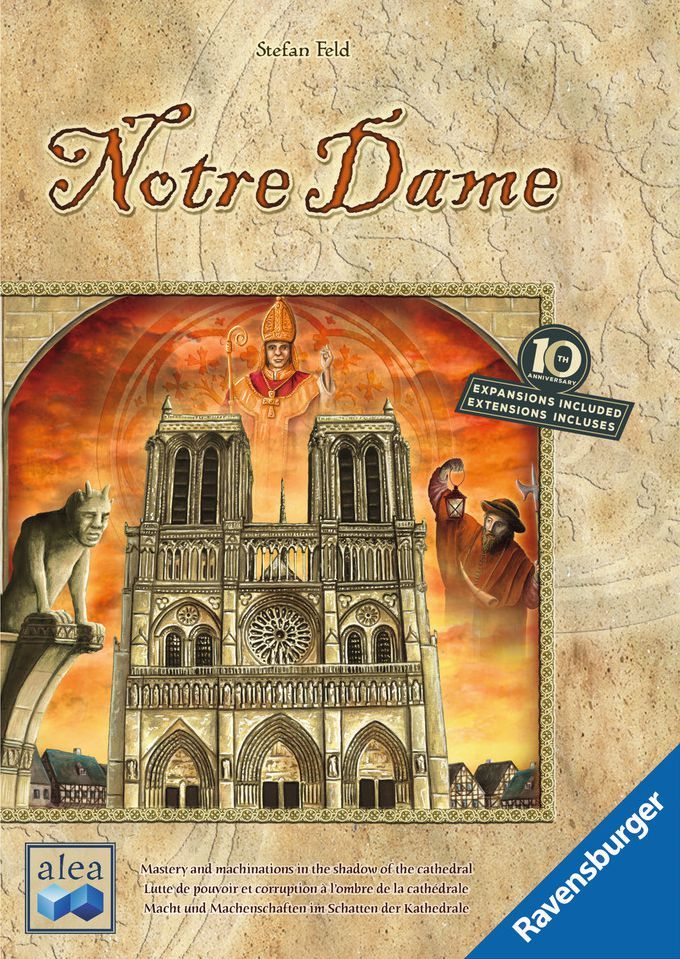
official art · alea
the rules in 60 seconds▶ auto · 1/6
🧩
01
Setup
Players choose a Notre Dame tile based on player count, then receive action cards, influence markers, a carriage, a plague marker, and starting gold. Message tokens are randomly placed face-up on market spaces.
The rules, step by step
Setup
To set up Notre Dame, players first select a Notre Dame tile that corresponds to the number of players (e.g., a specific side for 2 or 4 players, or a unique tile for 3 or 5 players). Each player then chooses a color and receives a set of action cards in that color, nine influence markers, a carriage, and a plague marker. Starting gold is distributed, and message tokens are shuffled and placed face-up on designated market spaces around the board. The plague marker for each player is placed on the '0' space of the plague track.
Objective
The primary objective in Notre Dame is to gather the most prestige points by the conclusion of the game. Players achieve this by strategically managing their resources, influencing various districts of Paris, and mitigating the effects of the plague. Each action taken should ideally contribute to increasing a player's prestige or hindering their opponents' progress.
On your turn
A game of Notre Dame is played over nine rounds, divided into three eras (A, B, C), with three rounds per era. Each round consists of five phases: 1. Drawing and passing character cards: Players draw three character cards, keep one, and pass the remaining two to an adjacent player. This continues until each player has three cards. 2. Playing character cards for actions: Players simultaneously reveal one character card and perform its associated action, such as placing influence markers, moving their carriage, or collecting message tokens. 3. Hiring people: Players can pay gold to hire special characters from a central display, gaining immediate benefits. 4. Determining plague effects: The plague marker advances on the track, potentially causing players to lose prestige or influence. 5. Preparing for the next round: Used cards are discarded, and new character cards are drawn.
Scoring
Prestige points are accumulated throughout the game and at the end. Players gain prestige by placing influence markers on district spaces, collecting sets of message tokens, and utilizing the abilities of hired characters. Some actions may also cause opponents to lose prestige. The player who has the highest total prestige points at the end of the game is declared the winner.
Game end
The game concludes after the third era (Era C), which consists of three rounds. Once all nine rounds are completed, players tally their final prestige points from all sources, including influence markers on the board, collected message tokens, and any bonus points from character abilities. The player with the highest total prestige points wins the game.
Tips
To excel in Notre Dame, focus on efficient resource management and adapting your strategy to the changing board state. Prioritize actions that give you a strong presence in districts, as this can lead to significant prestige gains. Keep an eye on your opponents' progress and the plague track, as mitigating negative effects and disrupting others' plans can be crucial for victory. Don't be afraid to pass on a seemingly good card if a better opportunity arises from the cards passed to you.
🔬 game anatomy
Complexity2.5 / 5
BGG rating7.5 / 10
Vibe
Strategy
Language dependence
No in-game text needed
🌐 plays without English
Play time
45–75 min
Players
2–5
Recommended age
10+ yrs
✨ from Trișache · verified
Frequently asked questions
Q1What is the goal of the game?
The primary objective in Notre Dame is to gather the most prestige points by the conclusion of the game. Players achieve this by strategically managing their resources, influencing various districts of Paris, and mitigating the effects of the plague. Each action taken should ideally contribute to increasing a player's prestige or hindering their opponents' progress.
Q2How do you set up the game?
To set up Notre Dame, players first select a Notre Dame tile that corresponds to the number of players (e.g., a specific side for 2 or 4 players, or a unique tile for 3 or 5 players). Each player then chooses a color and receives a set of action cards in that color, nine influence markers, a carriage, and a plague marker. Starting gold is distributed, and message tokens are shuffled and placed face-up on designated market spaces around the board. The plague marker for each player is placed on the '0' space of the plague track.
Q3How does a turn work?
A game of Notre Dame is played over nine rounds, divided into three eras (A, B, C), with three rounds per era. Each round consists of five phases: 1. Drawing and passing character cards: Players draw three character cards, keep one, and pass the remaining two to an adjacent player. This continues until each player has three cards. 2. Playing character cards for actions: Players simultaneously reveal one character card and perform its associated action, such as placing influence markers, moving their carriage, or collecting message tokens. 3. Hiring people: Players can pay gold to hire special characters from a central display, gaining immediate benefits. 4. Determining plague effects: The plague marker advances on the track, potentially causing players to lose prestige or influence. 5. Preparing for the next round: Used cards are discarded, and new character cards are drawn.
Q4How is scoring calculated?
Prestige points are accumulated throughout the game and at the end. Players gain prestige by placing influence markers on district spaces, collecting sets of message tokens, and utilizing the abilities of hired characters. Some actions may also cause opponents to lose prestige. The player who has the highest total prestige points at the end of the game is declared the winner.
Q5When and how does the game end?
The game concludes after the third era (Era C), which consists of three rounds. Once all nine rounds are completed, players tally their final prestige points from all sources, including influence markers on the board, collected message tokens, and any bonus points from character abilities. The player with the highest total prestige points wins the game.
Q6What tips are there for beginners?
To excel in Notre Dame, focus on efficient resource management and adapting your strategy to the changing board state. Prioritize actions that give you a strong presence in districts, as this can lead to significant prestige gains. Keep an eye on your opponents' progress and the plague track, as mitigating negative effects and disrupting others' plans can be crucial for victory. Don't be afraid to pass on a seemingly good card if a better opportunity arises from the cards passed to you.
Q7How much does Notre Dame: 10th Anniversary cost?
No store is currently tracking Notre Dame: 10th Anniversary. Check the Prices tab — you can set a price alert to be notified when it appears.
Q8Where can I buy Notre Dame: 10th Anniversary cheapest?
Check the Prices tab — howtoplay.ro aggregates offers from 7+ Romanian board-game stores and tracks price history.
Q9How do you play Notre Dame: 10th Anniversary?
Notre Dame: 10th Anniversary is a economic game, for 2–5 players, taking ~45–75 minutes, featuring area majority / influence. Check the Rules tab for setup, gameplay, and scoring, or ask Trișache anything about Notre Dame: 10th Anniversary — our AI assistant built by howtoplay.ro and trained specifically on board game rulebooks.
Q10How many players does Notre Dame: 10th Anniversary support?
Notre Dame: 10th Anniversary is played by 2–5 players.
💰 1 shop
All prices
1 shop · sorted by priceupdated today
Regatul JocurilorAnniversaryeasyboxCultural voucher
%2Fpic3617406.jpg)
%2Fpic3617406.jpg)