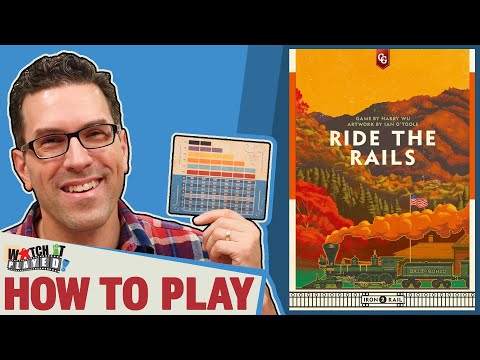
In Ride the Rails, you and the other players will be investing in railways and connecting cities with the goal of moving passengers around the country. Moving passengers will earn money for you and the other players. The player with the most money by the end of the game will win. In case of a tie for the most money, the tied players share the victory.
To find the best price for Ride the Rails, howtoplay.ro compares deals from Romanian shops every day.
FromRON 184
▶ Watch It Played · Ride The Rails - How To Play
Ride The Rails - How To Play
Watch It Played· 16 min· published Jul 2, 2020Community
the rules in 60 seconds▶ auto · 1/6
🧩
01
Setup
Place the game board, passenger tokens on cities, and sorted locomotive pieces beside the board; each player chooses a color, takes a player board and three discs, places two discs on the money track's zero spaces, and randomly places the third disc on the turn order track, then places the round marker on round one.
The rules, step by step
Setup
To set up, place the game board in the center of the playing area. Place one passenger token on each city hex with a city icon. Sort the locomotive pieces by color and place them beside the board. Find the seven colored pieces and place them in their matching spaces in the bottom right corner of the board. Each player chooses a color, taking the matching player board and three player discs. Place two of your discs on the zero spaces of the money track on the left side of the board. Randomly place your remaining disc into the first available space of the turn order track. Finally, place the round marker on the round one space.
Objective
In Ride the Rails, you and the other players will be investing in railways and connecting cities with the goal of moving passengers around the country. Moving passengers will earn money for you and the other players. The player with the most money by the end of the game will win. In case of a tie for the most money, the tied players share the victory.
On your turn
The game is played over a series of rounds, with each round consisting of three phases: Take a Share, Build Track, and Ride the Rails. In the Take a Share phase, players take turns in reverse order of the turn order track, selecting one available locomotive for the current round and placing it on their player map as a share. In the Build Track phase, players take turns in normal turn order, adding a certain number of locomotives (based on player count) to the board from their supply, adhering to placement restrictions for cities and mountains. In the Ride the Rails phase, players again take turns in normal turn order, choosing a passenger to move along a continuous path of locomotives to another city.
Scoring
When a passenger is moved, players earn money based on the number of links (connections between cities) the passenger traveled through for each color of locomotive. Each player with stock in those colors earns $1 per link per stock they own. The player who moved the passenger also earns an additional amount of money equal to the white marker's position on the scoring track. Bonuses can also be earned for placing trains in Chicago ($2), continuing a track into specific cities ($5), or completing a transcontinental line ($8 or $12 depending on the connection type).
Game end
The game concludes after six rounds. After the third phase of the sixth round is completed, the game ends. Players then compare their total money. The player who has accumulated the most money wins the game. If there is a tie for the most money, all tied players share the victory.
Tips
The game offers a France & Germany expansion map that can be purchased separately to introduce new gameplay variations. Players can use the bottom right area of the board to help calculate passenger scoring by moving colored markers to represent links traveled and a white marker for the total, or they can simply count points aloud with other players. When moving passengers, you don't have to travel the full possible distance, which can be a strategic choice to prevent other players from earning more money.
🔬 game anatomy
Complexity2.3 / 5
BGG rating7.1 / 10
Vibe
Strategy
Language dependence
No in-game text needed
🌐 plays without English
Play time
45–60 min
Players
3–5
Recommended age
12+ yrs
BGG rank
#1.900
✨ from Trișache · verified
Frequently asked questions
Q1What is the goal of the game?
In Ride the Rails, you and the other players will be investing in railways and connecting cities with the goal of moving passengers around the country. Moving passengers will earn money for you and the other players. The player with the most money by the end of the game will win. In case of a tie for the most money, the tied players share the victory.
Q2How do you set up the game?
To set up, place the game board in the center of the playing area. Place one passenger token on each city hex with a city icon. Sort the locomotive pieces by color and place them beside the board. Find the seven colored pieces and place them in their matching spaces in the bottom right corner of the board. Each player chooses a color, taking the matching player board and three player discs. Place two of your discs on the zero spaces of the money track on the left side of the board. Randomly place your remaining disc into the first available space of the turn order track. Finally, place the round marker on the round one space.
Q3How does a turn work?
The game is played over a series of rounds, with each round consisting of three phases: Take a Share, Build Track, and Ride the Rails. In the Take a Share phase, players take turns in reverse order of the turn order track, selecting one available locomotive for the current round and placing it on their player map as a share. In the Build Track phase, players take turns in normal turn order, adding a certain number of locomotives (based on player count) to the board from their supply, adhering to placement restrictions for cities and mountains. In the Ride the Rails phase, players again take turns in normal turn order, choosing a passenger to move along a continuous path of locomotives to another city.
Q4How is scoring calculated?
When a passenger is moved, players earn money based on the number of links (connections between cities) the passenger traveled through for each color of locomotive. Each player with stock in those colors earns $1 per link per stock they own. The player who moved the passenger also earns an additional amount of money equal to the white marker's position on the scoring track. Bonuses can also be earned for placing trains in Chicago ($2), continuing a track into specific cities ($5), or completing a transcontinental line ($8 or $12 depending on the connection type).
Q5When and how does the game end?
The game concludes after six rounds. After the third phase of the sixth round is completed, the game ends. Players then compare their total money. The player who has accumulated the most money wins the game. If there is a tie for the most money, all tied players share the victory.
Q6What tips are there for beginners?
The game offers a France & Germany expansion map that can be purchased separately to introduce new gameplay variations. Players can use the bottom right area of the board to help calculate passenger scoring by moving colored markers to represent links traveled and a white marker for the total, or they can simply count points aloud with other players. When moving passengers, you don't have to travel the full possible distance, which can be a strategic choice to prevent other players from earning more money.
Q7How much does Ride the Rails cost?
Ride the Rails costs around 184 RON in Romania.
Q8Where can I buy Ride the Rails cheapest?
The lowest price for Ride the Rails right now is 184 RON at Dragon Games. The Prices tab lists every store currently tracking it.
Q9How do you play Ride the Rails?
Ride the Rails is a economic game, for 3–5 players, taking ~45–60 minutes, featuring hexagon grid. Check the Rules tab for setup, gameplay, and scoring, or ask Trișache anything about Ride the Rails — our AI assistant built by howtoplay.ro and trained specifically on board game rulebooks.
%2Fpic5160528.jpg)