
%2Fpic357763.jpg)
Maailmanympäri peli
0m2–5p1970
%2Fpic209868.jpg)
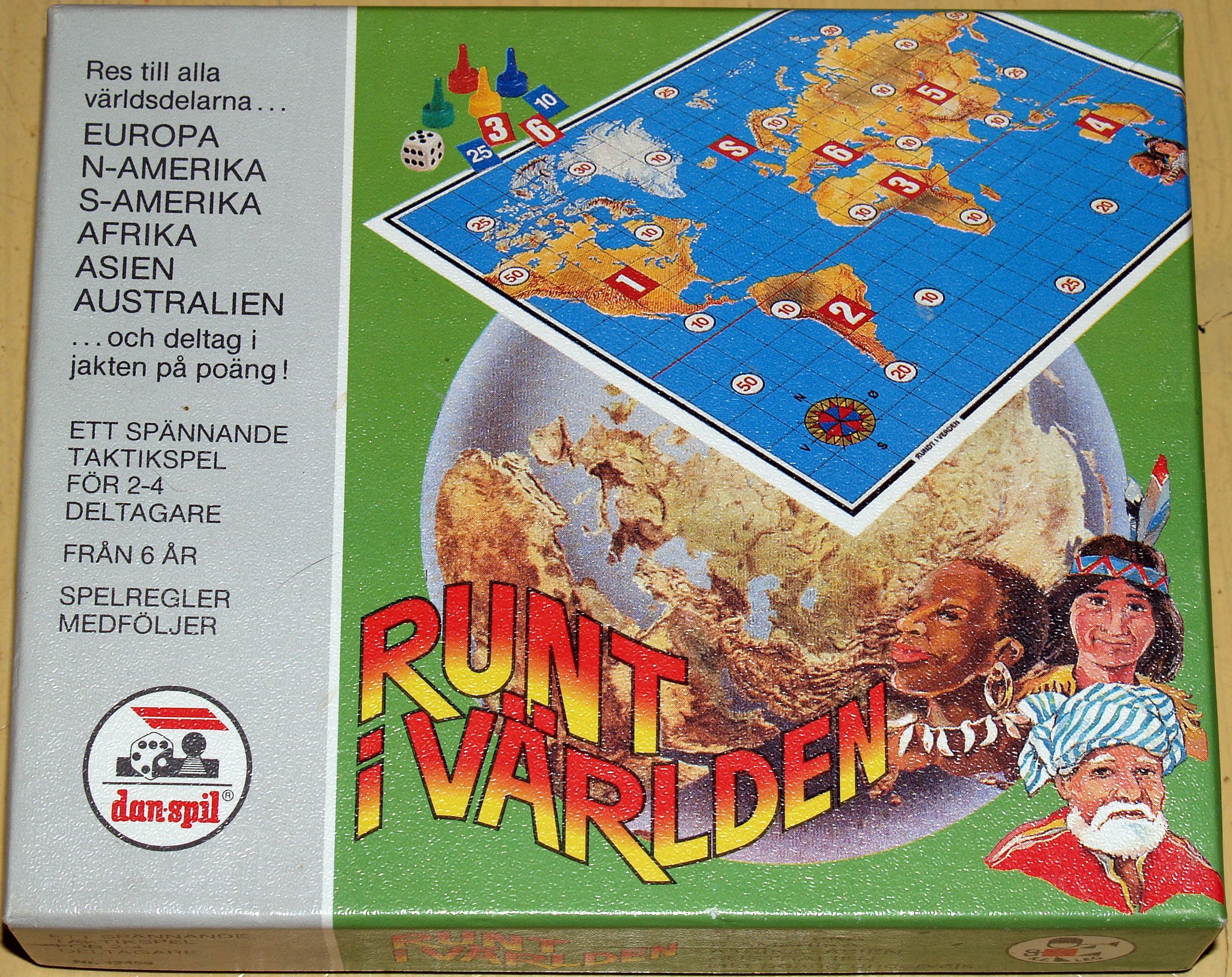
In this game, players are traveling around the world and score points by visiting various places around the world. The goal is to visit at least five different continents and return home, but even though the first player to complete his journey gets a points bonus, other players can still win by visiting more places.
To find the best price for Runt i världen, howtoplay.ro compares deals from Romanian shops every day.
%2Fpic209868.jpg)
In this game, players are traveling around the world and score points by visiting various places around the world. The goal is to visit at least five different continents and return home, but even though the first player to complete his journey gets a points bonus, other players can still win by visiting more places.
Travel to all the continents... Europe, North America, South America, Africa, Asia and Australia to get points along the way
An exciting tactic game for 2-4 players in from 6 and above.
The game board is a map of the world, devided into 286 squares (13x22). One (1) square is red with a big white S, six (6) of the squares are red with a white number - there is one on each continent. The 24 squares have a white circle with a number on (10, 20, 25, 30 or 50).
Before the game all the "white" spaces gets a blue token on, with the consistent number of the field; this will leave 10 tokens of each 10 points in spare, which is put aside together with the red "proof tokens".
All players start on "S" which is located on a field which have Iceland to the west, England to the south and Norway to the east. The players take turns by rollin the die (D6) and move the amount that the die shows. They can move North, South, East or West (not diagonally) and can move in zig-zig (Example on the roll 5: North, West, North, West, South). A player can not move into or pass a square where another player is on. When a player lands on either a point-field (white circle with red numbers) the player takes the point on the board, if it have not been taken before. If a player lands on one of the red fields on each continent, the player can take the matching number from the pool if (s)he do not have this number yet. The red "proof tokens" are put infront of the player, visible for everone. Each time you pass Equator you get 10 points from the pool, as long as there are still points left to take.
When you have at least fice (5) of the six (6) "proof tokens", you can move back to the "S" , and this will give you 100 points. Second one back to base get's 50, third gets 25 and the last don't get any points for returnin. When everyone is back you add the points (Home-coming, red tokens (75 points each) and blue tokens (10-50 points each). The player with the highest score is the winner.
Right now, none of the shops we track sells Runt i världen new.
%2Fpic4307770.jpg)
%2Fpic4159885.jpg)
%2Fpic2099472.png)
%2Fpic9479641.jpg)
%2Fpic61589.jpg)