
%2Fpic2649408.jpg)
Hanafuda
60m2–7p1701
%2Fpic1844152.png)
This is the earliest of a range of Japanese card games based on Portuguese playing cards brought to Japan in the mid 16th century. All these games as well as some unrelated and more recent games are denoted by the word "karuta" from Portuguese "carta".
To find the best price for Tenshō karuta, howtoplay.ro compares deals from Romanian shops every day.
%2Fpic1844152.png)
This is the earliest of a range of Japanese card games based on Portuguese playing cards brought to Japan in the mid 16th century. All these games as well as some unrelated and more recent games are denoted by the word "karuta" from Portuguese "carta". Due to the age of this loanword, it can be written in a bewildering number of ways. About equally frequent are かるた in hiragana as other old loans that have been naturalised and カルタ in katakana, like modern loanwords. Archaic and more rarely seen are "sound-ateji forms" like 歌留多, 加留多 or 嘉留太 using kanji for their sound value without reference to their meanings. The kanji 骨牌 might be read karuta, but primarily represents koppai こっぱい, meaning a particular type of cards, or "bone mahjong tiles" (from Chinese gǔ pái meaning "bone tile", referring to dominoes). Besides this, the term fuda ふだ might be used for at least some forms of playing cards. This may also be written with the kanji 札 with the primary meaning "paper money", and in this sense read satsu さつ.
The term "Tenshō karuta" is a later term later applied to distinguish the oldest form (which in origin actually predates the Tenshō period) from later developments.
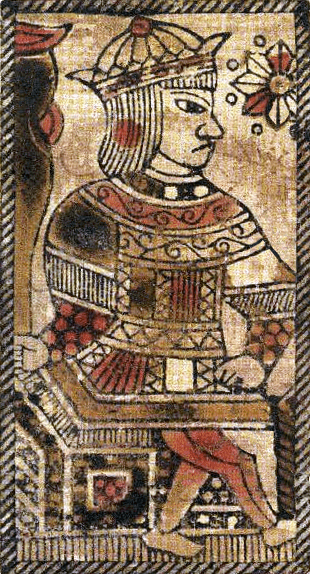
The 48-card deck is divided into the four suits of pau ぱう – from paus "clubs", isu いす – from espadas "swords" (shortened), koppu こっぷ – from copas "cups" and ōru おうる – from ouros "coins" (literally the plural of "gold"). Each suit consists of 12 cards: rei れい – from rei "king", kaba かば – from cavaleiro "knight" or cavalo "horse" (shortened), sōta そうた – from sota "servant" literally "lower [rank]" and number cards from ace to nine. As in the Portuguese precursor, the ace cards depicts a dragon holding the suit symbol. In the "short" suits of cups and coins the number cards rank in reverse from ace (high) to nine (low), while the "long" suits of clubs and swords are ranked normally. This feature is not only shared with older European cards, but at least for coins goes all the way back to the earliest Chinese playing cards.
Later some of the Portuguese-derived names are replaced by indigenous ones. Pau becomes hau はう, "flower", and the clubs are shown sprouting flowers; while kaba becomes uma うま "horse".
Unsun karuta and Sunkun karuta are rooted in Tenshō karuta
Right now, none of the shops we track sells Tenshō karuta new.
%2Fpic7017993.jpg)
%2Fpic1572937.png)
%2Fpic2301893.jpg)
%2Fpic1364729.jpg)