Prices updated today
%2Fpic3388680.jpg)
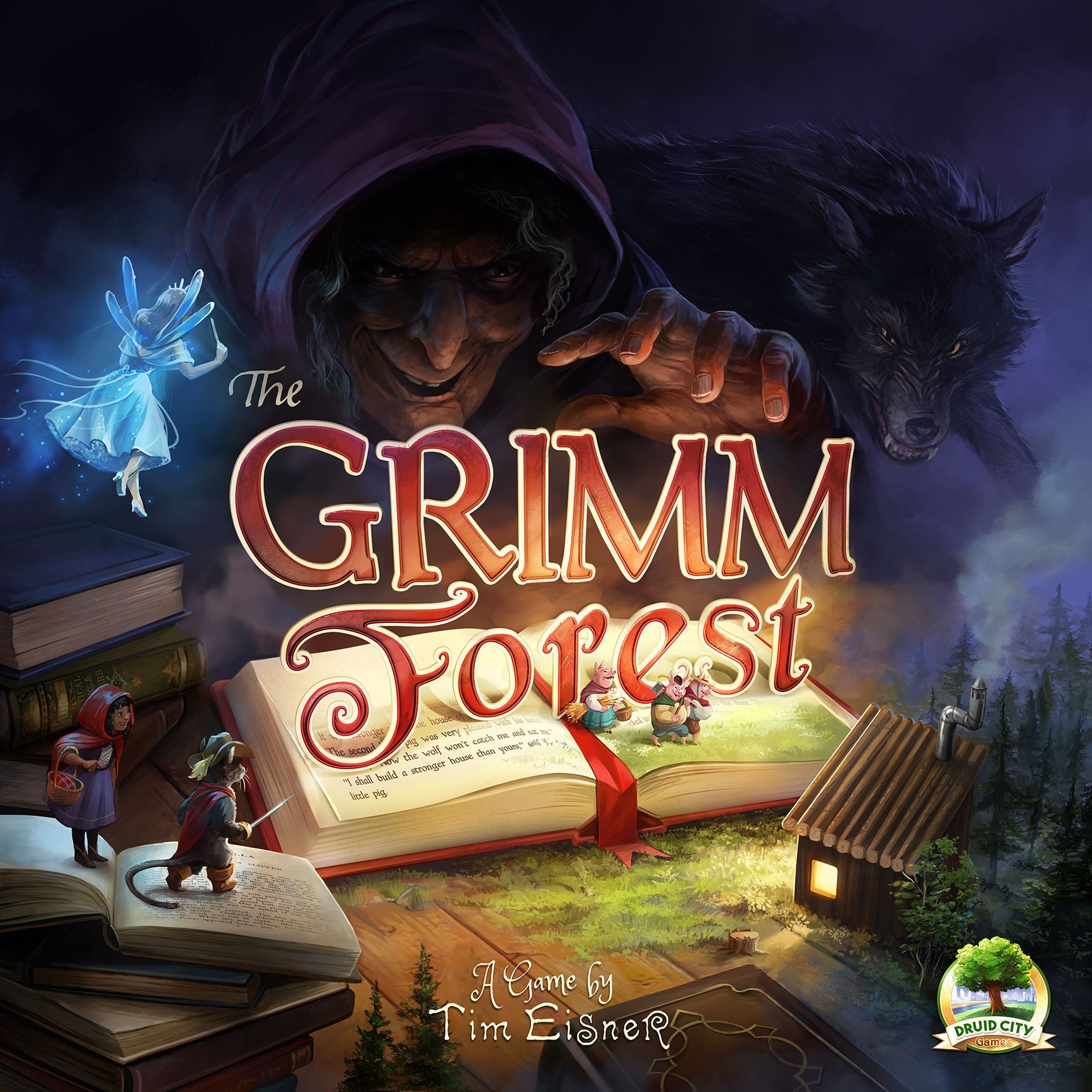
The Grimm Forest
Druid City Games · 2018
2–445–60 min14+ yrs1.9/5 complexity7.1 BGG#1.173 BGG12,4 K
⚡ short answer
How do you play The Grimm Forest?
The primary objective of The Grimm Forest is to be the first player to successfully construct three complete houses of any type (straw, wood, or brick). Players will gather resources, build house components, and strategically use friend and fable cards to achieve this goal while hindering opponents.
To find the best price for The Grimm Forest, howtoplay.ro compares deals from Romanian shops every day.
FromRON 194· 3 shops
Normal price-7% vs 90-day avg
%2Fpic3388680.jpg)
the rules in 60 seconds▶ auto · 1/6
🧩
01
Setup
Place location boards, resource tokens, and friend/fable decks in the center; each player gets a player board, help card, pig figure, and three resource cards, with the last bacon-eater starting.
The rules, step by step
Setup
To begin, place the three location boards (Fields, Forest, Quarry) in the center of the table, with the corresponding 'First Builder' reward tokens beneath them. For a 4-player game, also add the Market board. Next, place all resource tokens (straw, wood, brick) in a general supply next to the boards, and then place one mega-resource token (worth 3-5 units) on each location board. If the Market is in play, place one simple resource token of each type on it. Create separate decks for 'Friend' and 'Fable' cards, placing them face down in the center. Players can decide whether to include advanced cards in these decks. Arrange all roof, wall, and floor pieces, along with monster miniatures, near the decks. Each player receives a player board, a help card, a pig figure, and three resource collection cards matching their player color. In a 4-player game, players also receive the 'Go Shopping' card. The player who most recently ate bacon becomes the first player and receives the 'First Player' token. Once these steps are completed, the game is ready to begin.
Objective
The primary objective of The Grimm Forest is to be the first player to successfully construct three complete houses of any type (straw, wood, or brick). Players will gather resources, build house components, and strategically use friend and fable cards to achieve this goal while hindering opponents.
On your turn
Each round of The Grimm Forest is divided into three distinct phases, which all players complete before moving to the next phase. Phase 1: Collection. Players secretly choose one resource collection card from their hand and place it face down. Optionally, they can play a Fable card face down on top of it. All Fable cards are then revealed, and any 'On Reveal' effects are resolved in turn order. Some Fable cards are monsters, which the player who played them places on a location board, blocking resource collection there. Only one monster can be on a location. After Fable effects, all resource collection cards are revealed. Players place their pig figures on the corresponding location boards. Any 'Before Collecting' Fable effects are resolved. Pigs alone on a location collect all resources; if multiple pigs are on a location, resources are divided equally, rounded down. Any 'After Collecting' Fable effects are resolved. All Fable cards are discarded (unless specified otherwise), and pig figures return to players' hands. Phase 2: Construction. Starting with the first player, each player takes two actions, which can be the same action twice. Actions include: drawing a Fable card (adding it to hand, no hand limit), gaining a resource (taking one from the supply, no resource limit), building a house part (paying resources to build a floor, wall, or roof), or using a special action from a Friend card. To build a floor, pay 2 resources of the house type; for a wall, pay 4 resources and draw a Friend card; for a roof, pay 6 resources. When building a roof, check if you are the 'First Builder' for that house type and claim the corresponding reward token. Houses must be built in order: floor, then walls, then roof. Players can work on different house types simultaneously but cannot start a new house of a type they already have under construction. Each player can have a maximum of five houses under construction. Friend cards offer special abilities; a player can only have one Friend card at a time. If they gain a new one, they must discard their current Friend. Phase 3: Cleanup. The 'First Player' token passes to the next player in clockwise order. All pig figures are returned to their owners. One mega-resource token is placed on each location board. If the Market is in play, one simple resource token of each type is placed on it.
Scoring
Scoring is straightforward: the first player to complete three houses of any type is declared the winner. In the event of a tie (multiple players completing their third house in the same round), the tie-breaking criteria are applied in sequence: first, the player with the most brick houses wins. If still tied, the player with the most wood houses wins. If the tie persists, the player who claimed the 'First Builder' reward token for a brick house wins.
Game end
The game immediately concludes at the end of the Construction Phase if any player has successfully built three complete houses. If only one player has achieved this, they are the winner. If multiple players complete their third house in the same round, the tie-breaking rules determine the victor.
Tips
For a 2-player game, an additional element is introduced: the Prince's Die. In each round, the Prince's Die is rolled, and its outcome dictates which resources the Prince (a neutral third party) collects from the location boards. This adds an element of unpredictability and competition for resources, as players must factor in the Prince's actions when planning their collection strategies. The specific rules for the Prince's Die are detailed in the game manual.
game anatomy
Complexity1.9 / 5
BGG rating7.1 / 10
Language dependence
Moderate text — a crib sheet helps
Play time
45–60 min
Players
2–4
Recommended age
14+ yrs
BGG rank
#1.173
from Trișache · verified
Frequently asked questions
Q1What is the goal of the game?
The primary objective of The Grimm Forest is to be the first player to successfully construct three complete houses of any type (straw, wood, or brick). Players will gather resources, build house components, and strategically use friend and fable cards to achieve this goal while hindering opponents.
Q2How do you set up the game?
To begin, place the three location boards (Fields, Forest, Quarry) in the center of the table, with the corresponding 'First Builder' reward tokens beneath them. For a 4-player game, also add the Market board. Next, place all resource tokens (straw, wood, brick) in a general supply next to the boards, and then place one mega-resource token (worth 3-5 units) on each location board. If the Market is in play, place one simple resource token of each type on it. Create separate decks for 'Friend' and 'Fable' cards, placing them face down in the center. Players can decide whether to include advanced cards in these decks. Arrange all roof, wall, and floor pieces, along with monster miniatures, near the decks. Each player receives a player board, a help card, a pig figure, and three resource collection cards matching their player color. In a 4-player game, players also receive the 'Go Shopping' card. The player who most recently ate bacon becomes the first player and receives the 'First Player' token. Once these steps are completed, the game is ready to begin.
Q3How does a turn work?
Each round of The Grimm Forest is divided into three distinct phases, which all players complete before moving to the next phase. Phase 1: Collection. Players secretly choose one resource collection card from their hand and place it face down. Optionally, they can play a Fable card face down on top of it. All Fable cards are then revealed, and any 'On Reveal' effects are resolved in turn order. Some Fable cards are monsters, which the player who played them places on a location board, blocking resource collection there. Only one monster can be on a location. After Fable effects, all resource collection cards are revealed. Players place their pig figures on the corresponding location boards. Any 'Before Collecting' Fable effects are resolved. Pigs alone on a location collect all resources; if multiple pigs are on a location, resources are divided equally, rounded down. Any 'After Collecting' Fable effects are resolved. All Fable cards are discarded (unless specified otherwise), and pig figures return to players' hands. Phase 2: Construction. Starting with the first player, each player takes two actions, which can be the same action twice. Actions include: drawing a Fable card (adding it to hand, no hand limit), gaining a resource (taking one from the supply, no resource limit), building a house part (paying resources to build a floor, wall, or roof), or using a special action from a Friend card. To build a floor, pay 2 resources of the house type; for a wall, pay 4 resources and draw a Friend card; for a roof, pay 6 resources. When building a roof, check if you are the 'First Builder' for that house type and claim the corresponding reward token. Houses must be built in order: floor, then walls, then roof. Players can work on different house types simultaneously but cannot start a new house of a type they already have under construction. Each player can have a maximum of five houses under construction. Friend cards offer special abilities; a player can only have one Friend card at a time. If they gain a new one, they must discard their current Friend. Phase 3: Cleanup. The 'First Player' token passes to the next player in clockwise order. All pig figures are returned to their owners. One mega-resource token is placed on each location board. If the Market is in play, one simple resource token of each type is placed on it.
Q4How is scoring calculated?
Scoring is straightforward: the first player to complete three houses of any type is declared the winner. In the event of a tie (multiple players completing their third house in the same round), the tie-breaking criteria are applied in sequence: first, the player with the most brick houses wins. If still tied, the player with the most wood houses wins. If the tie persists, the player who claimed the 'First Builder' reward token for a brick house wins.
Q5When and how does the game end?
The game immediately concludes at the end of the Construction Phase if any player has successfully built three complete houses. If only one player has achieved this, they are the winner. If multiple players complete their third house in the same round, the tie-breaking rules determine the victor.
Q6What tips are there for beginners?
For a 2-player game, an additional element is introduced: the Prince's Die. In each round, the Prince's Die is rolled, and its outcome dictates which resources the Prince (a neutral third party) collects from the location boards. This adds an element of unpredictability and competition for resources, as players must factor in the Prince's actions when planning their collection strategies. The specific rules for the Prince's Die are detailed in the game manual.
Q7How much does The Grimm Forest cost?
The Grimm Forest costs between 194 and 259 RON across Romanian stores.
Q8Where can I buy The Grimm Forest cheapest?
The lowest price for The Grimm Forest right now is 194 RON at LexShop. The Prices tab lists every store currently tracking it.
Q9How do you play The Grimm Forest?
The Grimm Forest is a animals game, for 2–4 players, taking ~45–60 minutes, featuring rock-paper-scissors. Check the Rules tab for setup, gameplay, and scoring, or ask Trișache anything about The Grimm Forest — our AI assistant built by howtoplay.ro and trained specifically on board game rulebooks.
Q10How many players does The Grimm Forest support?
The Grimm Forest is played by 2–4 players.
3 shops
All prices
Normal price-7% vs 90-day avgHow we compute this →
3 shops · sorted by priceupdated today
Regatul JocurilorRomanian editioneasyboxCultural voucher
The Grimm Forest (Romanian Edition)
free over RON 149
● in stock
RON 219
affiliate links · prices include VAT · independent platform, no hidden sponsorships
🚚 Free shipping over RON 250
Price history
See price by edition
Price trend over the last 90 days: minimum 90 lei, maximum 259 lei, now 130 lei.
Mechanics & categories