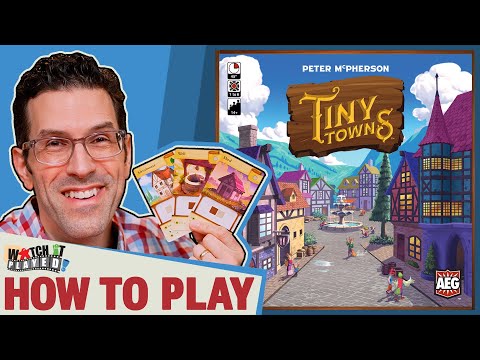
In Tiny Towns, players aim to build the most prosperous town by collecting various resources and strategically placing them on their personal town boards. These resources are arranged in specific patterns to construct different types of buildings, which in turn provide victory points and unique abilities. The challenge lies in managing limited space and carefully planning each construction to maximize points and minimize penalties for empty spaces.
To find the best price for Tiny Towns, howtoplay.ro compares deals from Romanian shops every day.
FromRON 309
▶ Watch It Played · Tiny Towns - How To Play
Tiny Towns - How To Play
Watch It Played· 10 min· published Apr 8, 2019Community
the rules in 60 seconds▶ auto · 1/6
🧩
01
Setup
Sort building cards by their backs, revealing one of each type, and place resource cubes and building pieces in piles; each player gets a town board, a monument piece, and a secret monument card.
To set up, sort the building cards into piles based on their backs, setting purple monument cards aside. Shuffle each non-purple pile individually and flip over one card from each to form a row of available buildings; return remaining cards to the box. Place all resource cubes (wood, wheat, brick, glass, stone) in a general supply. Sort the various building pieces into piles by their corresponding cards, matching shape and color. Deal one monument piece to each player and two monument cards, from which each player secretly selects one to keep, returning the other to the box. Each player receives a town board, and the player who last constructed something in real life (or a randomly chosen player) receives the first player token.
Objective
In Tiny Towns, players aim to build the most prosperous town by collecting various resources and strategically placing them on their personal town boards. These resources are arranged in specific patterns to construct different types of buildings, which in turn provide victory points and unique abilities. The challenge lies in managing limited space and carefully planning each construction to maximize points and minimize penalties for empty spaces.
On your turn
Each round consists of four steps. First, the player with the Master Builder token names any one type of resource (wood, wheat, brick, glass, or stone). Second, all players must take a cube of that named resource and place it into any empty square on their town grid. Once placed, a resource cube cannot be moved. Third, all players may construct any buildings they are eligible to build by matching resource patterns on their board to the patterns shown on the building cards. When constructing, players remove the used resource cubes from their board and place the corresponding building piece onto one of the squares where a resource was removed. Players can build multiple buildings in a single turn, but a single resource cube cannot be used for more than one building. Fourth, the Master Builder token is passed clockwise to the next player, and a new round begins.
Scoring
At the end of the game, players calculate their final scores. Many buildings provide victory points based on specific conditions, such as the number of other buildings of a certain type, adjacency to other buildings, or whether they have been 'fed' by a farm. Each player's secret monument card also provides unique scoring conditions. Points are deducted for any empty spaces remaining on a player's town grid. The player with the highest total score wins. In case of a tie, the tied player who had the fewest turns as the Master Builder wins. If still tied, the player with the fewest empty spaces wins. If there's still a tie, the player with the most cottages wins. If a tie persists, tied players share the victory.
Game end
The game ends immediately when any player's town board is completely filled with resources and buildings, or when a player cannot or chooses not to make any legal moves (i.e., they cannot place a resource or construct a building). Once a player is out of the game, they begin calculating their final score. The remaining players continue playing until only one player is left, or until all players are out of the game. The last remaining player continues to name resources as the sole Master Builder until they also cannot make any legal moves or choose to stop. All players then proceed to final scoring.
Tips
Strategic resource placement is crucial, as cubes cannot be moved once placed, and buildings occupy space permanently, limiting future construction options. Players should consider the long-term implications of each resource placement and building choice, aiming to create efficient patterns that maximize points from various building types. Pay attention to opponents' boards to anticipate their needs and potentially block them by naming resources that would hinder their plans. Utilizing the unique abilities of monuments and other special buildings can provide powerful advantages, so integrate them wisely into your town's development.
🔬 game anatomy
Complexity2.1 / 5
BGG rating7.2 / 10
Vibe
Strategy
Language dependence
Moderate text — a crib sheet helps
Play time
45–60 min
Players
1–6
Recommended age
14+ yrs
BGG rank
#533
✨ from Trișache · verified
Frequently asked questions
Q1What is the goal of the game?
In Tiny Towns, players aim to build the most prosperous town by collecting various resources and strategically placing them on their personal town boards. These resources are arranged in specific patterns to construct different types of buildings, which in turn provide victory points and unique abilities. The challenge lies in managing limited space and carefully planning each construction to maximize points and minimize penalties for empty spaces.
Q2How do you set up the game?
To set up, sort the building cards into piles based on their backs, setting purple monument cards aside. Shuffle each non-purple pile individually and flip over one card from each to form a row of available buildings; return remaining cards to the box. Place all resource cubes (wood, wheat, brick, glass, stone) in a general supply. Sort the various building pieces into piles by their corresponding cards, matching shape and color. Deal one monument piece to each player and two monument cards, from which each player secretly selects one to keep, returning the other to the box. Each player receives a town board, and the player who last constructed something in real life (or a randomly chosen player) receives the first player token.
Q3How does a turn work?
Each round consists of four steps. First, the player with the Master Builder token names any one type of resource (wood, wheat, brick, glass, or stone). Second, all players must take a cube of that named resource and place it into any empty square on their town grid. Once placed, a resource cube cannot be moved. Third, all players may construct any buildings they are eligible to build by matching resource patterns on their board to the patterns shown on the building cards. When constructing, players remove the used resource cubes from their board and place the corresponding building piece onto one of the squares where a resource was removed. Players can build multiple buildings in a single turn, but a single resource cube cannot be used for more than one building. Fourth, the Master Builder token is passed clockwise to the next player, and a new round begins.
Q4How is scoring calculated?
At the end of the game, players calculate their final scores. Many buildings provide victory points based on specific conditions, such as the number of other buildings of a certain type, adjacency to other buildings, or whether they have been 'fed' by a farm. Each player's secret monument card also provides unique scoring conditions. Points are deducted for any empty spaces remaining on a player's town grid. The player with the highest total score wins. In case of a tie, the tied player who had the fewest turns as the Master Builder wins. If still tied, the player with the fewest empty spaces wins. If there's still a tie, the player with the most cottages wins. If a tie persists, tied players share the victory.
Q5When and how does the game end?
The game ends immediately when any player's town board is completely filled with resources and buildings, or when a player cannot or chooses not to make any legal moves (i.e., they cannot place a resource or construct a building). Once a player is out of the game, they begin calculating their final score. The remaining players continue playing until only one player is left, or until all players are out of the game. The last remaining player continues to name resources as the sole Master Builder until they also cannot make any legal moves or choose to stop. All players then proceed to final scoring.
Q6What tips are there for beginners?
Strategic resource placement is crucial, as cubes cannot be moved once placed, and buildings occupy space permanently, limiting future construction options. Players should consider the long-term implications of each resource placement and building choice, aiming to create efficient patterns that maximize points from various building types. Pay attention to opponents' boards to anticipate their needs and potentially block them by naming resources that would hinder their plans. Utilizing the unique abilities of monuments and other special buildings can provide powerful advantages, so integrate them wisely into your town's development.
Q7How much does Tiny Towns cost?
Tiny Towns costs around 309 RON in Romania.
Q8Where can I buy Tiny Towns cheapest?
The lowest price for Tiny Towns right now is 309 RON at Red Goblin. The Prices tab lists every store currently tracking it.
Q9How do you play Tiny Towns?
Tiny Towns is a abstract strategy game, for 1–6 players, taking ~45–60 minutes, featuring end game bonuses. Check the Rules tab for setup, gameplay, and scoring, or ask Trișache anything about Tiny Towns — our AI assistant built by howtoplay.ro and trained specifically on board game rulebooks.

%2Fpic4460401.jpg)